


5 Minutes of Lowering Beats 45 Minutes of Lifting: ECU's 2026 Eccentric Protocol for Desk Workers, Busy Parents, and Anyone Over 40 Without Gym Time
Edith Cowan University's 2026 trial in the Journal of Sport and Health Science found four bodyweight eccentric exercises performed for five minutes a day produced measurable gains in strength, flexibility, strength-endurance, and mental health in sedentary adults. No gym, no equipment, no soreness. Here is the protocol, the mechanism, and how AI coaching wires it into a real week.
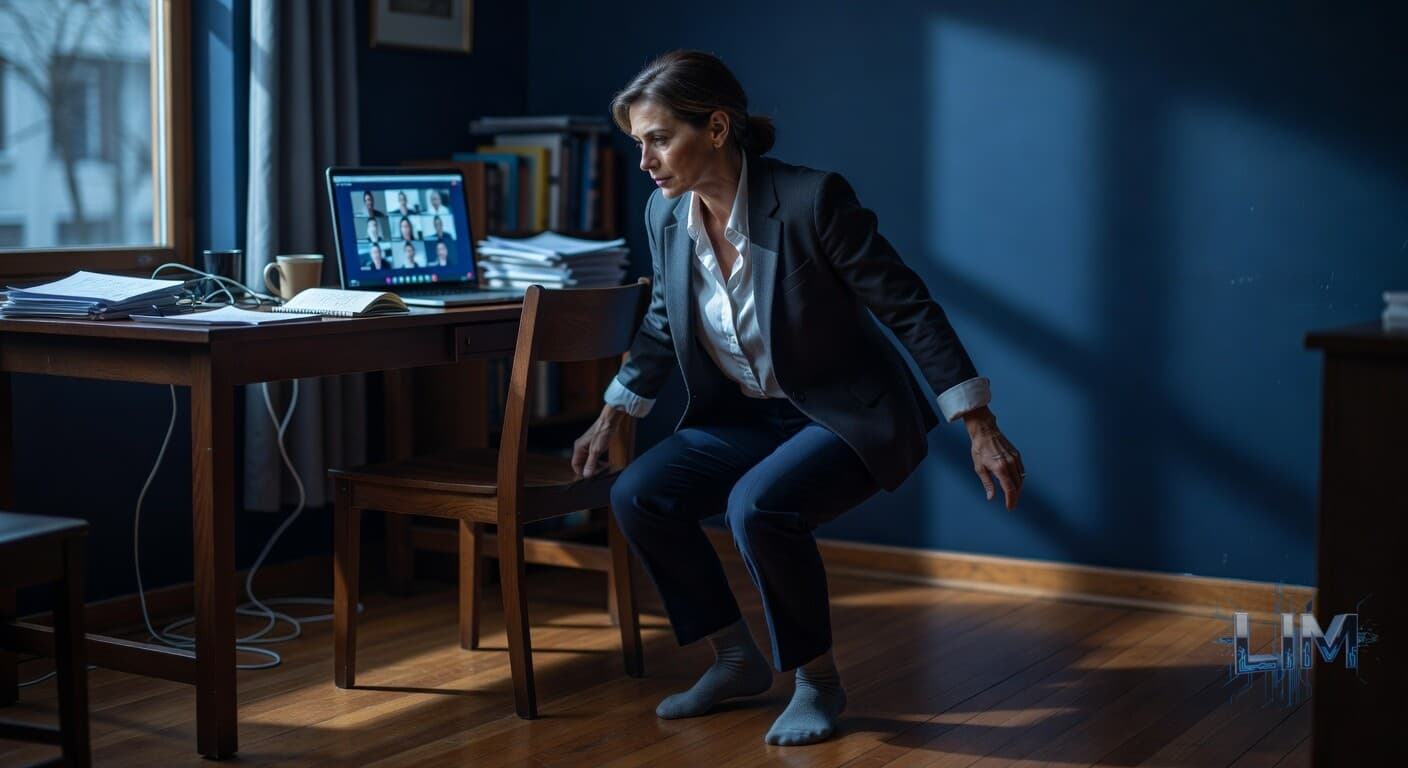
Mark is 54. CIDP, bilateral knee replacements long since healed, a torn rotator cuff he is working around. He trains twice a week with a coach he has had for nine years. The other five days are supposed to be "active recovery," which Mark and the coach both know means whatever Mark can actually do that day.
It is Monday, 11:47 a.m. Mark is between a quote review and a vendor call. He has not lifted since Saturday. The shoulder is chirping. The knees are fine but tired. The shift the coach already approved is the floor day — five days a week, the smallest thing that still counts as work.
The thing standing between Mark and the floor day is not motivation. It is the assumption — sold to him for thirty years — that a workout has to take forty-five minutes, gym clothes, and a shower. By that standard, Monday at 11:47 is not a workout opportunity. By that standard, Monday is a skip.
By 11:51, HERMES — our research bot — had surfaced a paper that retires that standard. Four bodyweight exercises, performed eccentrically, five minutes a day, four weeks, sedentary adults. Measurable gains in muscle strength, flexibility, strength-endurance, and mental health. No gym. No equipment. No soreness penalty.
Related Read
Supersets Cut Session Time 36% With Similar MuscleBurke 2026 found supersets cut session time 36% with similar muscle changes. The clock moved. The trophy did not.
That is the wedge for the over-40 restart, the desk-bound adult, the one-shoulder-out lifter who is trying to keep showing up. Five minutes that lives in the gap between the 12:30 and the 14:00 — and an AI coach who knows the paper, knows the calendar, and texts the cue at 11:55 instead of asking "did you have time today?"
What "Eccentric" Actually Means, And Why It Matters More At 54
Every muscle action has two phases. The concentric phase is when the muscle shortens under load — pushing up out of a squat, pressing the dumbbell off the chest. The eccentric phase is when the muscle lengthens under load — lowering into the squat, lowering the dumbbell back to the chest.
For forty years of strength-training culture, eccentric was the part you rushed through to get back to the next rep. That was always backwards. The muscle-biology literature is consistent on three points.
Eccentric contractions produce more force per motor unit. A muscle lengthening under load can generate roughly 1.3 to 1.8× the force of the same muscle shortening. That is why you can lower a dumbbell heavier than you can lift it.
Eccentric contractions cost less ATP per unit of force. The metabolic cost of eccentric work is a fraction of concentric work at equivalent force. That is why a five-minute eccentric session does not leave you needing a shower.
Eccentric loading is what builds tendon resilience. Type I collagen turnover and tendon stiffness adaptations are driven primarily by the lengthening phase. Over 40 — and especially with a healed surgical history or an active soft-tissue issue — tendon compliance is the limiting factor on most musculoskeletal flare-ups. That is the variable that matters most.
Put those three together and you have the answer to the question every working adult with a body that has been around the block has been asking and not getting answered. How do I get stronger without burning an hour I do not have, generating soreness I cannot afford, and risking the shoulder I am already working around?
Shorten the session. Emphasize the eccentric. Repeat it daily. The ECU paper is the cleanest demonstration we have that this works in the exact population we are trying to reach.
The Four-Move Protocol, Exactly As The Paper Ran It
Four bodyweight exercises, ten repetitions each, eccentric phase emphasized. The cue on every single rep is the same: the lowering phase takes about three seconds. The "return to start" phase is unloaded or assisted — it does not count as the work.
1. Chair squat (eccentric). Stand in front of a sturdy chair, feet hip-width. Lower toward the seat for a three-count, controlled the entire way, sitting just barely on the front edge. Stand back up however is easy — hands on thighs if needed. The work is the lowering. Ten reps.
2. Chair recline (eccentric sit-up). Sit on the front edge of the chair, arms crossed over the chest. Slowly recline backwards for a three-count — spine leaves the chair-back inch by inch, abdominals resisting the entire way. When the position no longer holds, rest against the back. Hands on chair arms to return to upright. Ten reps.
3. Wall push-up (eccentric). Arm's-length from a wall, hands at chest height shoulder-width apart. Lower chest toward the wall over a three-count, elbows tracking back and out. Push back to start however is easy — hop off the wall slightly with the hips if needed. Ten reps.
4. Heel drop (eccentric calf raise). Stand on the edge of a step with heels hanging off. Rise onto both toes. Lower one heel below the step level over a three-count, while the other foot stays up. Step back up and repeat with the other side. Ten reps per leg.
Total time, including a moment between moves: about five minutes. No warm-up required. No cooldown required. No shower required. The four movements cover the four largest muscle groups (quads, abdominals, chest/triceps/anterior delts, calves) and the kinetic patterns desk-bound adults lose first.
Why This Fits Four Different Bodies, One Protocol
The desk worker. The chair squat and chair recline literally use the chair that has been a six-hour load-bearing surface. The wall push-up uses the wall behind the monitor. The heel drop uses the bottom step of any stairwell. Five minutes between meetings, in office clothes, no sweat. The mental-health gain the ECU paper measured — and this is real, not motivational filler — likely owes more to the interrupt the seven-hour sit mechanism than to any aerobic effect. Movement variability is the variable.
The busy parent. Five minutes is the entire pitch. The protocol runs in the kitchen while the toddler eats Cheerios. It runs in the laundry room while the dryer cycles. It runs at 5:45 a.m. before anyone is awake or at 9:15 p.m. after everyone is down. Skipping it means skipping five minutes, which is a much smaller story to tell yourself than "I skipped my workout."
The frequent traveler. No equipment. Works in a hotel room. Works on the floor of an airport family-restroom if it comes to that. The chair recline works against the headboard of a hotel bed. Jet-lagged muscle on day two of a trip — when cortisol is still resetting and sleep architecture is wrong — handles eccentric load better than concentric load. Metabolic cost lower, cardiovascular demand lower, perceived exertion far below a hotel-gym session.
The over-40 restart. This is the population where the protocol is most useful and most under-prescribed. The adult who has not trained in a year, who has been told to "just start walking," who has dipped into Peloton and out, and who would actually benefit most from progressive overload — but cannot get to the gym for the reasons we know. The eccentric protocol is the on-ramp. Four weeks of this builds enough baseline strength, tendon resilience, and self-trust that the conversation about a real lifting program becomes possible. Without the on-ramp, the lifting conversation usually ends in three weeks of guilt and a canceled membership.
What This Protocol Does Not Do (The Honest Part)
This is the floor. It is not the ceiling.
Five minutes of bodyweight eccentric work, four weeks, will not turn a sedentary 54-year-old into a recreational athlete. The ECU paper measured gains, not reinvention. The gains it measured are real and reproducible — in people who started from sedentary.
The protocol does not directly address the over-40 leucine-floor we covered in the protein-per-meal piece — and protein nutrition is the limiting factor on any strength adaptation in adults over 40 regardless of the training stimulus. Eccentric loading without adequate protein is throwing seed on concrete.
The protocol also does not replace the resistance-training recommendation — two sessions per week, all major muscle groups, progressive load. The ECU protocol is what you do on the five days that are not those two sessions. Or what you do for the four weeks before you start those two sessions.
What it does, what no other protocol in the literature does as cleanly: it makes the gap between "I am sedentary" and "I am training" five minutes wide. The gap used to be 45 minutes wide. Five minutes is a gap any working adult — including Mark, between two calls, with a shoulder that is chirping — can step across.
How The AI Coach Uses This
Mark's protocol does not live in a PDF he has to remember to open. It lives in his phone, scheduled by an AI that knows his calendar and his shoulder.
At 11:55 daily, before his standing 12:30 call, a notification with the four exercises and a 30-second video for each. He runs the protocol at his desk in office clothes. Total elapsed: five minutes. Heart rate barely rises.
Friday afternoon, the coach checks in. Did he hit four out of five days? Five out of five? Two? The answer determines whether week two nudges harder or softer. The adherence data is more useful than the strength data — consistency at week four is what predicts whether his coach can approve a Saturday lifting expansion in week five.
Week five trigger: if adherence holds, the coach proposes a tweak to one of the existing twice-weekly sessions to add a single-leg eccentric. If adherence wobbles, the coach proposes a different time slot for the five-minute protocol rather than escalating the volume. The cardinal rule is do not break the habit you just built.
That is the part that does not exist anywhere else. Any influencer can name an eccentric protocol. Any free-exercise app can show the four moves. The thing nobody else can do is read the calendar, read the adherence data, read what is chirping this week, and decide whether to escalate or hold — for this person, this week, given how the last 14 days actually went. That is what an AI coach is for.
---
The data behind this
- Kirk, B. and Nosaka, K., et al. Eccentric Exercise: Muscle damage to the new normal. Journal of Sport and Health Science, 2026, Vol. 15, Article 101126.
- Edith Cowan University, School of Medical and Health Sciences. "Five Minutes a Day Eccentric Exercise Can Improve Your Life." ECU Newsroom, 2026.
- American College of Sports Medicine. 2026 Resistance Training Position Stand. Medicine & Science in Sports & Exercise, 2026.
---
Try the 7-Day Free Trial
If the five-minute protocol is the floor, the trial is the doorway. Thirty days, no charge, AI coaching that reads the calendar and the adherence data — and a program that scales the day Mark wants to add a third session, not the day he wants to quit.
---
Coaching that works the same shifts you do
Start logging and Chiron, our AI head coach, starts adjusting: protein targets per meal, training volume after short sleep, a deload when your numbers call for it instead of when the calendar does. HERMES, our research engine, feeds new research into your coaching the morning it publishes.
$29.99/month · $249.99/year · 7-day free trial · cancel anytime · no enrollment fee · no contract
Start coaching → · See the full app →
Jake Long built it after losing 112 lbs working hospital night shifts — when no human coach could keep up with his schedule. He wanted the system he wished he'd had at 308. Now you can use it too.
Comments (0)
Comments are reserved for Legacy In Motion members.
$29.99/month. No contracts. Cancel anytime.
Get StartedAlready a member? Sign in
You read this far. Now do this.
You've read the theory.
Now put it to work in your real week.
I went from 308 to 196 lbs working 12-hour overnight shifts with two kids and zero personal trainer. The system I used is now an app that plans your training and meals around YOUR schedule — overnight, day shift, all of it.
Cancel anytime · No setup fee · No long contract
Free Assessment
What's Holding Your Fitness Back?
Take our 60-second quiz and get a personalized breakdown of what's stopping your progress — plus how AI coaching solves it.
Take the QuizFree PDF · No Credit Card
Your free Shift Worker AI Fitness Blueprint
A 4-week plan that respects what shift work does to sleep: when to go down after a night, the four-minute REHIT window, post-shift macros, and when to back off. In your inbox in 30 seconds.
Built by someone who actually worked them. No fluff. Unsubscribe any time.
Keep Reading
2026-09-30
Supersets Cut Session Time 36% With Similar Muscle
Burke 2026 found supersets cut session time 36% with similar muscle changes. The clock moved. The trophy did not.
2026-09-25
Doubling Weekly Sets Did Not Grow More Muscle
Camargo 2026 found no extra quad growth from a 120 percent volume jump versus 20 percent. The protocol main effect is not a bigger change.
2026-07-26
Nordic Hamstring Curl Over 40: The Eccentric Brake Desk Workers Skip
Nordic hamstring curls cut injury rates roughly in half in the big BJSM meta-analysis — and they train the deceleration pattern busy parents and desk workers actually need. Progressions, a 15-minute protocol, and how Chiron inserts them when sprints keep failing.
Join our free fitness community — get coaching tips, share wins, and stay accountable.
JOIN THE DISCORD →