


The Rotator Cuff Is The Tissue At Risk — Not The Knee. The JOSPT Paper Mark Should Have Seen Last Tuesday.
The pickleball injury narrative is upside-down for the over-40 player. Shoulder and lateral elbow are the load-bearing tissues. The fix is three lifts a week, a seven-minute warm-up, and not jumping from two hours of play to six in three weeks.
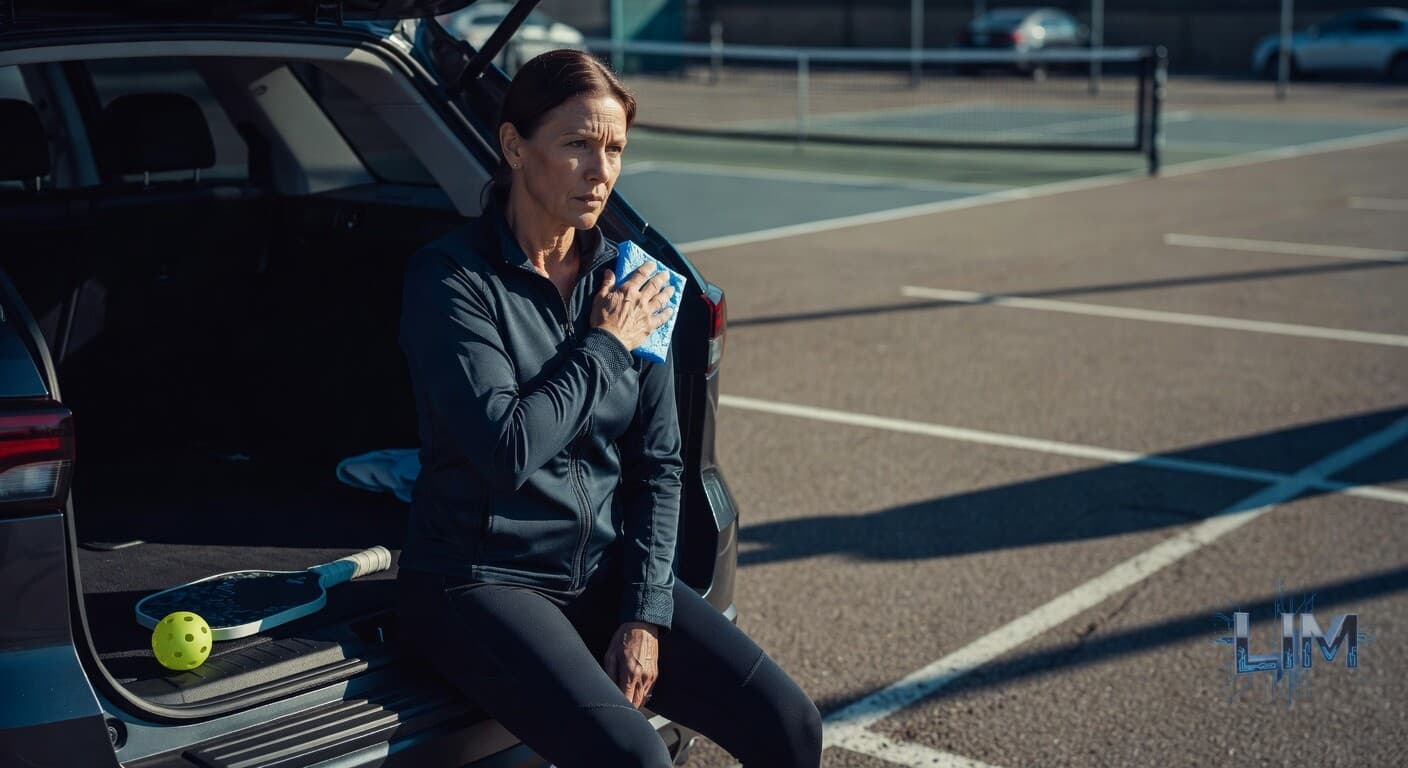
Mark is 56, retired logistics manager, two grown kids, drives himself to the courts at 08:00 every Sunday for the league round-robin he started last October. Right rotator cuff was repaired clean in 2019 and has been quiet ever since. Bilateral knee replacements in 2021 healed well — better, he says, than the original equipment ever was.
He works with the same coach he has worked with for nine years, twice a week, mostly lower-body and core, by design. The coach knows about the cuff. The coach has never seen a paddle in Mark's hand.
By 09:40 last Sunday, Mark was icing the right shoulder in the parking lot. By 10:15 he was at the cafe with his daughter telling her the morning was fine.
He has logged the injury in his head as I overdid it. The paper that landed on the JOSPT preprint server says he didn't overdo it. He underprepared the tissue that was absolutely going to take the load.
Related Read
Supersets Cut Session Time 36% With Similar MuscleBurke 2026 found supersets cut session time 36% with similar muscle changes. The clock moved. The trophy did not.
What the cohort actually measured
The Surveillance in Pickleball Players to Reduce Injury Burden Project — SPRINT-Pickleball — is the first prospective surveillance design built specifically for this sport. The 2026 JOSPT Open paper out of that project surveyed 2,055 consenting recreational players across the United States and pulled out the risk-factor model that nobody on Mark's court has read.
The injury narrative pickleball was telling itself — twisted ankles, fractured metatarsals, the occasional Achilles — is the emergency-department narrative. It is not the prevalence narrative for the recreational over-40 player.
The prevalence story is in the upper extremity. Rotator cuff. Posterior shoulder. Lateral epicondyle — the tennis elbow nobody on the court is calling tennis elbow because they are playing pickleball.
The over-40 player is being injured by the cumulative load — thousands of paddle accelerations, thousands of overhead reaches, thousands of low-volley extensions — not by the dramatic dive. And cumulative load is precisely what strength training prepares tissue to absorb.
The risk factors the model flagged were modifiable. Prior injury-prevention knowledge. Weekly play volume. Warm-up behavior. Strength-training participation.
Every one is a coaching variable, not a genetic one.
Why the shoulder and elbow are the load-bearing tissues at 56
There is a physiological reason this paper landed on upper extremity rather than lower. Three of them, actually.
Tendon ages differently than muscle. Type-I collagen turnover slows starting around age 35. By 50, the lateral elbow extensor tendon is significantly less compliant than it was at 30 — while the loads it experiences in a Sunday round-robin are unchanged. The mismatch is the entire mechanism of lateral epicondylopathy.
Rotator cuff fatty infiltration is silent. Imaging cohorts in adults over 50 show measurable fatty infiltration of the supraspinatus and infraspinatus in a meaningful percentage of asymptomatic shoulders. The cuff is not as healthy as the shoulder feels. A two-hour league session with six hundred paddle accelerations is the stress test that surfaces the deficit. Mark's right cuff was repaired clean six years ago. Repaired tissue is restored tissue — it is not original tissue.
The kinetic chain leaks at the trunk. When the over-50 player loses hip extension and thoracic rotation — the two mobility patterns that decline fastest in desk-bound adults and post-knee-replacement bodies — the shoulder is forced to generate power the legs and trunk should have produced. The shoulder is built to be the antenna. It is not built to be the engine.
That is why the JOSPT paper's emphasis on predictors matters more than the prevalence number itself.
The three-lift, two-day weekly minimum
Mark already lifts twice a week with his coach. That's the asset. The asset has not been talking to the paddle, and the paddle has not been talking to the asset.
The three patterns that change the math, integrated into the existing twice-weekly sessions.
Horizontal pull for the shoulder posterior chain. Cable row, dumbbell row, or band row. Three sets of eight to twelve. The posterior cuff and the rhomboids are the antagonists to every overhead and forehand motion in the sport. They are also the muscles desk workers under-train by a factor of ten relative to chest and front delt.
Single-leg hip pattern for the kinetic chain anchor. Rear-foot-elevated split squat, step-up, or reverse lunge. Three sets of six to ten per side. This is what restores hip extension and re-trains the leg drive the shoulder has been compensating for. Almost every over-40 court injury has a hip-extension deficit upstream of it — and post-knee-replacement bodies are particularly vulnerable to losing hip drive if the program doesn't deliberately train it.
Rotational and anti-rotation core. Cable Pallof press for anti-rotation, plus a half-kneeling cable rotation for rotation. Three sets of eight to ten. The trunk has to transmit power from leg to paddle, and it has to resist power leaking through the lumbar spine. Both jobs are trainable in the same five minutes a week.
Two sessions a week. Forty-five minutes apiece. That is the entire prescription Mark's coach needs to know about. Add a heavy carry — farmer walk for 30 to 60 seconds — and you have covered grip endurance, the variable that protects the lateral elbow more than any forearm-stretch routine.
The seven-minute warm-up the parking lot pre-game does not replace
The paddle club's warm-up is two practice serves and a slow dink rally. That is a loosener, not a warm-up. A real warm-up before a 90-minute league session is seven minutes of deliberate tissue prep.
Ninety seconds of band pull-aparts and band external rotations to wake the posterior cuff. Ninety seconds of world's-greatest stretch on alternating sides for hip mobility and thoracic rotation. Sixty seconds of wrist circles plus light forearm pronation-supination to load the lateral elbow extensor at zero intensity. Sixty seconds of bodyweight squats and reverse lunges to elevate core temperature. Two minutes of paddle shadow swings with controlled tempo, progressing from half-speed to game speed.
That is six and a half minutes. The over-40 player who skips it is the over-40 player in the parking lot at 09:40.
The load-management number nobody on the court is tracking
The risk model flagged rapid increases in weekly play volume as a meaningful injury predictor. This is the same principle that has restructured every professional racquet sport.
The simple version for the recreational player — do not increase weekly play hours by more than ten to fifteen percent week over week. If you played four hours last week, do not jump to seven. If you played six hours last week, seven is fine. The over-40 player who joins a new league and goes from two hours a week to eight in three weeks is the player whose lateral elbow flares in week four.
It does not feel like an injury risk. It feels like enthusiasm. Enthusiasm is what the published data flags as the proximal cause of an emergency-room visit at 50.
Recovery is not a luxury after 40
Sleep is the recovery variable that subsumes the others. Seven to nine hours, prioritized over the 06:00 league slot. The over-40 player who sleeps six and plays Sunday is the over-40 player whose cuff flares Monday.
A few specific levers worth knowing.
Creatine at 3 to 5 grams a day. Two decades of safety data. For the over-50 pickleball player it is a strength-and-cognition multiplier with one of the cleanest evidence bases in the supplement world. Not optional after 50.
Protein at 1.6 grams per kilogram of body weight, distributed across three to four feedings. Tissue repair is not a vitamin. It is amino acids landing in the bloodstream when you need them.
Soft-tissue work after play, not before. Foam rolling and self-myofascial release have small but meaningful effects on flexibility and post-play soreness. They are recovery tools, not warm-up tools.
Compression sleeves and recovery boots are nice. They are not the lift.
Why this is the AI-coaching wedge
Mark's coach is an asset. The coach is in the room twice a week, watching form, calling load. What the coach cannot do is run the math on the weekly play volume, the last shoulder twinge, the strength-session adherence, the JOSPT preprint that landed last Tuesday, and the warm-up sequence calibrated to a 56-year-old post-cuff-repair shoulder. A static program PDF cannot, either.
LIM is the system that does. The same research engine that pulled the JOSPT paper is indexing the next one, and the next, and feeding Chiron — the AI head coach — the load-management protocol that adjusts when Mark's Sunday play creeps from two hours to four. The lift program adapts. The warm-up adapts. The recovery prompts adapt. The output lands in the format Mark's coach can use.
This is not a replacement for the coach Mark has worked with for nine years. It is the layer underneath that coach. The paper, the protocol, the rolling fourteen-day adherence window — all visible, all updating, all ready before next Sunday's round-robin.
The conversation Mark wishes he had heard from someone before last Sunday — you do not need to play less. You need to lift twice a week with intent toward the paddle, warm up for seven minutes, and not jump from two hours of play to six in three weeks. The paper landed Tuesday. The program already adjusted.
Bottom line
The pickleball-injury narrative is mid-pivot. The cohort data is converging. The over-40 player's risk is upper extremity. The mechanism is cumulative load on under-prepared tissue. The solution is a strength-and-warm-up protocol that is shockingly cheap to run.
Two lifts a week with intent. Seven-minute warm-up. Weekly volume jumps capped at fifteen percent. Three to five grams of creatine. Sleep.
That is the entire prevention plan. It is what your 30-year-old self would have ignored. It is what your 70-year-old self will thank you for.
The paddle is not the problem. The preparation around the paddle is.
The 7-day free trial is at legacyinmotion.fit. The shoulder you are protecting is the one that lifts your grandkid in 2031.
---
The data behind this
- JOSPT Open 2026, manuscript 0171 — Understanding Upper Extremity Injury Prevalence and Risk Factors in Recreational Pickleball Players. SPRINT-Pickleball Project, n=2,055 consenting recreational players. jospt.org/doi/pdf/10.2519/josptopen.2026.0171
- PMC PMC12259589 — The Epidemiology of Pickleball Injuries Presenting to US Emergency Departments. ~19,000 ED visits/year, roughly 90% in players 50 and older.
- MDPI 10.3390/jfmk10030247 — Risk of Upper Extremity Injury in Recreational Pickleball Players.
- Chilibeck PD et al. 2023 (Med Sci Sports Exerc, PMC10487398) — two-year RCT on creatine supplementation during exercise for postmenopausal bone health; creatine preserved bone bending strength and improved walking speed when paired with resistance training.
- Type-I collagen turnover decline after age 35 — composite from the connective-tissue aging literature; tendon compliance reduction tracks with age and predicts lateral epicondylopathy risk.
- Asymptomatic rotator-cuff fatty infiltration in adults over 50 — imaging-cohort literature; measurable fatty infiltration of supraspinatus and infraspinatus in a meaningful percentage of pain-free shoulders.
- Acute-to-chronic workload ratio framework — adapted from the professional racquet-sport injury-prevention literature; recreational over-40 application capped at 10–15% weekly volume increase.
- Jake's own numbers: 308 → 196 in 9.5 months on 12-hour overnight hospital security shifts (started May 2025). Sample of one — informed perspective, not population data, and not the cohort this protocol was built for first.
---
Coaching that works the same shifts you do
Start logging and Chiron, our AI head coach, starts adjusting: protein targets per meal, training volume after short sleep, a deload when your numbers call for it instead of when the calendar does. HERMES, our research engine, feeds new research into your coaching the morning it publishes.
$29.99/month · $249.99/year · 7-day free trial · cancel anytime · no enrollment fee · no contract
Start coaching → · See the full app →
Jake Long built it after losing 112 lbs working hospital night shifts — when no human coach could keep up with his schedule. He wanted the system he wished he'd had at 308. Now you can use it too.
Comments (0)
Comments are reserved for Legacy In Motion members.
$29.99/month. No contracts. Cancel anytime.
Get StartedAlready a member? Sign in
You read this far. Now do this.
Close the tab.
Go train the plan that fits your life.
I went from 308 to 196 lbs working 12-hour overnight shifts with two kids and zero personal trainer. The system I used is now an app that plans your training and meals around YOUR schedule — overnight, day shift, all of it.
Cancel anytime · No setup fee · No long contract
Free Assessment
Where's Your Training Stuck?
Take our 60-second quiz and get a personalized breakdown of what's stopping your progress — plus how AI coaching solves it.
Take the QuizFree PDF · No Credit Card
Download the Shift Worker AI Fitness Blueprint
The protocol Jake wishes he'd had at 308 lbs: sleep timing for rotating shifts, post-shift macros, and the AI deload trigger, from the run that took him to 196. Free, no card needed.
Built by someone who actually worked them. No fluff. Unsubscribe any time.
Keep Reading
2026-09-30
Supersets Cut Session Time 36% With Similar Muscle
Burke 2026 found supersets cut session time 36% with similar muscle changes. The clock moved. The trophy did not.
2026-09-25
Doubling Weekly Sets Did Not Grow More Muscle
Camargo 2026 found no extra quad growth from a 120 percent volume jump versus 20 percent. The protocol main effect is not a bigger change.
2026-08-07
The 90-Minute Strength Dose That Cuts Death Risk 13%
Zhang 2026 BJSM tracked ~147k adults for 30 years: 90–120 minutes of weekly strength training cut all-cause death risk 13%. How busy parents and shift workers hit the dose without a 5-day split.
Join our free fitness community — get coaching tips, share wins, and stay accountable.
JOIN THE DISCORD →