


AI Coaching vs Traditional Trainers: What the Data Actually Says
Adherence below 50% in six months. Stanford's 26% AI cohort. Why one human coach holding 200 clients was always going to break.
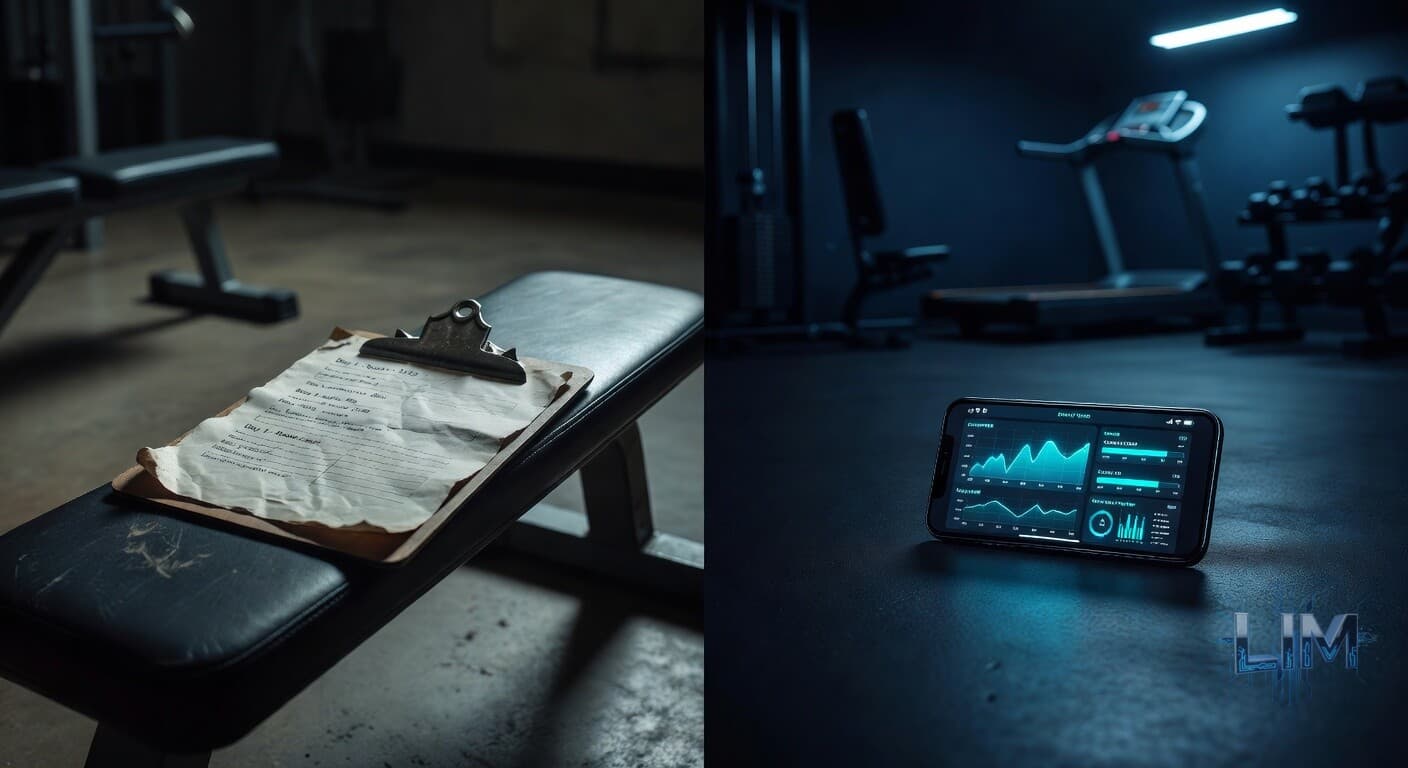
Tomas is 53, parked in his Silverado outside the union hall at 06:48 on a Wednesday, thumb hovering over the screen.
The text from his coach reads: "Hey man, can we push tomorrow to next week?" Third reschedule this month. Nine years they've trained together. CIDP since 47, both knees rebuilt at 50 and 51, an 18-month rotator cuff he's been working around. Tomas isn't mad. He's tired. He's also quietly deciding he might just stop going.
TL;DR
- BJSM 2024 meta-analysis: adherence dropped below 50% within six months across supervision styles — except programs that adapted to real life, which held above 70%.
- Stanford Human Performance Lab 2025, 12-week cohorts: no coaching 11% body-comp improvement, human trainer 2x/week 19%, AI adaptive daily coaching 26%.
- The AI cohort didn't win on smarts. It won on daily presence.
- One human cannot track sleep, RPE, pain, nutrition, and biometrics across 50-200 clients and re-plan each one tonight. The math does not bend.
- Jake dropped 308 to 196 in 9.5 months working hospital-security graveyards because the program adjusted on Tuesday, not next Saturday.
The trainer industry has a math problem
Most personal trainers are good people. Some are exceptional. The structural problem isn't competence.
The problem is how much one human can hold, how many calls they can take, how fast they can adjust before something cracks. I hired three trainers during the 9.5 months I dropped from 308 to 196.
Related Read
Why Fitness Programs Fail at 6–8 Weeks (And How Busy Adults Fix It)Most people don't quit fitness in week one — they stall around week 6–8 when novelty dies, life interrupts, and the plan freezes. Here's the science of plateaus, adherence, and progressive overload for busy parents, desk workers, and over-40 restarts.
Two were excellent. One was a disaster. None of them worked around a hospital-security graveyard rotation.
None caught the unexplained fatigue that turned out to be internal bleeding. All of them had a default program they fell back on the second my life got complicated. That isn't a roast. It's a job description with a ceiling.
Adherence is the only metric that matters
You can have the prettiest program on Earth. If you don't run it, it doesn't exist.
A 2024 British Journal of Sports Medicine meta-analysis found adherence dropped below 50% within six months across the majority of participants, regardless of supervision style. The exception was the cohort whose program adapted to real-world constraints — schedule, equipment, injuries, life events. That cohort held above 70% through the same window.
Read that twice. The variable that predicts whether you finish is not your trainer's pedigree. It's whether the program bends when your week does.
A good trainer sees Tomas on Tuesday. By Thursday his shoulder is barking, the CIDP fatigue is louder, and his wife's surgery just landed on the only day she can drive him. He texts. Maybe his coach replies.
The plan doesn't actually move until they sit across from each other Saturday. By Saturday he's missed three sessions and is quietly deciding he "can't do this right now." He isn't lazy. The feedback loop is just too slow to catch the slip.
This is the kind of pattern Chiron — our AI head coach — flags in the daily program review the night Thursday's session gets skipped, not three days later.
The personalization gap
Here's what a usable coaching system has to track and respond to in real time:
- Sleep quality and duration
- Stress and shift changes
- Injury reports and pain points
- Workout performance — reps, weights, RPE
- Nutrition adherence
- Biometric trends across weeks and months
No single human can hold all of that across 50, 100, 200 clients and re-plan each one tonight. The math does not bend. There are not enough hours in a day.
Stanford's Human Performance Lab 2025 ran a 12-week, three-cohort comparison. No coaching produced 11% body-composition improvement. A human trainer at 2x per week produced 19%. An AI adaptive coaching system running daily produced 26%.
The AI cohort didn't win because the model was smarter than the trainers. It won because it was there every single day. That is the entire margin.
That daily presence is what changes the math for a 53-year-old with CIDP and two replaced knees who needs his program to listen to today, not last Saturday. The daily AI program update worker rewrites your week the moment your HealthKit logs an off-night — before Tomas ever opens the app.
What AI coaching still can't do
Be honest about the ceiling.
A great trainer watches you squat and fixes your knee tracking before the third rep. AI coaching leans on your video, your wearable, and your self-report. That gap is real.
A great trainer remembers your dog's name and asks about your wife's surgery. That mattered to me at 308 pounds, and it would be a lie to pretend a model replicates it. Great trainers also pattern-match overtraining — or something darker — against thousands of bodies they've watched in person.
These gaps are real. They're also fixable in specific ways.
Form gets caught with a 30-second video upload. The "how was your week" question gets answered by the voice-note check-in, which catches the cortisol-tell in your voice before the scale moves.
The pattern-matching for things the weekly form misses gets caught by HERMES, which scrapes 12,000 fitness papers a week so your protocol updates the day new evidence lands — not the next continuing-ed weekend.
The point of an AI coaching system isn't to fire the trainer Tomas already loves. It's to put a second set of eyes on the days the trainer can't show up.
Why I built this instead of hiring a fourth trainer
At 308 pounds, working hospital-security graveyards, with iron so low I was running on fumes, no trainer I could afford was going to help me. Not because they didn't care. Because their programs were built for the 9-to-5 person who shows up at 07:00 with a wearable and a clean fasted state.
I needed something that worked at 03:00. Something that knew when I'd been up all night on a combative-patient call and slept four hours. Something that adjusted Tuesday instead of waiting for our Saturday slot.
I dropped 112 pounds. The program that did it is the program inside Legacy In Motion now — sharper, faster, run by a coaching system instead of a tired version of me with a clipboard.
Tomas, the 53-year-old with CIDP and the rebuilt knees, is exactly who this was always built for. His longtime coach stays in the picture. The system fills the days the coach can't.
If your week bends, your program should bend with it. That's the whole pitch.
---
Coaching that works the same shifts you do
Start logging and Chiron, our AI head coach, starts adjusting: protein targets per meal, training volume after short sleep, a deload when your numbers call for it instead of when the calendar does. HERMES, our research engine, feeds new research into your coaching the morning it publishes.
$29.99/month · $249.99/year · 7-day free trial · cancel anytime · no enrollment fee · no contract
Start coaching → · See the full app →
Jake Long built it after losing 112 lbs working hospital night shifts — when no human coach could keep up with his schedule. He wanted the system he wished he'd had at 308. Now you can use it too.
Frequently Asked Questions
Is AI fitness coaching actually better than a personal trainer?
Stanford's Human Performance Lab 2025 compared three 12-week cohorts: no coaching produced 11% body-composition improvement, a 2x/week human trainer produced 19%, and AI adaptive daily coaching produced 26%. The AI cohort didn't win on smarts, it won on daily presence.
Why do people quit workout programs after a few months?
A 2024 BJSM meta-analysis found adherence drops below 50% within six months regardless of supervision style. The only cohort that held above 70% was the one whose program adapted to real-world constraints like schedule changes, equipment, and injuries.
Can a personal trainer realistically handle 100+ clients well?
No, and it's a math problem, not a competence problem. One human cannot track sleep, stress, RPE, pain points, nutrition, and biometric trends across 50 to 200 clients and re-plan each one nightly.
Comments (0)
Comments are reserved for Legacy In Motion members.
$29.99/month. No contracts. Cancel anytime.
Get StartedAlready a member? Sign in
You read this far. Now do this.
You've read the theory.
Now put it to work in your real week.
I went from 308 to 196 lbs working 12-hour overnight shifts with two kids and zero personal trainer. The system I used is now an app that plans your training and meals around YOUR schedule — overnight, day shift, all of it.
Cancel anytime · No setup fee · No long contract
Free Assessment
What's Holding Your Fitness Back?
Take our 60-second quiz and get a personalized breakdown of what's stopping your progress — plus how AI coaching solves it.
Take the QuizFree PDF · No Credit Card
Grab the Shift Worker AI Fitness Blueprint
If your training keeps dying by week two, start here: the 4-week shift-worker protocol behind Jake's 112 lb loss, with the sleep timing and post-shift macros that made it stick.
Built by someone who actually worked them. No fluff. Unsubscribe any time.
Keep Reading
2026-07-14
Why Fitness Programs Fail at 6–8 Weeks (And How Busy Adults Fix It)
Most people don't quit fitness in week one — they stall around week 6–8 when novelty dies, life interrupts, and the plan freezes. Here's the science of plateaus, adherence, and progressive overload for busy parents, desk workers, and over-40 restarts.
2026-07-05
The Over-40 Morning Ritual: 5 Minutes to Fight Joint Stiffness, Muscle Loss & Brain Fog Before Your First Meeting
Desk workers and busy parents over 40 don't need another gym plan. This simple 5-minute morning sequence (backed by longevity research) attacks overnight stiffness, preserves muscle, and sharpens cognition — all before coffee. Here's the exact protocol and how AI coaching locks it in.
2026-07-04
The 10-Minute Post-Meal Walk: The Habit Busy Parents, Desk Workers & Over-40 Transformations Actually Stick With
Forget the hour-long gym sessions that never happen. The simplest evidence-based habit — a 10-15 minute walk right after eating — is delivering outsized results for busy parents, desk workers, and adults over 40. Here's the science, real protocols, and how AI coaching makes it automatic.
Join our free fitness community — get coaching tips, share wins, and stay accountable.
JOIN THE DISCORD →