


After 40, Your Daily Protein Total Is Lying to You
Per-meal protein threshold doubles after 40. Daily totals look fine while muscle quietly leaves. Here's the per-meal layout that actually works.
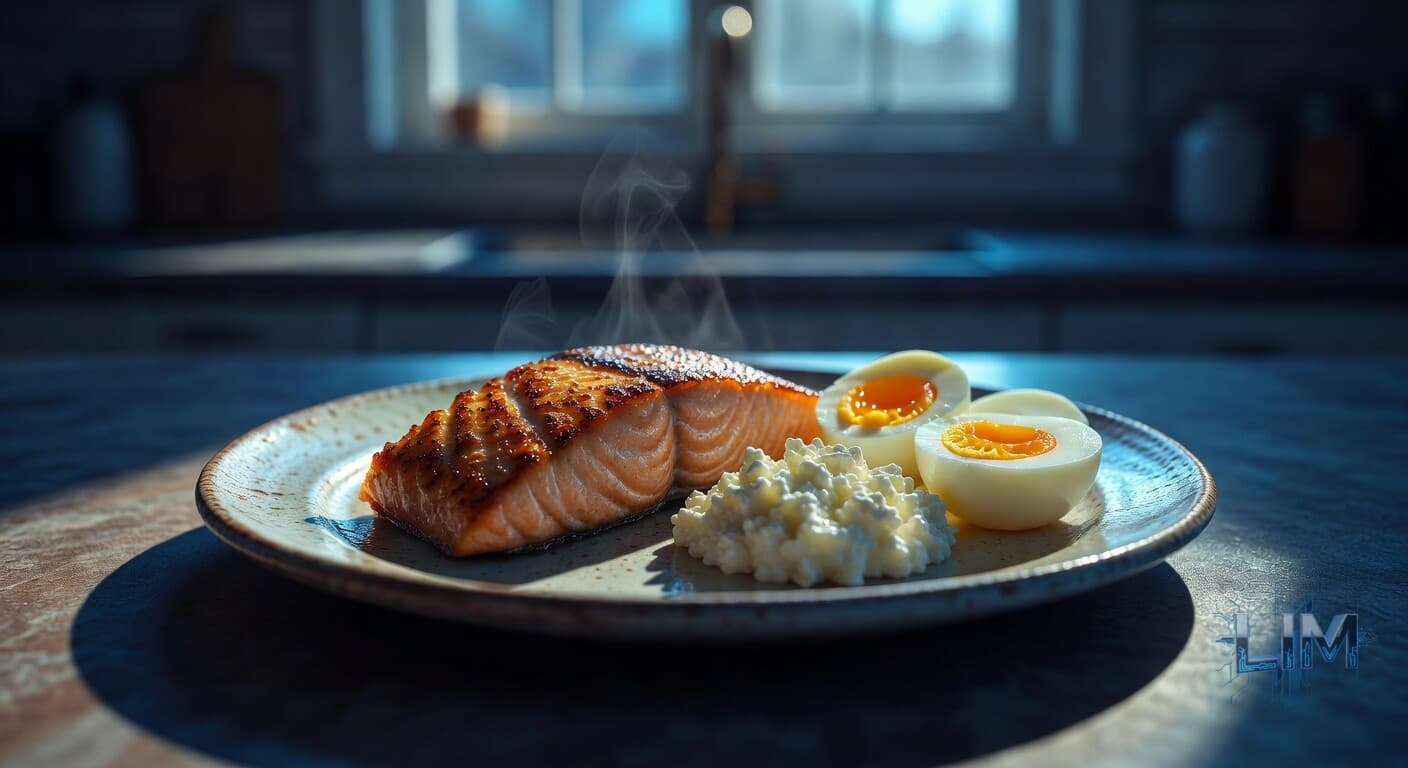
Mark is in his 50s. CIDP managed, bilateral knee replacements healed, torn rotator cuff he is working around. He trains twice a week with the same coach he has had for nine years. He has been eating clean for a year — down 18 pounds. Mirror looks better.
At his physical, the nurse runs a grip-strength test. Fifth percentile for his age. The doctor pulls up the DEXA from last week. Seven pounds of lean mass gone. Body fat percentage up two points.
He is not skipping meals. He is hitting 150 grams of protein a day in MyFitnessPal. The daily number says win.
The daily number is lying.
Related Read
Semaglutide Slows Biological Aging — But Only If You Protect the MuscleNew UCSD RCT in Nature Communications shows semaglutide slows epigenetic aging clocks across inflammation, brain, heart, and metabolic systems. For over-40 desk workers and busy parents on GLP-1s, the real win comes when AI coaching locks in resistance training and protein so you keep the muscle while the drug does its work.
TL;DR - After 40, the per-meal protein threshold roughly doubles, from ~0.24 g/kg to ~0.40 g/kg of high-quality protein (American Journal of Physiology, Endocrinology and Metabolism). - Even distribution at matched daily total drives 25% higher 24-hour muscle protein synthesis than back-loading (Mamerow et al, Journal of Nutrition 2014). - Per-meal leucine threshold sits at 2.5 to 3 g. That is roughly 30 to 40 g animal protein, or 40 to 50 g plant. - Three resistance training sessions per week is the sarcopenia-prevention sweet spot (2025 Frontiers in Physiology network meta-analysis). - Active adults over 40 need 1.2 to 1.6 g/kg daily total. How you split it is the lever.
The receptor curve bends after 40
Anabolic resistance is the formal name. The mTORC1 pathway — the muscle-building switch leucine flips — gets quieter with age.
The American Journal of Physiology, Endocrinology and Metabolism nailed the numbers. Younger adults max out muscle protein synthesis at about 0.24 g/kg of high-quality protein per meal. Older adults need about 0.40 g/kg per meal to hit the same response.
The same meal makes less muscle at 45 than it did at 25. That is not opinion. That is the receptor curve.
For a 180-pound adult, that is about 33 g of quality protein per meal. Not the target. The floor.
Below the floor, the switch does not flip. Your body does not bank the leftovers for tomorrow either.
The 2023 meta-analysis in Clinical Nutrition ESPEN and the ESPEN Expert Group recommendations on protein in aging both land in the same place. Daily totals matter. Per-meal threshold is the lever that actually moves muscle preservation.
This is the kind of pattern Chiron, our AI head coach, flags in your daily program review. A 22-gram breakfast does not get a green check because it is "clean." It gets a nudge to add an egg or a scoop of whey. The math runs on your body weight, not a generic chart.
Leucine is the switch
Protein and leucine are not the same thing. Protein is the package. Leucine is the keycard.
Leucine, one branched-chain amino acid, is what flips mTORC1. The practical threshold is 2.5 to 3 grams per meal. Hit it and the synthesis pulse fires. Miss it and the protein still digests fine. It just does not build.
Animal sources are leucine-dense. Whey, eggs, chicken, beef. Thirty to forty grams of protein clears the threshold. Plants run lean on leucine. Closer to 40 to 50 grams of plant protein to clear the same bar.
Below 2.5 grams per meal, the switch does not flip.
This is why "I had a salad with chickpeas for lunch" reads as healthy and tracks as muscle-loss-neutral. Twelve grams of plant protein does not move MPS. It just feeds you.
The big-dinner trap
Most over-40 adults default to one layout. Coffee for breakfast. A light lunch, 15 to 20 grams. Then 60 to 80 grams loaded onto dinner because the family is eating together.
Daily total looks like 90 to 120 grams. Looks fine on paper. The body reads a different story.
Mamerow et al, Journal of Nutrition 2014, ran a controlled feeding study at the University of Texas Medical Branch. One group ate even distribution, about 30 g at each of three meals. The other ate the back-loaded pattern — 10 g, 15 g, 65 g — at matched daily totals.
The even group ran 25 percent higher 24-hour muscle protein synthesis. Same grams. Different muscle.
The back-loaded day clears the threshold once. The even day clears it three times. Three pulses of building beat one pulse and two windows of nothing, every time.
I ran a per-meal version of this when I dropped 112 pounds working hospital-security graveyard shifts. The schedule was hell. Sleep was random. Meals at 2 a.m. The one thing that did not move was the per-meal threshold. That is the consistency that survives a chaotic life.
Three sessions, not five
Protein without lifting slows the loss. It does not reverse it. Lifting is the multiplier, and the dose has been measured.
A 2025 GeroScience paper (Holwerda et al, Springer Nature) ran a cohort of pre-frail and frail older women, average age 77.5, through twelve weeks of resistance training plus optimized protein at 1.2 g/kg/day. Result: increased basal muscle protein synthesis and reversal of frailty markers.
Adding leucine on top of the protein added nothing in this cohort. The lift was the lever.
The 2025 Frontiers in Physiology network meta-analysis on resistance training dosing for sarcopenia was just as clean. Three sessions per week was optimal for handgrip strength gain. Two was meaningful.
Five was not better than three.
You do not need to live in the gym. You need to be there three times, lifting heavy enough that the last two reps cost you something.
When the daily AI program update worker sees your HRV crash after a 14-hour day, it pulls back lift volume and keeps the protein floor intact. A bad-sleep week does not blow up the program. The signal stays alive.
The layout that actually works
For a 180-pound adult over 40, a workable day looks like this. Swap equivalents. Examples, not commandments.
- Meal 1. Four whole eggs and a cup of Greek yogurt, or a 35 g whey shake with oats. ~35 g protein. Threshold cleared.
- Meal 2. 6 oz chicken breast on a salad, or a 6 oz tuna pouch with rice. ~40 g protein.
- Meal 3. 7 oz salmon, sirloin, or lean ground beef with a starch and vegetables. ~45 g protein.
- Optional Meal 4 (pre-sleep). 30 to 40 g casein or a cottage-cheese bowl. Slow-digesting protein that supports overnight MPS, which drops harder in older adults.
Three meals is the floor for active adults. Four is the high-preservation configuration for people training hard, recovering from injury, or on weight-loss medication where lean-mass preservation is the entire game. The 2026 JAMA data on weight-loss medication and lean mass keeps pointing back at per-meal protein as the primary defense.
Two practical adds. Vitamin D status matters. The Journal of Cachexia, Sarcopenia and Muscle found whey plus vitamin D improved handgrip strength more than whey alone. And total daily protein lands in 1.2 to 1.6 g/kg for active adults over 40, with 1.6 the upper end for people building, not just holding.
Cross the threshold three times. Add a fourth if the day is hard. That is it.
HERMES, our research engine, scrapes 12,000 fitness papers a week. The moment a new MPS threshold or training-dose study lands, your protocol updates. You do not have to read the journals. We already did.
What Mark does next
Mark goes home and pulls up his MyFitnessPal log. Breakfast: 14 g. Lunch: 19 g. Dinner: 71 g. Snacks: 8 g.
Daily total: 112 g. Looks like a win.
Crossed the threshold once. Two muscle-protein-synthesis windows open and empty.
We built Legacy In Motion for the Marks. Per-meal tracking that flags a low breakfast before the day spirals. Three-day-a-week resistance programming that backs off when your HRV says back off. In-app meal log with barcode scan so tracking takes one tap, not ten. Shift-aware scheduling for people whose lives do not fit a 9-to-5 fantasy. Adaptive programming that works around CIDP, the rotator cuff you are protecting, the knee replacement you do not want to compromise.
Muscle preservation after 40 is a consistency problem. The point of the platform is to make the consistency invisible.
If any of this hit home, you know where to find us: https://legacyinmotion.fit
---
The data behind this
- American Journal of Physiology, Endocrinology and Metabolism — per-meal MPS dose-response in younger vs. older adults (the 0.24 g/kg vs. 0.40 g/kg threshold).
- Mamerow et al, Journal of Nutrition, 2014 — matched-total even vs. back-loaded distribution, 24-hour MPS.
- Clinical Nutrition ESPEN meta-analysis, 2023 — protein per meal vs. daily total in aging.
- ESPEN Expert Group recommendations on protein in aging.
- Holwerda et al, GeroScience, 2025 — 12-week resistance training plus optimized protein in pre-frail and frail older women.
- Frontiers in Physiology network meta-analysis, 2025 — resistance-training dose-response for sarcopenia and handgrip strength.
- Journal of Cachexia, Sarcopenia and Muscle — whey plus vitamin D vs. whey alone, handgrip strength.
- JAMA, 2026 — weight-loss medication and lean-mass preservation.
---
Log tonight's shift. Wake up to an adjusted plan.
Most programs die in the gap between the plan and your real week. Chiron, our AI head coach, reads what you log (meals, workouts, skipped sessions) and rewrites tomorrow instead of waiting for you to fall off. HERMES, our research engine, keeps the coaching current with new science the week it publishes.
$29.99/month · $249.99/year · 7-day free trial · cancel anytime · no enrollment fee · no contract
Start coaching → · See the full app →
Jake Long built it after losing 112 lbs working hospital night shifts — when no human coach could keep up with his schedule. He wanted the system he wished he'd had at 308. Now you can use it too.
Questions Worth Asking
How much protein per meal do I need after 40?
About 0.40 g/kg of high-quality protein per meal, up from roughly 0.24 g/kg in younger adults, per the American Journal of Physiology, Endocrinology and Metabolism. For a 180-pound adult that lands near 33 g per meal as the floor, not the target.
Does it matter if I eat most of my protein at dinner?
Yes. Mamerow et al (Journal of Nutrition, 2014) ran matched daily totals and found even distribution (about 30 g across three meals) drove 25 percent higher 24-hour muscle protein synthesis than the 10/15/65 g back-loaded pattern. Same grams, different muscle.
Why doesn't my chickpea salad count toward muscle even though it has protein?
Because leucine, not total protein, flips the mTORC1 switch, and the per-meal threshold is 2.5 to 3 g of leucine. Plant sources run lean on leucine, so you need roughly 40 to 50 g of plant protein per meal to clear the bar versus 30 to 40 g of animal protein. Twelve grams of chickpeas digests fine but does not move MPS.
Comments (0)
Comments are reserved for Legacy In Motion members.
$29.99/month. No contracts. Cancel anytime.
Get StartedAlready a member? Sign in
You read this far. Now do this.
Enough reading about it.
Time to train around the life you actually live.
I went from 308 to 196 lbs working 12-hour overnight shifts with two kids and zero personal trainer. The system I used is now an app that plans your training and meals around YOUR schedule — overnight, day shift, all of it.
Cancel anytime · No setup fee · No long contract
Free Assessment
What's Blocking Your Results?
Take our 60-second quiz and get a personalized breakdown of what's stopping your progress — plus how AI coaching solves it.
Take the QuizFree PDF · No Credit Card
Download the Shift Worker AI Fitness Blueprint
The protocol Jake wishes he'd had at 308 lbs: sleep timing for rotating shifts, post-shift macros, and the AI deload trigger, from the run that took him to 196. Free, no card needed.
Built by someone who actually worked them. No fluff. Unsubscribe any time.
Keep Reading
2026-06-27
Semaglutide Slows Biological Aging — But Only If You Protect the Muscle
New UCSD RCT in Nature Communications shows semaglutide slows epigenetic aging clocks across inflammation, brain, heart, and metabolic systems. For over-40 desk workers and busy parents on GLP-1s, the real win comes when AI coaching locks in resistance training and protein so you keep the muscle while the drug does its work.
2026-05-21
One Year Ago Today I Weighed 308: The Muscle-Loss Frame Just Got Rewritten
On May 21 2025 I stepped on a scale at 308 lbs. One year later — 196, 14.1% body fat, 168.7 lbs fat-free mass. The Cell Reports Medicine and ECO Istanbul May 2026 readout (n=486, mean age 49.9) just walked back the 20% lean-mass-loss panic that was internet conventional wisdom when I started. Here is what the new evidence changes, what it does not, and what the over-40 patient on the ride right now should do about it.
2026-05-06
Wednesday 06:30: The Cinco de Mayo Salvage Protocol That Refuses to Lecture
Two margaritas, three meetings, a noon lift you swore you'd hit. Here's the four-lever salvage that respects the mechanism, not your willpower.
Join our free fitness community — get coaching tips, share wins, and stay accountable.
JOIN THE DISCORD →