


The Ring Was Green. The Bar Was Heavier. Two Clocks, One Training Week.
Sleep duration resets in 48 hours. Sleep architecture takes a week. The traveler protocol for the over-40 lifter who keeps trying to PR on Thursdays.
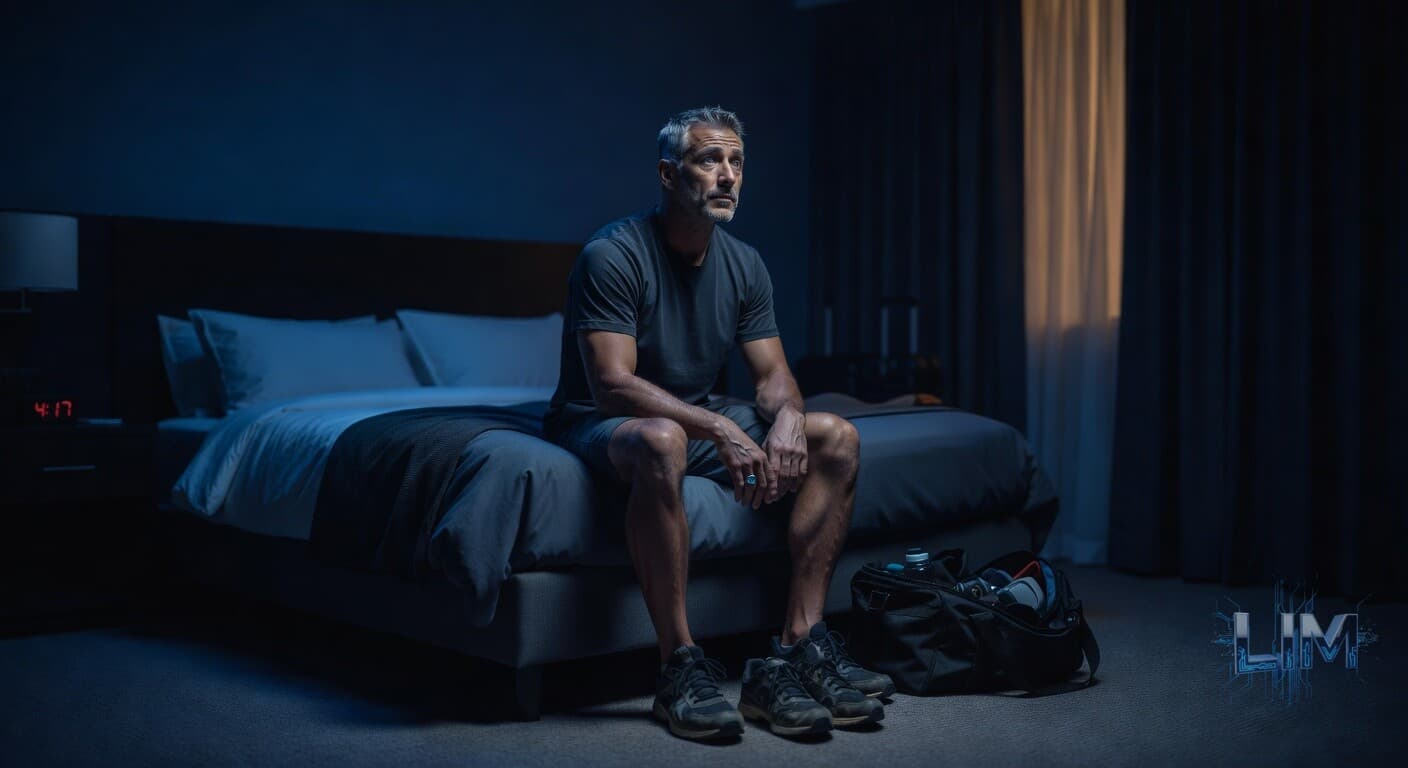
Trevor flies the 21:00 Atlanta-to-Frankfurt redeye every other Tuesday. He is 51, regional VP, lifts heavy three days a week, has held a 405 squat across most of the last decade.
His Oura ring told him duration was back to baseline by Wednesday night. Eight hours, green ring, the icon his wife teases him about checking before coffee. Thursday morning at 06:15 in the basement gym his warm-up sets felt heavier than last Friday's working sets.
The bar did not change. His body did.
The ring just answered the wrong question.
Related Read
You Don't Have to Fly Anywhere to Get Jet Lag. Your Weekend Sleep-In Hands You a Dose.Social jet lag, the two-to-three hour gap between your weekday alarm and your Saturday lie-in, is the cleanest hidden tax on a busy person's training. A 2024 Journal of Applied Physiology study shows the schedule swing blunts the exact mitochondrial adaptations your workouts are supposed to build. Here is what the data shows, why travelers and busy parents get hit hardest, and the one anchor that protects the gains you already earned.
Duration is the headline. Architecture owns the bar.
Every Oura, Whoop, and Apple Watch shows total sleep on the front of the dashboard. That's the easy number to log. The number that decides what your Thursday lift feels like is buried two screens deeper — deep sleep, REM, sleep midpoint, mid-night awakenings.
Across 1.5 million nights of wearable data pooled from travelers, duration came back to baseline by the second post-flight night. Architecture took more than a week. Slow-wave sleep — the largest nightly growth-hormone window. REM — the consolidation pass for motor patterns. Sleep midpoint — the marker your body uses to schedule cortisol release tomorrow morning.
A duration-normal week with fragmented architecture is not a recovered week. It is a deload nobody put on the calendar.
Walking is good. Walking does not rebuild architecture.
Your body clock delays easier than it advances
The human circadian period averages slightly longer than twenty-four hours. Drop a person in a windowless room with no clocks and they drift later, not earlier. Eastward travel asks the suprachiasmatic nucleus to do the harder operation — advance, not delay — on a redeye timeline.
The data is clean on this. Eastward delays sleep onset, fragments the middle of the night, cuts deep and REM. Westward does the opposite, easier and faster.
The field consensus on resync — half a day per timezone west, one full day per timezone east. Trevor's four-hour Tuesday eastward trip is not architecturally home until next Tuesday.
That is the training week. Not the recovery week. The training week.
You bleed sleep before the wheels leave the ground
Buried in the same dataset, the cleanest finding most coverage skipped. Sleep duration drops thirty to fifty minutes the night BEFORE the flight. Pre-travel. Same time zone. The 04:15 shuttle alarm ate it.
This is the easiest free win on the calendar. Either book the second flight of the day, or move bedtime earlier by exactly the number of minutes you are moving the alarm.
This is the kind of pattern Chiron — the AI head coach inside LIM — flags the moment the calendar imports a flight. Trevor's pre-travel sleep debt gets a planned bedtime, not an accidental one.
Age is not the lever. Baseline architecture is.
The counterintuitive finding from the same wearable cohort. A 20-year-old lost roughly fifteen more minutes per post-flight night than a 60-year-old on the same trip.
The reason is mechanical. Older adults already wake more, sleep lighter, and run a flatter circadian amplitude at baseline. Less signal to disturb. Younger travelers have farther to fall.
The over-40 lifter sits in the middle of the curve. The lever Trevor controls is not his birthday. It is the structure of the training week around the flight.
Chronotype is the other hidden variable. Late sleepers struggle westward. Early larks struggle eastward. Same flight, two different costs depending on which body is in seat 7C.
The week after a flight is a hidden deload
Reduced slow-wave sleep means a measurable drop in growth-hormone pulse amplitude, slower clearance of the day's metabolic byproducts, and a longer resolution window on muscle protein synthesis. REM disruption tracks with motor learning loss and shorter patience under load.
The plane is not a 12-hour shift. The architectural pattern is close enough that the warning carries.
For the over-40 lifter the cost is sharper. Masters lifters run roughly 60 to 70 percent of a 25-year-old's daily protein synthesis amplitude, with resolution times stretched. Stack a Frankfurt redeye on top of that and Trevor's Thursday squat is not a workout. It is an overreach.
The week after a flight is a deload whether you scheduled one or not. The lever is whether you cooperate with it or fight it.
The travel-week protocol
Two days before. Pull weekly volume twenty to twenty-five percent on the lift days inside this window. Heavy singles move earlier.
Night before. Match the wake-time delta. Shuttle ninety minutes earlier than your normal alarm? Bed ninety minutes earlier than normal lights-out. Skip the late caffeine.
Eastward in flight. Set the watch to destination time at the gate. Stop eating four hours before destination breakfast. Sleep the first half. Light meal on landing. No coffee until destination 09:00 local. The light cue on arrival is the strongest entrainment lever you have.
Westward in flight. Stay awake. Eat on the airline schedule. Biology is on your side. Westward delay is the easier direction.
Day one at destination. Walk outside for twenty minutes within ninety minutes of local sunrise on an eastward trip, or local sunset on a westward trip. Highest-leverage circadian intervention available. It is free.
Days two through four. Strength sessions return at seventy to eighty percent of normal load. Rep ranges in the eight-to-twelve zone. No heavy singles. Heavy singles on day two of an eastward trip is how you herniate something.
Day five through return. Normal load resumes. Track morning resting heart rate the day before, day of, and day after each flight. If it sits more than seven beats above baseline, the next session defaults to volume work and heavy work moves out 48 hours.
When the Apple Watch logs that resting-HR spike, the daily AI program update worker rewrites Trevor's week before he finishes breakfast. He does not have to remember the rule. The system does.
The nutrition layer that pairs with the architecture
Magnesium glycinate at 300 to 400 milligrams, 60 to 90 minutes before destination bedtime, supports GABA-mediated sleep onset without next-morning sedation. Glycine at 3 grams in the same window drops core body temperature — the physiological event that initiates slow-wave sleep. Neither replaces the light cue. Both stack with it.
Protein distribution matters more on travel weeks. The over-40 per-meal floor sits around 0.4 grams per kilogram, and the synthesis resolution window tightens when architecture is fragmented. Four meals at threshold beats three, especially in the 48 hours after an eastward flight.
I ran a version of this protocol working hospital security graveyard shifts when I dropped from 308 to 196 pounds. Different schedule. Same architecture problem. The lessons that survived those nights are the same lessons inside the travel-week module.
The honest limitations
Self-tracking ring users self-select. A finger-worn device is not lab polysomnography, though the validation literature is now strong enough that the relative direction of effects can be trusted.
The dataset did not stratify by training status, so the math on whether a 40-year-old lifter recovers faster than a 40-year-old non-lifter on the same trip is open. Conservative read: lifters carry a marginally higher recovery debt during the post-flight window because they are stacking circadian disruption on a training stimulus. The protocol above accounts for that.
Two clocks, one training week
Duration resyncs in forty-eight hours. Architecture takes a full week, longer on an eastward multi-zone trip.
Architecture is the clock that owns bar speed, recovery between sets, tolerance for heavy work, and willingness to skip the second espresso at the destination hotel. Plan around the architecture clock. The duration clock will lie to you in green.
Trevor stopped trying to PR on Thursdays. His Tuesday redeye now lands into a calendar that already pulled Wednesday's squat to volume work and pushed his heavy day to Friday.
The platform reads sleep architecture off HealthKit, morning resting heart rate, and the timezone delta on the calendar. It rewrites the training week before the gate closes. The protocol runs while Trevor runs the meeting.
Train around the trip you're going to take anyway.
---
The data behind this
- Insights about Travel-Related Sleep Disruption from 1.5 Million Nights of Data — National University of Singapore team, SLEEP (March 24, 2025). Pooled wearable data from roughly 57,000 Oura users across ~65,000 long-distance trips. Sleep duration returned to baseline by the second post-travel night; architecture (deep sleep, REM, midpoint, awakenings) took more than a week.
- Eastward vs. westward asymmetry — same NUS dataset. Eastward delayed sleep onset, fragmented mid-night, suppressed deep and REM more than westward.
- Pre-travel sleep loss — same dataset, traveler sleep duration dropped 30–50 minutes the night before the outbound flight.
- Age effect — 20-year-olds lost ~15 more minutes per post-flight night than 60-year-olds on the same trip; older adults' flatter baseline circadian amplitude left less signal to disturb.
- Vincent et al. 2024 — cortisol and shift-work data; modest architecture disruption shifted morning cortisol curves and raised perceived exertion at fixed loads.
- Schoenfeld and Aragon — per-meal leucine literature for masters lifters; daily protein synthesis amplitude runs ~60–70% of a 25-year-old's with resolution times 12–24 hours longer.
- Magnesium glycinate / glycine sleep protocol — established GABA-mediated sleep-onset and core-body-temperature-drop literature (covered in detail in our 3g glycine 60 minutes out piece).
- Jake's own numbers: 308 → 196 in 9.5 months on 12-hour overnight hospital security shifts (started May 2025). Sample of one — informed perspective, not population data.
---
Get Chiron in your pocket — $29.99/month
Chiron, our AI head coach, coaches the week you actually have: overnights, doubles, rotation flips, kid pickups. Log the change and tomorrow's plan already knows. No static program that assumes you sleep at 10pm and train at 6.
$29.99/month · $249.99/year · 7-day free trial · cancel anytime · no enrollment fee · no contract
Start coaching → · See the full app →
Jake Long built it after losing 112 lbs working hospital night shifts — when no human coach could keep up with his schedule. He wanted the system he wished he'd had at 308. Now you can use it too.
Comments (0)
Comments are reserved for Legacy In Motion members.
$29.99/month. No contracts. Cancel anytime.
Get StartedAlready a member? Sign in
You read this far. Now do this.
Stop reading about it.
Start training around your real life.
I went from 308 to 196 lbs working 12-hour overnight shifts with two kids and zero personal trainer. The system I used is now an app that plans your training and meals around YOUR schedule — overnight, day shift, all of it.
Cancel anytime · No setup fee · No long contract
Free Assessment
What's Really Stopping Your Progress?
Take our 60-second quiz and get a personalized breakdown of what's stopping your progress — plus how AI coaching solves it.
Take the QuizFree PDF · No Credit Card
Get the Shift Worker AI Fitness Blueprint
The exact 4-week protocol Jake used to lose 112 lbs working hospital security overnights — sleep timing, the four-minute REHIT window, post-shift macros, and the AI deload trigger. Drops in your inbox in 30 seconds.
Built by someone who actually worked them. No fluff. Unsubscribe any time.
Keep Reading
2026-05-30
You Don't Have to Fly Anywhere to Get Jet Lag. Your Weekend Sleep-In Hands You a Dose.
Social jet lag, the two-to-three hour gap between your weekday alarm and your Saturday lie-in, is the cleanest hidden tax on a busy person's training. A 2024 Journal of Applied Physiology study shows the schedule swing blunts the exact mitochondrial adaptations your workouts are supposed to build. Here is what the data shows, why travelers and busy parents get hit hardest, and the one anchor that protects the gains you already earned.
2026-05-11
5 Minutes of Lowering Beats 45 Minutes of Lifting: ECU's 2026 Eccentric Protocol for Desk Workers, Busy Parents, and Anyone Over 40 Without Gym Time
Edith Cowan University's 2026 trial in the Journal of Sport and Health Science found four bodyweight eccentric exercises performed for five minutes a day produced measurable gains in strength, flexibility, strength-endurance, and mental health in sedentary adults. No gym, no equipment, no soreness. Here is the protocol, the mechanism, and how AI coaching wires it into a real week.
2026-05-10
The Rotator Cuff Is The Tissue At Risk — Not The Knee. The JOSPT Paper Mark Should Have Seen Last Tuesday.
The pickleball injury narrative is upside-down for the over-40 player. Shoulder and lateral elbow are the load-bearing tissues. The fix is three lifts a week, a seven-minute warm-up, and not jumping from two hours of play to six in three weeks.
Join our free fitness community — get coaching tips, share wins, and stay accountable.
JOIN THE DISCORD →