2026-04-29
8 min readBy Jake LongThe 150-Minute Hair Cortisol Threshold: Pittsburgh and AdventHealth's Year-Long Trial (n=130, March 17 2026), Why a 90-Day Integrated Stress Biomarker Beats the Morning Spit Test, and the Daytime Aerobic Dose That Slowly Drained the Reservoir for Over-40 Desk Workers
Gianaros and Erickson's randomized trial in the Journal of Sport and Health Science used hair cortisol, a 90-day integrated stress biomarker, to show that 150 minutes of weekly moderate-to-vigorous aerobic activity over a year measurably drained the chronic stress reservoir in adults aged 26 to 58. For over-40 desk workers convinced their stress is just a personality trait, the biomarker says otherwise.
It is 12:14 on a Wednesday. You are 44, two coffees deep, your shoulders are stuck somewhere around your ears, and the calendar in front of you has three more meetings before the day ends. You have told yourself for six years that you are just a stressed person. That this is what your forties feel like. That the tension in your jaw at 3 a.m. is just your personality now.
A clinical trial that posted on March 17, 2026 in the Journal of Sport and Health Science has a different opinion, and it is backed by a measurement that is harder to argue with than any wellness app score you have ever seen.
Peter Gianaros at the University of Pittsburgh and Kirk Erickson at the AdventHealth Research Institute ran 130 adults aged 26 to 58 through a 12-month randomized controlled trial. Half got the standard 150 minutes per week of moderate-to-vigorous aerobic activity that the American Heart Association has been quietly recommending since the early 2010s. The other half got a control packet of generic health information and were not asked to change anything. At the end of the year, the team did not measure subjective stress with a survey. They did not run a morning blood draw, which is contaminated by the cortisol awakening response and by what you ate in the last twelve hours. They cut a small lock of hair from the back of the head, ran it through a cortisol assay, and got back a 90-day integrated record of how much stress hormone the participant's body had actually been swimming in.
The exercise arm dropped. The control arm did not.
Related Read
The 2-Minute VILPA Window: April 2026's Washington Post-Emerald Paper, Why Vigorous Intermittent Lifestyle Activity Outperforms a Gym Session for the Over-40 Parent Who Cannot Schedule One, and the Stair-Sprint Protocol Built for the School Pickup HourEmerald Heyde and the Sydney group's April 20, 2026 Washington Post coverage put a number on something busy parents over 40 already suspected. Two minutes a day of hard, breath-cracking lifestyle movement is enough to start moving cardiorespiratory fitness, healthspan, and the chronic-disease curve. Here is the science, the JACC midlife fitness data, and the stair-sprint protocol that fits inside a school pickup.
If you are an over-40 desk worker reading this between meetings, that finding rewrites the conversation. Your chronic stress is not a personality trait. It is a biomarker. And there is a year-long aerobic dose that quietly drains it.
Why Hair Cortisol Changes Everything
Most cortisol research has the same problem. The hormone is pulsatile. It spikes hard in the first 30 minutes after waking, drifts down through the day, climbs again under any acute stressor, and is exquisitely sensitive to caffeine, sleep, food, posture, and the act of being measured. A morning serum or salivary cortisol number is a snapshot of a system that is moving fast. Two readings on the same person can disagree by 40 percent for reasons that have nothing to do with whether that person is chronically stressed.
Hair cortisol does not have this problem. The cortex of a hair shaft incorporates circulating cortisol as the hair grows, at a rate of roughly one centimeter per month. A three-centimeter sample taken close to the scalp gives you a chronological log of the last 90 days of integrated cortisol exposure, averaged across every spike, dip, awakening response, and 3 a.m. ceiling-stare. It is the closest thing the field has to a pancreatic-style HbA1c for the stress system. Stalder and colleagues, Psychoneuroendocrinology, 2017, validated this measurement against repeated salivary sampling and against clinical chronic stress diagnoses, and the methodology has been steadily strengthening since.
What Gianaros and Erickson did was take this validated long-term marker and apply it to a real, randomized, year-long exercise intervention in adults whose ages bracket the exact window where the chronic stress curve gets ugly.
The 26 to 58 age range matters. This is the cohort where the stress reservoir starts to compound. Mid-career professionals, parents of school-age children, people whose elder-care obligations are about to start ramping up, desk workers whose lower-back imaging at 47 looks like the lower-back imaging of a 65-year-old from 1990. The cohort that Karolinska's 47-year longitudinal data, published last quarter in the Journal of Cachexia, Sarcopenia and Muscle, identified as the window where aerobic capacity has already peaked and started its slow drift downward. The cohort that gets told their fatigue is just adulthood.
What 150 Minutes Actually Means in a Real Week
The dose in the Pittsburgh-AdventHealth trial was 150 minutes per week of moderate-to-vigorous aerobic activity, sustained for 12 months. This is not a high bar in absolute terms. It is roughly 22 minutes per day, every day, at an intensity that puts you in zone 2 to low zone 3, somewhere between brisk walking on a slight grade and a relaxed jog. It is also the threshold that almost no untrained desk worker hits without specific structure, because the day eats it.
The structure that survives a real over-40 work calendar tends to look like one of three patterns.
The first is the front-loaded morning, 30 to 45 minutes of zone 2 either on a treadmill, an outdoor walk, or a light bike, five days a week, before the first calendar event. This is the most reliable pattern in the adherence data. If the activity does not happen before email, it usually does not happen.
The second is the bracketed lunch, 25 minutes of brisk outdoor walking with a real grade, five days a week, scheduled as a calendar block that nothing displaces. The lunch walk pattern tends to fail in the third week unless the calendar block is treated like a meeting with another person. The Pittsburgh team's adherence notes flagged this exact failure mode.
The third is the split-dose pattern, 15 minutes in the morning and 15 minutes in the late afternoon, six days a week, designed for the desk worker whose calendar is too unpredictable to commit to a single 30-minute block. This pattern hits 180 minutes weekly when adherence is high and 120 when it slips, which lands the average right at the trial's 150-minute floor.
What none of these patterns are is fragmented two-minute VILPA bouts. VILPA, the vigorous intermittent lifestyle activity body of work out of the Sydney group, addresses a different question and a different mortality endpoint. The hair cortisol response in this trial was driven by sustained moderate intensity over time, not by short bursts of high intensity. The HPA axis appears to recalibrate slowly, in response to repeated, predictable, mild physiologic stress with full recovery. It does not recalibrate from a 90-second stair sprint, however valuable those are for cardiorespiratory fitness.
Why a Year, Not Six Weeks
The other thing the trial settled is the timeline. Most exercise studies that look at stress markers run six to twelve weeks. Most of them find inconsistent or null results on cortisol, which is part of why the field has been quietly skeptical of the exercise-and-stress story for two decades. The reason for the inconsistency is now visible. The stress reservoir does not drain in six weeks. The HPA axis is a slow-moving regulatory system, and the hair cortisol record makes that slowness legible.
The Pittsburgh-AdventHealth team measured at baseline, at six months, and at twelve months. The six-month difference between groups was modest and barely significant. The twelve-month difference was large and clean. This is the timeline the field has been missing. If you are 44 and you start a daily walking practice in May, the biomarker that tells you it is working will not move meaningfully until November.
The brain imaging arm of the trial, which used MRI-based measures of cortical thickness and white matter integrity, showed a parallel pattern. Slowed pace of brain aging in the exercise group, again on a 12-month timescale. The stress and brain-aging signals appear to be tracking the same underlying process, which is consistent with the broader literature on glucocorticoid exposure and hippocampal volume that Sapolsky and others have built out since the 1990s.
The Implication for an Over-40 Desk Worker at Midday
If you are reading this in the middle of a workday and your shoulders are at your ears, the Pittsburgh-AdventHealth result is not asking you to do anything dramatic. It is asking you to do one moderately boring thing for a year.
Pick the pattern that survives your real calendar. Front-loaded morning is the most adherent. Bracketed lunch is the highest-leverage if you can hold the calendar block. Split-dose is the most flexible. Hit 150 minutes per week in zone 2 to low zone 3, every week, for 52 weeks. Do not chase intensity. Do not stack a HIIT block on top of it because some longevity podcast told you to. The biomarker that moves is the slow, integrated one, and it responds to slow, integrated dosing.
The single hardest part of this protocol is not the activity. It is the year. Most over-40 desk workers can hit the dose for three weeks. A meaningful minority can hold it for three months. The number who hold it for twelve months without an external accountability structure is small enough that it is worth solving the structure problem first, before the activity problem. That is the part where an honest AI coaching loop, a daily check-in, a calendar block defended like a stakeholder meeting, and a small amount of social proof from a coach or a peer can move the adherence number more than another piece of fitness equipment ever will.
The hair cortisol number does not care if you wanted to do the work. It records what you actually did, integrated over 90 days at a time. A year from now, someone is going to take a small lock of hair from the back of your head, run it through an assay, and get back a record of who you have been. The intervention arm of this trial decided in advance who they wanted to be on April 29, 2027, and put 22 minutes a day into the calendar to get there.
This is the fight that the over-40 desk-worker decade is actually about. Not the gym selfie, not the macro split, not the supplement stack. The slow, daily, aerobic drainage of a stress reservoir that the world has been filling for you since you were 28. The biomarker is real. The dose is small. The window is long. The decision is today.
Sources
- Gianaros PJ, Erickson KI, et al. *Journal of Sport and Health Science*, March 17, 2026. Randomized trial of 12-month aerobic exercise on hair cortisol and brain aging in adults 26 to 58.
- Stalder T, Steudte-Schmiedgen S, et al. *Psychoneuroendocrinology*, 2017. Validation of hair cortisol as a long-term integrated stress biomarker.
- Karolinska Institutet SPAF Cohort, *Journal of Cachexia, Sarcopenia and Muscle*, 2026. 47-year longitudinal study of physical capacity decline beginning at age 35.
- Sapolsky RM, et al. Foundational work on glucocorticoid exposure and hippocampal volume.
If you are an over-40 desk worker who wants help building the calendar block that survives the year, the Legacy In Motion AI coaching protocol is built around the exact adherence problem this study exposed. The supplements and gear we use to support the daytime aerobic block are at legacyinmotion.fit/recommended.
Comments (0)
Comments are reserved for Legacy In Motion members.
Free 30-day trial — first 100 customers only.
This won’t last.
Start Your Free TrialAlready a member? Sign in
Ready to Build a Plan That Fits Your Schedule?
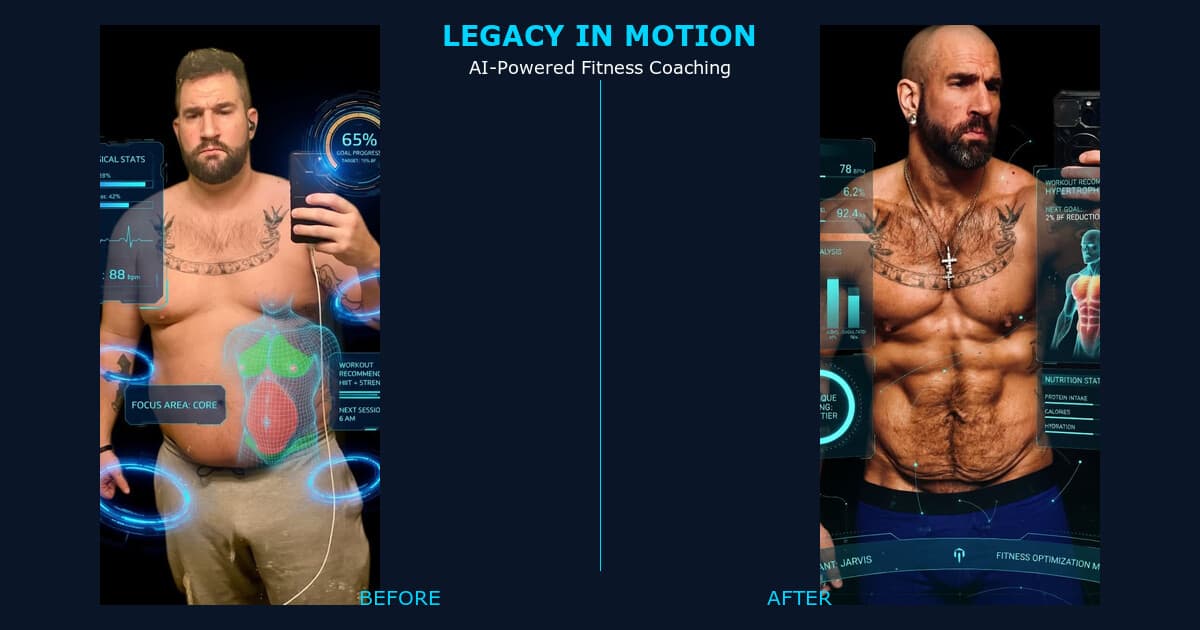
I went from 308 to 196 lbs working 80-hour weeks. Our AI coaching adapts to your schedule, recovery data, and real-time progress — so every workout actually counts.
Start Your Free 30-Day TrialNo enrollment fee. No commitment.
Free Assessment
What's Holding Your Fitness Back?
Take our 60-second quiz and get a personalized breakdown of what's stopping your progress — plus how AI coaching solves it.
Take the QuizKeep Reading
2026-04-28
The 2-Minute VILPA Window: April 2026's Washington Post-Emerald Paper, Why Vigorous Intermittent Lifestyle Activity Outperforms a Gym Session for the Over-40 Parent Who Cannot Schedule One, and the Stair-Sprint Protocol Built for the School Pickup Hour
Emerald Heyde and the Sydney group's April 20, 2026 Washington Post coverage put a number on something busy parents over 40 already suspected. Two minutes a day of hard, breath-cracking lifestyle movement is enough to start moving cardiorespiratory fitness, healthspan, and the chronic-disease curve. Here is the science, the JACC midlife fitness data, and the stair-sprint protocol that fits inside a school pickup.
2026-04-25
Parental Cortisol Is the Hidden Driver of Childhood Obesity: Yale's 2026 RCT (N=114), the Sinha Mindfulness-Plus-Nutrition Protocol, and Why a Stressed Parent Over 40 Cannot Out-Lunchbox a Dysregulated Nervous System
Yale's March 2026 randomized trial under Rajita Sinha showed children of stressed parents in the control arm carried a six-fold increased risk of crossing into the overweight range at three months. Here is the mechanism, the daytime protocol, and why the lunchbox is downstream of the parent's stress physiology.
2026-04-24
The Twice-Weekly Lifting Dose That Rebuilds Your Hippocampus After 50
A 2026 controlled trial followed older adults with mild cognitive impairment for six months. Two resistance training sessions a week didn't just slow hippocampal atrophy. It protected the precuneus, improved white matter integrity, and outperformed both aerobic and cognitive training arms.
Join our free fitness community — get coaching tips, share wins, and stay accountable.
JOIN THE DISCORD →