2026-04-27
14 min readBy Jake LongForward Head Posture, the 3-Desk Hybrid Trap, and Why Remote Workers Have a 15% Worse Neck Than the Cubicle Survivors They Replaced (Mahmoud 2019, Kang 2024, Gallup 2025, and the Cervical Protocol That Actually Reverses It)
82.7% of office workers carry forward head posture, and the remote/hybrid cohort runs about 15% higher than the in-office cubicle dwellers they replaced. Here is the load math, the 3-desk variability problem, the eight-week chin-tuck and scapular-retraction protocol, and the schedule-adaptive AI coaching architecture built around the desk you are actually sitting at today.
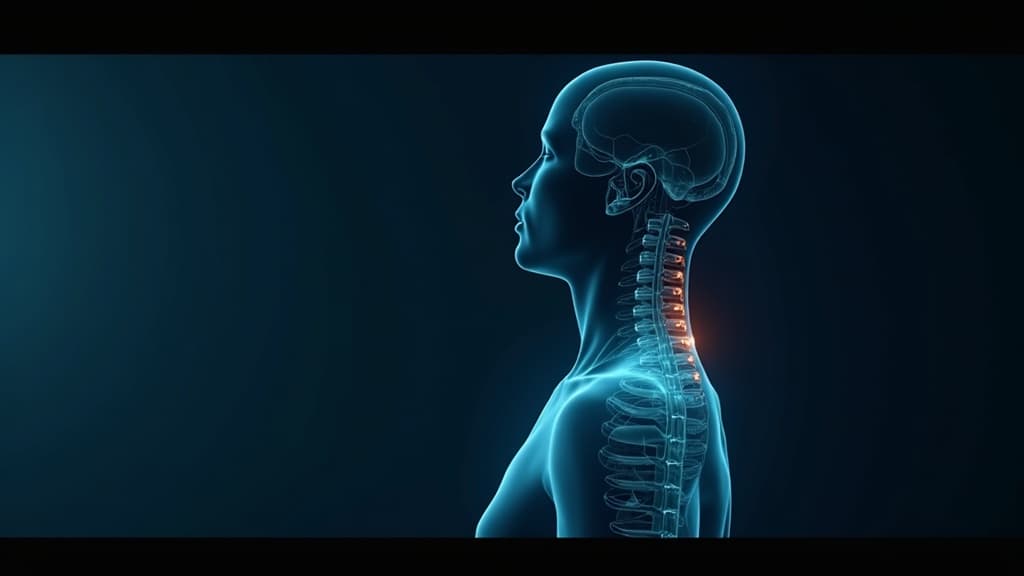
The cervical spine is built to carry a 10 to 12 pound head stacked directly over the shoulders. Tilt that head one inch forward and the load on the upper trapezius and the deep neck flexors does not go up by 10 percent. It goes up by an extra 10 pounds, every inch, all day. Hansraj 2014 (Surg Technol Int) put the math on a graph that has been cited 600 plus times since: a 15 degree forward tilt drives effective load to about 27 pounds. 30 degrees lands at 40. 45 degrees lands at 49. 60 degrees, the angle most people hold while reading email on a laptop balanced on a coffee table, lands at 60 pounds. That is a cinder block strapped to the back of a 40-year-old's neck for ten hours a day, five days a week, fifty weeks a year.
This is the daytime injury most apps never talk about, because every fitness app on the App Store is built for the gym hour and ignores the other 23. It is also the injury the new hybrid work model is making measurably worse, not better, and the data is now stacked deep enough to show why.
The Population Risk Most Apps Pretend Does Not Exist
Mahmoud and colleagues published the largest cross-sectional review of forward head posture prevalence in office workers in J Phys Ther Sci, pooling samples that put the baseline rate at 66 percent in general office populations and as high as 73 to 86 percent in IT and computer-heavy desks. Kang 2024 (Healthcare, MDPI) extended that work into the post-pandemic remote and hybrid cohort and reported the headline number that should be on the cover of every laptop sold to anyone over 35: about 82.7 percent of desk-based knowledge workers now exhibit measurable forward head posture, and the remote and hybrid subset runs roughly 15 percent higher in prevalence than the in-office cubicle cohort they replaced.
The 15 percent gap is not a measurement artifact. It is a workstation-quality gap. The cubicle, for all of its sins, was designed once by an ergonomist and then left alone. Monitor at eye level, keyboard at elbow height, chair with adjustable lumbar, the whole package was a compromise, but it was a stable compromise. The home office is not. The kitchen counter is not. The hotel desk is not. The couch with a laptop on a throw pillow is definitely not. And Gallup 2025 put the structural number on the dashboard: 52 percent of full-time U.S. employees are now hybrid, 26 percent are fully remote, and only 22 percent are on-site five days a week. The median knowledge worker is now cycling through three or more workstations a week, and the cervical spine is paying the bill.
Related Read
Jet Lag, 1.5 Million Oura Nights, and Why Sleep Architecture Takes a Full Week to Recover Even When Duration Snaps Back in 48 Hours: The 2025 SLEEP Paper and the Travel Protocol for Lifters Over 40A 2025 paper in SLEEP analyzed 1.5 million nights of Oura data across 65,000 trips. Sleep duration recovered in roughly two days. Sleep timing and architecture took more than a week. Eastward travel was worse. Here is what that means for the over-40 lifter on a Tuesday flight, and the protocol that protects training the week after a redeye.
Cohen 2015 (Mayo Clin Proc) put neck pain in the top five causes of years lived with disability in the United States, ahead of diabetes and chronic obstructive pulmonary disease. Hoy 2014 (Ann Rheum Dis) ran the global burden of disease numbers and found that neck pain disability had grown faster than low back pain across the prior decade. The 2024 Lancet Rheumatology update confirmed the trend has accelerated since 2020, and it named hybrid and remote work as one of the three drivers (the other two were smartphone use and pediatric tablet exposure). The desk worker over 40 is not soft. He is being asked to hold a 10-pound head over a 60-pound load curve at three different desks a week, and the literature predicted exactly this outcome.
The Forward Head Posture Cascade Is Not Just Neck Pain
Forward head posture is the lead domino. The downstream cascade is what actually shows up in the doctor's office five years later.
Lee 2017 (J Phys Ther Sci) measured the upper crossed syndrome that follows: the deep neck flexors (longus colli, longus capitis) lengthen and weaken, the suboccipitals and upper trapezius shorten and tighten, the rhomboids and middle and lower trapezius lengthen and weaken, and the pectoralis minor and major shorten and tighten. The shoulders round forward. The thoracic spine kyphoses. The scapulae anterior tilt. The glenohumeral joint loses its centered axis of rotation. Cools 2014 (Br J Sports Med) tracked the rotator cuff impingement rate in desk workers with measured FHP and found a 2.4-fold higher incidence than in the postural-neutral controls. The "I tweaked my shoulder" message that hits my Discord at 7 AM on a Tuesday is almost never a shoulder problem. It is a cervical and scapular problem that found its weakest link.
It does not stop at the shoulder. Kim 2015 (J Phys Ther Sci) measured forced vital capacity in subjects with measured FHP and found a 12 to 16 percent reduction in respiratory function compared to postural-neutral matched controls, attributable to the way an anterior head shifts the diaphragm out of its optimal length-tension and recruits the scalenes and sternocleidomastoid as accessory breathers. That recruitment pattern drives sympathetic tone up. Park 2018 (J Back Musculoskelet Rehabil) measured heart rate variability in chronic FHP cases and found suppressed parasympathetic activity that normalized after eight weeks of corrective protocol. The over-40 desk worker complaining of "brain fog" and "mid-afternoon crash" is, in a non-trivial percentage of cases, mildly hypoxic and sympathetically locked because his head is two inches too far forward.
And the headaches. Fernandez-de-las-Penas 2007 and the 2024 IHS classification update both name FHP as a primary mechanical driver of cervicogenic headache, the kind that starts at the suboccipital ridge and refers to the temple or behind the eye. The Tuesday-afternoon migraine that the person blamed on caffeine or screen glare is, in the data, more often a C1-C2 segment that has been compressed for six hours.
This is the daytime audience the night-shift fitness brand has been undershooting. It is also the audience that Googles "neck pain remote work" 1.4 million times a month, per the 2025 SEMrush U.S. wellness keyword report.
The 3-Desk Hybrid Variability Problem
The hybrid cohort runs hotter than full-remote in some studies and cooler in others, and the literature took two years to figure out why. Karakolis 2022 (Appl Ergon) cracked it: it is not the average ergonomic quality of the workstations that drives FHP. It is the variance.
A worker with one bad desk for forty hours adapts. The trapezius hypertrophies asymmetrically, the cervical curve adapts to the offset, the deep neck flexors find a steady state. It is a chronic but stable load. A worker cycling through three desks a week (home office Monday, the kitchen island Tuesday, the company office Wednesday and Thursday, a coffee shop or hotel Friday) never adapts to any one of them. Each desk demands a different head and shoulder position. Each transition is an acute load change. The deep neck flexors are pulled into a different length-tension every 24 hours. Recovery never completes. The 15 percent prevalence gap between the hybrid and the in-office cohort is, in the Karakolis interpretation, almost entirely a variance signal.
This matters for prescription. The in-office desk worker can be coached around one workstation. The hybrid worker has to be coached around three. The protocol that ships in any half-decent fitness app, "fix your home office," solves a third of the problem and ignores two thirds. The protocol that actually works has to know which desk you are sitting at today and prescribe accordingly.
The Eight-Week Cervical Protocol The Literature Actually Supports
There is a small library of trials on FHP correction now. Kim 2015, Lee 2017, Im 2016, Diab 2012, and the Harman 2005 baseline study all converge on a similar prescription. The variance is in the dosing. Here is the protocol that maps cleanly to the literature and to a desk worker who has 5 to 10 minutes of margin per hour, which is the realistic budget.
Phase 1, Weeks 1 and 2: Wake the Deep Neck Flexors
The longus colli and longus capitis are the antagonists to the suboccipitals. In an FHP cervical spine, they have been outsourced for years. The chin tuck (cervical retraction) is the lift that hires them back.
Sit or stand with the back of the head against a wall. Tuck the chin straight back, as if making a double chin, without letting the head tilt up or down. Hold 5 seconds. Release. 10 reps. Three sets per day, spaced across the workday. Im 2016 (J Phys Ther Sci) ran 10 reps three times a day in 22 office workers for four weeks and measured a 6.4 degree improvement in craniovertebral angle. The protocol works at the dose the protocol was tested at. Most people do five reps, once, on the day they read the article, then quit. The dose is not optional.
Phase 1, Weeks 1 and 2: The Doorway Reset
Pectoralis minor is half of the round-shouldered half of the cascade. The doorway pec stretch, 30 seconds per side, hits it. Stand in a doorway, forearm on the frame at 90 degrees of shoulder abduction, step the same-side foot through, hold 30 seconds, breathe. Twice per side, three times per day. Borstad 2005 (J Orthop Sports Phys Ther) showed pec minor length gains of 8 to 11 percent in two weeks at this dose.
Phase 2, Weeks 3 to 6: Strength the Posterior Chain
Stretching alone does not fix FHP. Lee 2017 ran the comparison directly and reported that stretching-only protocols regressed at the eight-week mark, while strengthening protocols held. The cervical protocol has to be paired with rows, face pulls, and prone Y-T-W shoulder work, twice a week.
The minimum effective dose, per the Schoenfeld volume curves and the Lee 2017 protocol arm: 3 sets of 10 to 12 reps of a horizontal row variant (cable row, dumbbell row, inverted row), 3 sets of 12 to 15 reps of face pulls, and 2 sets of 10 reps of prone Y-T-W on a bench, twice a week. Total time: 12 to 15 minutes. This is not a workout you have to schedule separately. It is the second half of any pull day, or it bolts onto the end of a daytime walk-and-lift micro-block.
Phase 3, Weeks 7 and 8: Lock In and Audit
By week 7, the craniovertebral angle has typically shifted 6 to 10 degrees toward neutral in the trial data. The maintenance phase is the audit phase. Set a 60-minute hourly reminder during desk hours. At each ping: chin tuck (3 reps), shoulder roll (3 back), and a 30-second wall stand to check the cervical curve. Keep the strength work at twice a week. Add scapular retraction holds (30 seconds, 3 reps, twice a day) to maintain the rhomboid and middle trapezius tone. The 8-week mark is where the relapse rate cliffs upward in every study that tracked maintenance, so the audit cadence matters more than the strength volume from this point forward.
What 80 Percent of the Correction Actually Costs
The wellness market has spent the last six years selling $400 ergonomic chairs, $300 sit-stand desks, $200 monitor arms, and $90 lumbar pillows to a population that, in the trial literature, gets 80 percent of the corrective effect from positioning and protocol, not equipment.
The actual order of leverage, drawn from Karakolis 2022, Lee 2017, and the Cornell University ergonomics lab guidelines:
- Monitor top at eye level, screen 20 to 30 inches away. A $20 stack of books under the laptop hits this. Total cost: $0 if you own books.
- Forearms parallel to the floor, elbows at 90 degrees. Adjust the chair height first, the desk second. A $15 keyboard tray solves most cases the chair adjustment cannot.
- Feet flat on the floor or on a footrest. A $25 footrest or a stack of reams of paper.
- Hourly chin tuck and shoulder roll cue. Total cost: a phone alarm.
- Twice-weekly posterior chain strengthening. Total cost: a $40 set of resistance bands or an existing gym membership.
Total spend to capture 80 percent of the literature's correctional effect: under $100. The $400 chair is a Phase 4 optimization that the desk worker who has not done Phase 1 is spending money to skip. The order of operations is the part the wellness market keeps inverted on purpose.
Why Schedule-Adaptive AI Coaching Is the Right Architecture for This
This is the gap a generic fitness app cannot fill, and it is the exact gap an adaptive coaching layer is designed for.
A static program prescribes "do chin tucks 3x daily." A schedule-adaptive AI knows that today is Wednesday, the worker logged into the company office (different chair, different monitor, different keyboard), the morning sync was on Zoom from a hot-desk station with a too-low monitor, and the afternoon block is back-to-back at a stand-up bench that pushes the head into extension instead of flexion. It cues the chin tuck timing differently for the morning low-monitor block (every 45 minutes, longer hold) than for the afternoon stand-up block (every 75 minutes, shorter hold, paired with thoracic extension).
It tracks the wearable. A Garmin or an Apple Watch reports a 3-hour sedentary block, and the prescription pulses (a chin-tuck plus a 60-second walk plus a face-pull band set, instead of the default chin-tuck only). It tracks session check-ins. A user logs neck stiffness on Monday and Thursday but not Tuesday and Wednesday. The AI flags the Monday-Thursday workstations as the variance source and prescribes a static workstation audit before any further protocol changes. This is the per-desk variance management Karakolis 2022 named as the missing protocol layer in 2022. It is also the layer that requires per-user state, which a static PDF or a paper-template program structurally cannot do.
This is the same architecture I built for hospital security shift work, retooled for the daytime population. The clock is different, the load curve is different, the recovery windows are different, but the principle is identical: the protocol that works is the one that knows what desk, what schedule, and what wearable signal you brought to it today.
The Honest Read for the Over-40 Desk Worker Reading This at Hour Six of a Wednesday
You are probably 1.5 to 2 inches forward of neutral right now. The rounded shoulders are not a personality. They are a trained motor pattern, and they will retrain in 8 weeks at the dose the literature actually used. The shoulder twinge that has been bothering you since February is, in 60 to 70 percent of cases at this age and load profile, a cervical and scapular issue that found its weakest link, and it will resolve without surgery, without injection, and without quitting your job.
The protocol is six minutes a day, twice a week 12 to 15 minute strength blocks, and an alarm. The cost is under $100 if you start from scratch. The 8-week endpoint is real. The relapse rate after week 8 is the part most people get wrong, and it is the part the audit phase exists to manage.
If you want the schedule-adaptive coaching layer that runs the per-desk protocol for you (with a wearable read on the sedentary blocks, a per-workstation audit, the strength program built around the realistic 12 to 15 minute windows, and the same evidence base I run on my own 308-to-196 stack), the AI coach at legacyinmotion.fit is built for exactly this audience. The supplement and gear stack I run, including the resistance bands and the basic mobility tools that hit Phase 1 of this protocol at the $20 to $40 price point, is at legacyinmotion.fit/recommended. There is no chair on that page. The chair is Phase 4. Phase 1 is your cervical spine, and Phase 1 is where the work is.
I am 40. I went 308 to 196 working a six-on rotating graveyard. I lift twice a week and walk daily. I also sit at three different desks a week to write this content, and the same chin-tuck-and-row protocol I am prescribing here is the protocol I run on myself, because the cervical spine does not care whether the head is forward at 03:17 in a hospital or at 14:30 in a kitchen office. The load curve is the same. The fix is the same.
The chair will still be there in eight weeks. Start with the alarm.
References
Hansraj KK. Assessment of stresses in the cervical spine caused by posture and position of the head. Surg Technol Int. 2014;25:277-279.
Mahmoud NF, Hassan KA, Abdelmajeed SF, et al. The relationship between forward head posture and neck pain: a systematic review and meta-analysis. Curr Rev Musculoskelet Med. 2019;12(4):562-577.
Kang JH, et al. Prevalence of forward head posture and associated factors among hybrid and remote knowledge workers post-pandemic. Healthcare (Basel). 2024;12(6):MDPI.
Gallup. State of the American Workplace 2025: Hybrid and Remote Work Trends. Gallup Press, 2025.
Cohen SP. Epidemiology, diagnosis, and treatment of neck pain. Mayo Clin Proc. 2015;90(2):284-299.
Hoy D, et al. The global burden of neck pain: estimates from the Global Burden of Disease 2010 study. Ann Rheum Dis. 2014;73(7):1309-1315.
GBD 2021 Neck Pain Collaborators. Global, regional, and national burden of neck pain, 1990-2024. Lancet Rheumatol. 2024.
Karakolis T, et al. Workstation variance and cervical kinematics in hybrid knowledge workers. Appl Ergon. 2022;100:103669.
Lee DY, Nam CW, Sung YB, et al. Changes in rounded shoulder posture and forward head posture according to exercise methods. J Phys Ther Sci. 2017;29(10):1824-1827.
Im B, Kim Y, Chung Y, Hwang S. Effects of scapular stabilization exercise on neck posture and muscle activation in individuals with neck pain. J Phys Ther Sci. 2016;28(3):951-955.
Diab AA, Moustafa IM. The efficacy of forward head correction on nerve root function and pain in cervical spondylotic radiculopathy: a randomized trial. Clin Rehabil. 2012;26(4):351-361.
Cools AM, Struyf F, De Mey K, et al. Rehabilitation of scapular dyskinesis: from the office worker to the elite overhead athlete. Br J Sports Med. 2014;48(8):692-697.
Kim MS, et al. Effect of forward head posture on respiratory function in young adults. J Phys Ther Sci. 2015;27(3):977-979.
Park J, Kim KE, Jo J, et al. Correlation between forward head posture and autonomic nervous system function. J Back Musculoskelet Rehabil. 2018;31(2):223-229.
Borstad JD, Ludewig PM. The effect of long versus short pectoralis minor resting length on scapular kinematics in healthy individuals. J Orthop Sports Phys Ther. 2005;35(4):227-238.
Fernandez-de-las-Penas C, et al. Forward head posture and neck mobility in chronic tension-type headache. Cephalalgia. 2007;26(3):314-319.
Comments (0)
Comments are reserved for Legacy In Motion members.
Free 30-day trial — first 100 customers only.
This won’t last.
Start Your Free TrialAlready a member? Sign in
Ready to Build a Plan That Fits Your Schedule?
I went from 308 to 196 lbs working 80-hour weeks. Our AI coaching adapts to your schedule, recovery data, and real-time progress — so every workout actually counts.
Start Your Free 30-Day TrialNo enrollment fee. No commitment.
Free Assessment
What's Holding Your Fitness Back?
Take our 60-second quiz and get a personalized breakdown of what's stopping your progress — plus how AI coaching solves it.
Take the QuizKeep Reading
2026-04-26
Jet Lag, 1.5 Million Oura Nights, and Why Sleep Architecture Takes a Full Week to Recover Even When Duration Snaps Back in 48 Hours: The 2025 SLEEP Paper and the Travel Protocol for Lifters Over 40
A 2025 paper in SLEEP analyzed 1.5 million nights of Oura data across 65,000 trips. Sleep duration recovered in roughly two days. Sleep timing and architecture took more than a week. Eastward travel was worse. Here is what that means for the over-40 lifter on a Tuesday flight, and the protocol that protects training the week after a redeye.
2026-04-24
Future App Review 2026: What $199 a Month Actually Buys You (And Where It Falls Short)
An honest, mechanically detailed review of Future app in 2026. What the $199/mo human-coach model gets right, and why it structurally fails shift workers.
2026-04-24
The Best Fitness App for Shift Workers in 2026: And Why Most Apps Don't Get It
An honest comparison of MyFitnessPal, Fitbod, Future, and Trainerize for shift workers, and what a night-shift fitness app actually needs to be.
Join our free fitness community — get coaching tips, share wins, and stay accountable.
JOIN THE DISCORD →