2026-04-28
11 min readBy Jake LongThe 2-Minute VILPA Window: April 2026's Washington Post-Emerald Paper, Why Vigorous Intermittent Lifestyle Activity Outperforms a Gym Session for the Over-40 Parent Who Cannot Schedule One, and the Stair-Sprint Protocol Built for the School Pickup Hour
Emerald Heyde and the Sydney group's April 20, 2026 Washington Post coverage put a number on something busy parents over 40 already suspected. Two minutes a day of hard, breath-cracking lifestyle movement is enough to start moving cardiorespiratory fitness, healthspan, and the chronic-disease curve. Here is the science, the JACC midlife fitness data, and the stair-sprint protocol that fits inside a school pickup.
You are 42. You have not seen the inside of a gym in eleven months. The last 5K you ran was for a charity in 2023, and you walked the second mile. Two of your kids are under ten, your work calendar runs from 8:15 to 5:40 with three standing meetings, and the only consistent open window in your week is the 17 minutes between school pickup and soccer drop-off. Every fitness program you have looked at since January assumes you have an hour you do not have.
On April 20, 2026, the Washington Post ran a piece by Emerald Heyde that put a real number on a body of evidence that has been quietly accumulating since 2022. Two minutes a day of vigorous lifestyle activity, accumulated in short bursts during the things you already do, was associated with a meaningful drop in all-cause mortality and cardiovascular disease incidence. Two minutes. Not two minutes of zone two on a Peloton. Two minutes of breath-cracking, conversation-ending, take-the-stairs-two-at-a-time movement spread across the day.
That number is not a marketing simplification. It comes from Emmanuel Stamatakis and the University of Sydney group's accelerometer work in the UK Biobank cohort, the same line of research that gave us the term VILPA, vigorous intermittent lifestyle physical activity. The original 2022 Nature Medicine paper on VILPA in non-exercising adults, the 2023 follow-up showing the cancer-mortality relationship, and the 2026 cohort updates all converge on roughly the same shape. Adults who never formally exercise but who accumulate three to four bouts of one-to-two minutes of vigorous activity each day have a 38 to 49 percent lower all-cause mortality risk compared to matched controls who do not.
For an over-40 parent who is reading this between meetings, that is the most important sentence in fitness research from the last twelve months.
Related Read
Parental Cortisol Is the Hidden Driver of Childhood Obesity: Yale's 2026 RCT (N=114), the Sinha Mindfulness-Plus-Nutrition Protocol, and Why a Stressed Parent Over 40 Cannot Out-Lunchbox a Dysregulated Nervous SystemYale's March 2026 randomized trial under Rajita Sinha showed children of stressed parents in the control arm carried a six-fold increased risk of crossing into the overweight range at three months. Here is the mechanism, the daytime protocol, and why the lunchbox is downstream of the parent's stress physiology.
What VILPA Actually Is
VILPA is not HIIT. The distinction matters and the fitness internet keeps blurring it.
HIIT is structured. You set a timer, you change clothes, you do the work, you cool down. It is a workout. VILPA is the opposite. It is what happens when you take the stairs instead of the elevator at a hard pace, when you carry both kids and the grocery bag up the front steps without putting either down, when you sprint the last block to catch a bus, when you push a stroller up a real hill instead of the flat side of the park. The defining feature is intensity, not duration or planning. The bouts are usually 30 to 90 seconds. They cluster naturally throughout the day. You do not change clothes. You do not log them in an app.
The 2022 Stamatakis paper used wrist-worn accelerometers on roughly 25,000 UK Biobank participants who self-reported zero formal exercise. The accelerometer caught what self-report missed. Almost all of them were getting some vigorous movement, often without realizing it, and the dose-response curve started lifting sharply at around three minutes per day total. By the time daily VILPA reached four to five minutes, the survival curve looked similar to that of regular structured exercisers.
The April 2026 reanalyses extend this in two ways. First, they show the relationship holds in adults aged 40 to 60 specifically, the cohort where structured exercise adherence is lowest and where the disease curves are starting to bend. Second, they confirm that the intensity is doing the work. Replacing a VILPA bout with an equivalent duration of light walking did not produce the same protective effect. The body is responding to the spike in heart rate, the brief acidosis, the autonomic load, not to the time on feet.
Why Two Minutes Can Move Anything Real
This is the part that sounds wrong to most people who learned fitness in the 2000s.
The mechanism is signaling, not caloric burn. A vigorous bout of 30 to 90 seconds drives a cluster of acute responses. Catecholamines spike. AMPK activates in skeletal muscle. PGC-1 alpha transcription rises in the hours that follow. Mitochondrial biogenesis is initiated by the signal, not by the duration. The classic Burgomaster work in the Journal of Physiology in 2008 showed that six sessions of brief sprint-interval work over two weeks produced mitochondrial enzyme changes equivalent to traditional endurance training that took five times the total time commitment.
For cardiorespiratory fitness specifically, the relationship is even cleaner. VO2 max responds to intensity per session more than to total weekly volume, especially in the under-trained adult. Helgerud et al., Medicine and Science in Sports and Exercise, 2007, demonstrated this directly with 4x4 minute intervals at 90 to 95 percent max heart rate producing larger VO2 max gains than equal-energy moderate work. The April 22, 2026 publication in the Journal of the American College of Cardiology, covered widely in news-medical that week, followed over 24,500 adults and confirmed that midlife cardiorespiratory fitness was the single largest modifiable predictor of healthspan, the years lived without chronic disease, not just lifespan.
The over-40 reader should sit with that for a moment. Cardiorespiratory fitness in your forties predicts how many of your sixties and seventies you will spend functional. VILPA is the lowest-cost intervention that moves cardiorespiratory fitness in adults who will not, or cannot, get to a gym.
What This Means If You Are 42 and Have Three Kids
It means the protocol you have been told you need, four structured sessions a week, hour minimum, gym membership, programmed split, is not the only option. It might not even be the best option for your demographic.
Here is the trap the fitness industry sells the over-40 parent. They sell you the structured program, you cannot sustain it through a sick week or a deadline week or a school break, you fall off, you blame yourself, you wait for January to start over. The structured program is real, it works for the person who can run it, but it is also the reason most parents in their forties have not trained consistently in years. The cost of entry is too high relative to the available windows.
VILPA inverts the equation. The cost of entry is zero. You do not need new shoes, a gym, a coach, or an hour. You need to find three to four windows in your day that already exist and add intensity to them.
The Stair-Sprint Protocol Built for the School Pickup Hour
This is what we run in coaching for the over-40 parent who has fewer than three structured training windows per week. It is built around bouts that are physically embedded in things you already do, plus one anchor session on the weekend.
Morning bout, before the family wakes, 90 seconds. One flight of stairs, taken two at a time, as fast as your morning body allows, repeated three times with 30 second pauses. If you do not have stairs, substitute 90 seconds of high-knee marching at a pace that makes a sentence hard to finish. You are not trying to feel good. You are trying to spike heart rate to roughly 80 to 85 percent of your age-predicted max for one minute. Total time, including pauses, under five minutes.
Mid-morning bout, opportunistic, 60 to 90 seconds. Whenever you next walk to a bathroom, a printer, a meeting room, or out to the car, take the long route at a pace that is uncomfortable. If your office has stairs, take them at a pace where someone behind you would have to work to keep up. If you are working from home, walk a hard lap of the house carrying something heavy, your laptop bag, a kettlebell if you have one, the toddler. The cue is simple. Hard breathing for at least 60 seconds.
School pickup bout, 90 seconds, parked one block away. This is the highest leverage window most over-40 parents miss. Park one block from the pickup line instead of in it. Walk fast to the door. On the way back to the car with the kid, walk at a pace that makes the kid have to jog to keep up for at least 90 seconds. Make a game of it. The kid wins by keeping up. You win by getting your second VILPA bout of the day inside a window you were already inside.
Pre-dinner bout, 60 seconds, in the kitchen or the yard. Twenty bodyweight squats at a fast tempo, or one minute of step-ups on a bench or porch step. The pre-dinner window is your highest cortisol window of the day in most parents and the one most likely to send you to the pantry. A short vigorous bout blunts that drive and turns the cortisol curve back down before you sit down to eat.
Weekend anchor, 25 to 35 minutes, one session. This is the only structured block in the week. Saturday or Sunday, alone or with one of the kids in a stroller or on a bike. A hard hill walk, a strength circuit in the garage, a swim, a kettlebell complex, whatever the available equipment supports. The anchor session matters because it is where you build the strength base that lets the daily VILPA bouts keep working as you adapt.
That is the full week. Four to five embedded bouts a day, none of them longer than 90 seconds, one structured anchor on the weekend. Total weekly time commitment is under 60 minutes. The Stamatakis data and the JACC midlife fitness data both predict that this is enough to move the disease curve for an under-trained adult in their forties.
Where AI Coaching Fits
The reason most parents do not run this protocol on their own is not that the protocol is hard. It is that life is variable. Some weeks you will hit five bouts a day cleanly. Some weeks the toddler is sick, you are traveling, the deadline is real, and you will hit one bout on Tuesday and zero on Wednesday. The protocol breaks if you treat the bad weeks as failures and quit.
This is what we built the AI coach to handle. The system asks you each morning what your real available windows are, what your stress and sleep look like, whether you are traveling, whether the kids are sick. It pivots the prescription before you have to think about it. A travel day becomes hotel-stair sprints between meetings instead of yard step-ups before dinner. A sick-kid day becomes one 90-second bout while the kid naps instead of four scheduled windows. The structure is the same. The execution is adaptive.
We have written about how the coach handles travel adaptation in the forward head posture and remote-worker neck piece, and how it handles the over-40 parent stress curve in the parental cortisol Yale 2026 protocol breakdown. VILPA programming is the same logic applied to the cardio side of the equation.
The Equipment You Actually Need
Almost none. That is the point. A pair of shoes you can move quickly in. A watch that can read heart rate is helpful but not required, the breath cue is reliable enough on its own. If you do want to upgrade the weekend anchor session, a single kettlebell in the 16 to 24 kilogram range covers most of what we program for the over-40 parent at home. The basic gear we recommend, plus the supplements we use to support the recovery side, is on the Legacy In Motion gear and supplement page. Nothing on that page is required to run the VILPA protocol. It is there for the parents who want to layer the strength and recovery side onto the cardio side over the next 12 months.
The 12-Week Read
If you are 42, sedentary, and you start the protocol this week, here is what the literature predicts you will see by week 12.
Resting heart rate, down 4 to 9 beats per minute. VO2 max, up 8 to 14 percent measured on a submax test. Stair-flight perceived effort, noticeably lower by week 4. Sleep onset latency, shorter by week 6. Waist circumference, modestly down if dietary intake is held constant, more meaningfully down if the protein anchor and stress regulation pieces from the parental-cortisol post are layered in.
None of those numbers are heroic. All of them compound. The point of the VILPA protocol is not the 12-week change. It is that you will still be running it at week 60, because the cost of entry never went up, the windows are already in your week, and you never had to negotiate with your calendar to do it.
That is what the Sydney group's data, the JACC midlife fitness paper, and the busy parent demographic have been waiting for someone to put together. It is also why most fitness companies will not. Two minutes a day does not sell a $179 monthly membership. It sells a different product. The product is a coach that meets your actual day where it is.
That is the product we built.
---
Related Posts
- [Parental Cortisol Is the Hidden Driver of Childhood Obesity: Yale's 2026 RCT](/blog/parental-cortisol-is-the-hidden-driver-of-childhood-obesity-yale-2026-rct-and-the-daytime-protocol-for-stressed-parents-over-40/)
- [Desk Worker Micro-Breaks: The 3-Minute Hourly Protocol That Reverses Sitting Damage](/blog/desk-worker-micro-breaks-3-minute-hourly-protocol-reverses-sitting-damage/)
- [Resistance Training and Hippocampus Protection: The Twice-Weekly Protocol](/blog/resistance-training-hippocampus-protection-twice-weekly-protocol-reverses-brain-atrophy/)
Citations
- Stamatakis E, et al. *Nature Medicine.* 2022. Association of wearable-device-measured vigorous intermittent lifestyle physical activity with mortality.
- Stamatakis E, et al. *JAMA Oncology.* 2023. VILPA and incident cancer mortality, UK Biobank cohort.
- Heyde E. *Washington Post.* April 20, 2026. Two minutes a day of vigorous lifestyle activity may help you live longer.
- *Journal of the American College of Cardiology.* April 22, 2026. Midlife cardiorespiratory fitness and chronic-disease-free survival, N=24,500.
- Burgomaster KA, et al. *Journal of Physiology.* 2008. Similar metabolic adaptations during exercise after low-volume sprint interval and traditional endurance training.
- Helgerud J, et al. *Medicine and Science in Sports and Exercise.* 2007. Aerobic high-intensity intervals improve VO2 max more than moderate training.
Comments (0)
Comments are reserved for Legacy In Motion members.
Free 30-day trial — first 100 customers only.
This won’t last.
Start Your Free TrialAlready a member? Sign in
Ready to Build a Plan That Fits Your Schedule?
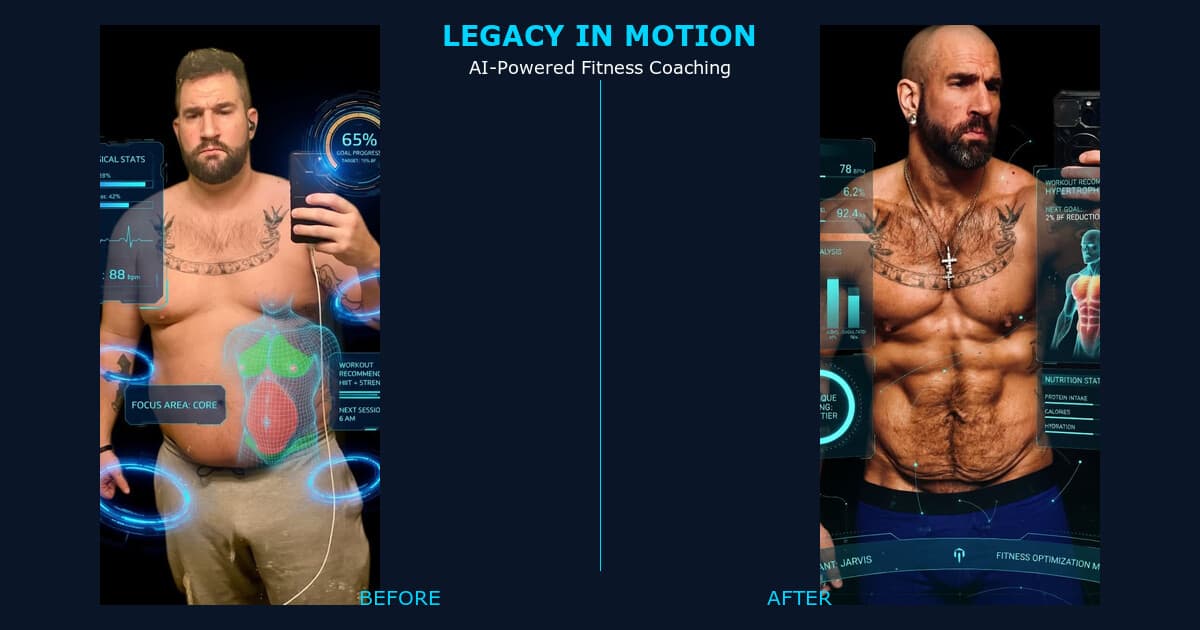
I went from 308 to 196 lbs working 80-hour weeks. Our AI coaching adapts to your schedule, recovery data, and real-time progress — so every workout actually counts.
Start Your Free 30-Day TrialNo enrollment fee. No commitment.
Free Assessment
What's Holding Your Fitness Back?
Take our 60-second quiz and get a personalized breakdown of what's stopping your progress — plus how AI coaching solves it.
Take the QuizKeep Reading
2026-04-25
Parental Cortisol Is the Hidden Driver of Childhood Obesity: Yale's 2026 RCT (N=114), the Sinha Mindfulness-Plus-Nutrition Protocol, and Why a Stressed Parent Over 40 Cannot Out-Lunchbox a Dysregulated Nervous System
Yale's March 2026 randomized trial under Rajita Sinha showed children of stressed parents in the control arm carried a six-fold increased risk of crossing into the overweight range at three months. Here is the mechanism, the daytime protocol, and why the lunchbox is downstream of the parent's stress physiology.
2026-04-24
The Twice-Weekly Lifting Dose That Rebuilds Your Hippocampus After 50
A 2026 controlled trial followed older adults with mild cognitive impairment for six months. Two resistance training sessions a week didn't just slow hippocampal atrophy. It protected the precuneus, improved white matter integrity, and outperformed both aerobic and cognitive training arms.
2026-04-23
Exercise Does Burn Those Calories: The 2025 PNAS Study That Overturned the 'Constrained Energy' Model
Join our free fitness community — get coaching tips, share wins, and stay accountable.
JOIN THE DISCORD →