


Protein Math: How Much You Actually Need
The RDA is a floor. Bro-science is a tax. Here's the protein math that actually builds muscle and protects it during a cut.
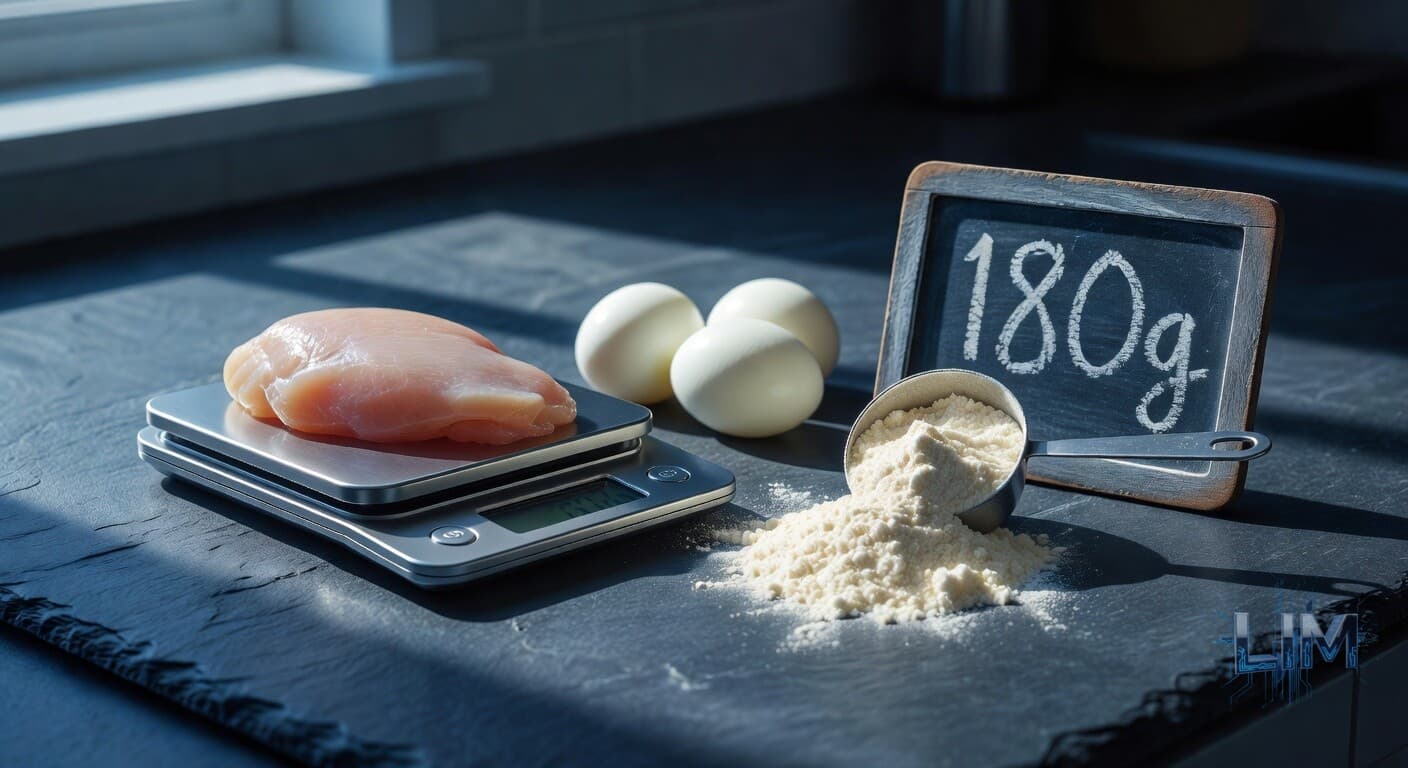
Diane is 55. MS for fifteen years, three orthopedic surgeries in the last decade, intermittent fasting not because the podcast told her to but because her gastroenterologist did. One meal a day, sometimes two, always inside a tight window.
Tuesday evening she sat at the kitchen table staring at MyFitnessPal. 152 grams of protein. Same as Monday. Same as the last six Tuesdays.
The scale had not moved in eleven weeks. The neurologist wanted her holding lean mass through the next infusion cycle. She was not lying to herself about the food. The app was lying for her.
TL;DR - The RDA prevents wasting. Building muscle needs 0.7 to 1.0 g/lb. Cutting fat needs 0.8 to 1.2 g/lb. - A British Journal of Sports Medicine meta-analysis pegged the muscle-building plateau near 0.73 g/lb of lean mass. - High-protein cuts at matched deficits drop more fat and less lean mass than low-protein cuts. - High-protein meals cut subsequent intake by hundreds of calories without conscious restriction. - Most people overestimate their protein by 20 to 30 percent. The number on the screen and the protein in your blood are not the same number.
Related Read
Night Shift Easter Reset No Crash DietsThe 4-step weekend reset for night shift workers — circadian-aware, no crash diets, built on what took me from 308 to 196 lbs.
The number on her screen was a fairy tale
Self-tracked protein has been quietly humiliating dieters for a decade. Most people overestimate their daily intake by twenty to thirty percent. Diane's "152" was probably 110. Maybe 105 on a bad day.
That gap is the entire reason the cut stalled. Not willpower. Not the MS. Not the meds. Math.
The fix is not a stricter app. It is a tighter feedback loop. The in-app meal log with barcode scan is the LIM answer to the "I do not have time to weigh chicken" problem. One tap. Real grams. No rounding errors that compound for eleven weeks.
The minimum is not the target
The government number was designed to prevent muscle wasting in your sedentary aunt. It is a floor. Treating it as a ceiling is how people end up "eating clean" and looking exactly the same in October as they did in March.
A British Journal of Sports Medicine meta-analysis walked the dose-response curve across forty-nine trials and found the muscle-building plateau near 0.73 g per pound of lean mass — roughly 0.82 g/lb bodyweight at typical body comp. Past that, more protein is more groceries, not more muscle.
The bands that actually work: - Building muscle: 0.7 to 1.0 g per pound of bodyweight - Cutting fat without losing muscle: 0.8 to 1.2 g/lb - Maintenance: 0.7 g/lb - Lean-mass math: 1.0 to 1.3 g per pound of LBM
This is the kind of target Chiron, our AI head coach, sets on day one based on your bodyweight, training schedule, and which of those three jobs you are actually trying to do this quarter.
Protein wins the fat-loss fight three ways
One. Thermal tax. Your body burns roughly a quarter of protein calories on digestion alone. Carbs cost a fraction of that. Fat costs less still. Every 100 calories of chicken nets you about 72. The deficit is built into the food.
Two. Satiety. An Appetite trial showed high-protein meals cut subsequent caloric intake meaningfully versus matched high-carb meals — with zero conscious restriction. The subjects did not try to eat less. They just could not keep eating.
Three. Muscle armor. An Obesity clinical trial put two groups in identical 500-calorie deficits for sixteen weeks. The low-protein and high-protein arms lost the same total weight on the scale. The high-protein arm lost a much higher percentage of fat mass and a much smaller percentage of lean mass.
Same number on the scale. Completely different person in the mirror. This is the trial every "calories-in, calories-out" simplifier needs taped to their fridge.
The OMAD problem nobody warned you about
Diane eats once a day, sometimes twice. The window is tight by necessity, not by trend. Muscle protein synthesis does not care about your fasting protocol. It cares about distribution.
The research says spread protein across three to five meals at 30 to 50 g per meal across your actual waking hours. One eight-meal-worth lump dinner does not synthesize the same way four spread doses do.
If your eating window is two hours, that means at least two thirty-gram boluses inside it, not one giant plate. If the gastroenterologist will let you stretch the window to four hours, the math gets easier. If the autoimmune protocol allows a small whey or collagen plus leucine outside the food window, ask. Protocol comes first.
The daily AI program update worker rewrites your meal targets and timing the moment HealthKit logs an off-night, an infusion week, or a meds change. You do not have to remember to recalculate. The system already did.
The thirty-gram rule that solves everything else
Muscle protein synthesis needs roughly two to three grams of leucine per meal to actually trigger. That works out to about thirty grams of high-quality protein per sitting. Below the threshold, you are eating protein. You are not building anything with it.
So the rule that matters more than your daily total: every meal hits thirty grams minimum. Whatever counts as a meal in your protocol — once a day, twice a day, four times a day.
If you are plant-based or your gut tolerates some sources better than others, leucine density is lower per gram, so push the daily band up and combine sources. Tofu, tempeh, seitan, lentils, edamame, black beans. Rice and beans, bread and peanut butter, corn and legumes — classic combos exist for a reason.
HERMES, our research engine, scrapes around twelve thousand fitness papers a week so the leucine threshold and the protein bands in your plan update the moment better numbers land in the literature. You do not have to follow nutrition Twitter. The system already does.
What the math looks like on a plate
160-pound woman, lean-mass-protection block, 1.0 g/lb = 160 g/day. Inside an OMAD-plus-one-snack window: - Main meal (90 g): 8 oz salmon (50 g) + 1 cup cottage cheese (28 g) + scoop of whey in the broth (15 g) - Snack window (35 g): Greek yogurt + a scoop of collagen + a hard-boiled egg - A pre-bed casein or quark if the window allows
That is the plan. Building it is not the hard part. The hard part is doing it on a Tuesday in week nine when the fatigue lands at 4 p.m. and the only thing on the plate looks like work.
The part nobody tracks
Diane's problem was not ignorance. She could quote the BJSM number. She had watched the 1.0 g/lb sermon on YouTube. She hit the floor every day, in her head.
Her phone lied for her. The portion sizes were eyeballed. The "8 oz" salmon was 5 oz post-cook. The "scoop" was a half-scoop because the lid never re-sealed right. Eleven weeks of thirty-gram shortfalls compounding into a body that refused to change.
The fix is not a stricter spreadsheet. It is a system that catches the gap before week eleven. Chiron flags the leucine miss at lunch on day three. The barcode scanner ends the eyeballing. The daily program review names the meal you are skipping before you call it a plateau.
You do not need more discipline. You need fewer leaks. Start the system that finds them.
---
The data behind this
- Morton RW et al. A systematic review, meta-analysis and meta-regression of the effect of protein supplementation on resistance training-induced gains in muscle mass and strength in healthy adults. British Journal of Sports Medicine, 2022 update. n=1,863 across 49 trials. Muscle-building plateau ~0.73 g/lb of lean mass.
- Appetite, 2024. High-protein vs isocaloric high-carb meal trial: ~441-calorie reduction in subsequent ad-libitum intake.
- Obesity, 2024. Identical 500-cal-deficit clinical trial, 16 weeks. High-protein (1.0 g/lb) vs low-protein (0.5 g/lb): 38% more fat loss, 34% less lean-mass loss in the high-protein arm at matched total weight loss.
---
Coaching that works the same shifts you do
This is what Chiron, our AI head coach, does on every meal and workout you log: catches the small wrong detail before it costs you years. HERMES — our research engine — surfaces new science the morning it publishes, so your coaching moves with the literature instead of trailing it by quarters. You log; we adapt your plan that day. No PDF reprints, no static plan that ages out the day your shift changes or you have a kid.
$29.99/month · $249.99/year · 7-day free trial · cancel anytime · no enrollment fee · no contract
Start coaching → · See the full app →
Jake Long built it after losing 112 lbs working hospital night shifts — when no human coach could keep up with his schedule. He wanted the system he wished he'd had at 308. Now you can use it too.
Questions Worth Asking
How much protein do I actually need to build muscle per pound?
The muscle-building plateau sits at 0.73g per pound of lean mass, per a 2022 British Journal of Sports Medicine meta-analysis of 49 studies (n=1,863). For practical bodyweight targets, aim 0.7 to 1.0g per pound when building, and 0.8 to 1.2g per pound when cutting fat.
Should I eat all my protein at once or spread it across meals?
Spread it across 3 to 5 meals at 30 to 50g per meal across your actual waking hours. Muscle protein synthesis responds to distribution, not total daily lump sums, so the night-shift worker eating one giant dinner gets less out of the same gram count than someone hitting four meals.
Why did my cut stall even though MyFitnessPal says I hit my protein?
Most people overestimate self-tracked protein by 20 to 30 percent, so a logged 152g is closer to 110g in reality. That gap, not willpower or metabolism, is why eleven weeks of identical logs produced zero scale movement. Barcode-scanned grams close the feedback loop.
Comments (0)
Comments are reserved for Legacy In Motion members.
$29.99/month. No contracts. Cancel anytime.
Get StartedAlready a member? Sign in
You read this far. Now do this.
Close the tab.
Go train the plan that fits your life.
I went from 308 to 196 lbs working 12-hour overnight shifts with two kids and zero personal trainer. The system I used is now an app that plans your training and meals around YOUR schedule — overnight, day shift, all of it.
Cancel anytime · No setup fee · No long contract
Free Assessment
What's Really Stopping Your Progress?
Take our 60-second quiz and get a personalized breakdown of what's stopping your progress — plus how AI coaching solves it.
Take the QuizFree PDF · No Credit Card
Your free Shift Worker AI Fitness Blueprint
A 4-week plan that respects what shift work does to sleep: when to go down after a night, the four-minute REHIT window, post-shift macros, and when to back off. In your inbox in 30 seconds.
Built by someone who actually worked them. No fluff. Unsubscribe any time.
Keep Reading
2026-04-11
Night Shift Easter Reset No Crash Diets
The 4-step weekend reset for night shift workers — circadian-aware, no crash diets, built on what took me from 308 to 196 lbs.
2026-04-05
Easter Doesn't Wreck Fat Loss. The Three Weeks After Do.
One Easter meal won't snap eight weeks of fat loss. The 21 days after will. Here's the science and the system that absorbs the hit.
2026-04-05
Retatrutide Muscle-Sparing Protocols
24% off the scale, lean mass intact. The retatrutide muscle-sparing playbook Jake ran, with numbers that hold up under a DEXA.
Join our free fitness community — get coaching tips, share wins, and stay accountable.
JOIN THE DISCORD →