


The 3-Minute Hourly Protocol
A Feb 2026 BMC trial proved 3-min hourly bodyweight breaks reverse the metabolic damage of sitting. Run it from a real desk.
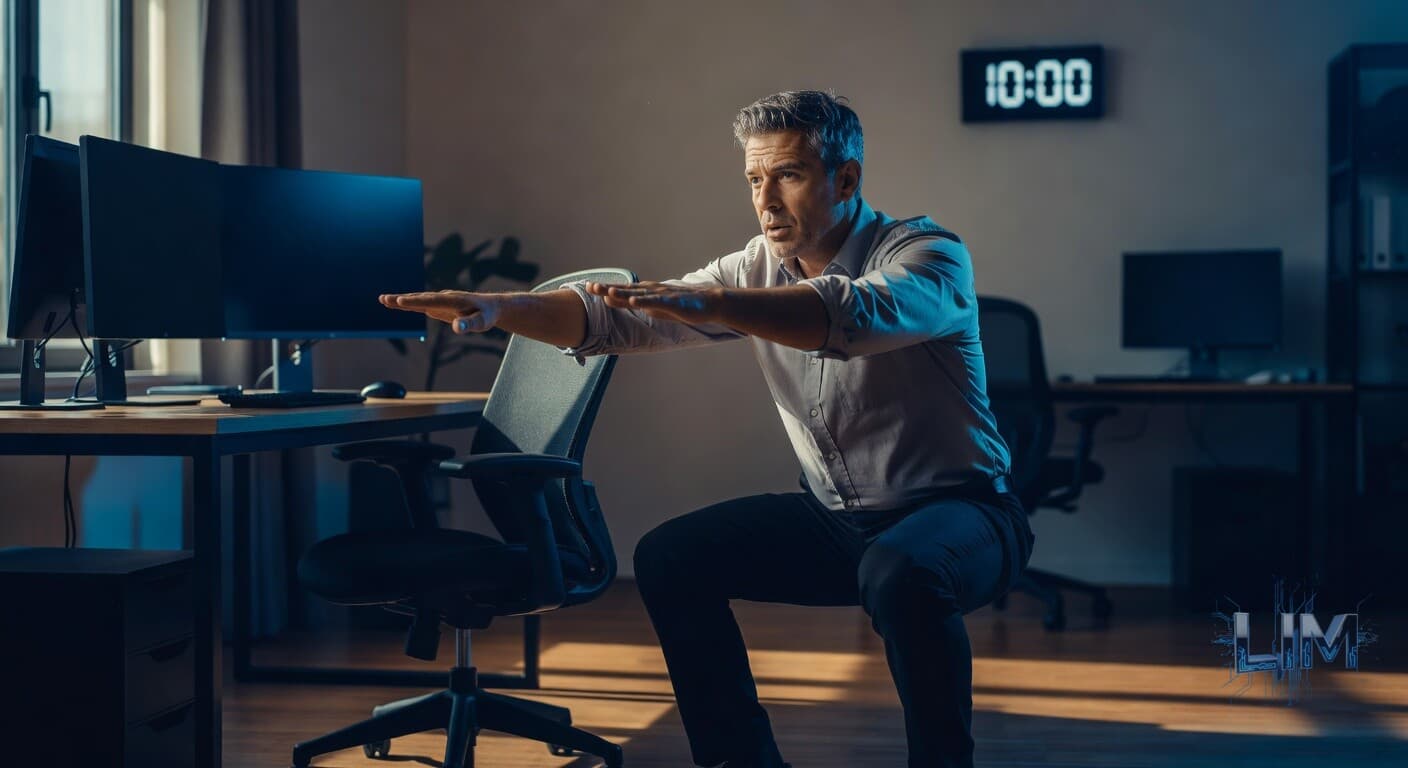
Marcus is 41. IT operations lead at a regional hospital. Two kids under ten, a Costco membership, and a chair that's slowly killing him.
By 2 PM Tuesday he hasn't stood since the 9 AM standup. His Apple Watch has buzzed three "stand reminders." He swiped them all away.
The fourth buzz hit at 2:47, ten minutes before his physical. The doctor said three words he'd been ducking for two years. Pre-diabetic. Borderline hypertensive. Hip mobility of a guy pushing sixty.
Marcus doesn't have a fitness problem. He has a chair problem. So do you.
Related Read
The 35-Minute Window — Why The Same Peloton Class Stopped Working In Year TwoYou do not need more time. You need less repetition inside the time you already have. The four-modality rotation for the busy parent who has been on the same Peloton class library since 2022.
TL;DR
- Sit more than 8 hrs/day without compensation: 59% higher all-cause mortality (Stamatakis et al., Lancet Public Health, 2024, n=1M+).
- Lipoprotein lipase activity collapses ~90% within hours of sustained sitting (Bey & Hamilton, J Physiology, 2003).
- A Feb 2026 BMC Public Health trial of 3-minute hourly bodyweight breaks improved fasting glucose, post-meal response, and energy.
- Jan 2026 BJSM meta-analysis (n=414, 11 RCTs): exercise snacks under 5 minutes hit 91% compliance (Jenkins et al., 2026).
- Total cost: 24 minutes out of 480. Five percent of your day.
Your Tuesday workout doesn't time-travel
You can't out-train forty hours of stillness with a Tuesday gym session. The math doesn't bend that way.
A 2024 Lancet Public Health pooled analysis of over a million adults tied 8+ daily sitting hours, without compensating activity, to a 59% higher all-cause mortality risk (Stamatakis et al., 2024). Read that qualifier twice. The chair isn't the killer. The chair plus stillness is.
Here's what's quietly going wrong while you're closing tickets:
- Glucose dysregulation. Contracting muscles pull blood sugar straight out of circulation through GLUT4 transporters. You stop contracting, your pancreas eats the bill (Dempsey et al., Diabetes Care, 2016).
- Lipoprotein lipase shutdown. The enzyme that clears triglycerides from your blood drops ~90% within hours of sustained sitting (Bey & Hamilton, J Physiology, 2003).
- Postural muscle atrophy. Your glutes go offline for hours. The forward-head, dormant-glute office silhouette is the receipt.
- Cortisol drift. Sedentary work elevates basal cortisol under deadline pressure (Wang et al., Psychoneuroendocrinology, 2020). Your chair is louder than you think.
A marathoner who sits nine hours straight still pays most of these costs. The problem is duration, not VO2 max.
Six moves. Three minutes. Once an hour. Done.
The February 2026 BMC Public Health trial — "Micro-exercise breaks every hour" — tested the most boring intervention on record. Three minutes of bodyweight movement, once an hour, across an eight-hour shift.
No standing desk. No treadmill. No gym clothes. The six moves were chosen for someone who can't change clothes or leave their workstation:
- Sit-to-stand reps — quads, glutes, posterior chain reactivation
- Calf raises — the soleus pump that walks venous blood back uphill
- Wall or desk push-ups — chest, triceps, serratus
- Bodyweight squats — the biggest GLUT4 recruiter you can do in 30 seconds
- Standing hip hinges — hamstrings, glutes, erector spinae wake-up
- Neck and thoracic mobility — undoes monitor-neck and T-spine flexion drift
Six moves, thirty seconds each. Floor space required: a meter.
The micro-break group beat the sit-as-usual control on fasting glucose, post-meal response, and self-reported energy. That tracks with the January 2026 BJSM meta-analysis of 11 randomized trials (n=414): exercise snacks under five minutes significantly improve cardiorespiratory fitness in inactive adults, with 91% compliance (Jenkins et al., BJSM, 2026).
That 91% is the whole game. Compliance is the variable that beats every other variable you can think of.
Why micro-breaks beat your 7 PM gym plan
Activity snacks attack the damage at the moment it's happening. Think flossing daily versus a cleaning every six months. The cleaning is great. It is not a substitute.
There's a second reason this protocol crushes traditional exercise for desk workers. Willpower is finite, and by 7 PM it's gone.
A 3-minute break at 10:17 AM, kicked off by a calendar buzz, doesn't fight your motivation. It fires before motivation enters the equation. The desk worker booking a 7 PM session is fighting their own biology and losing most weeks.
This is the kind of hourly micro-pattern Chiron — our AI head coach — schedules around your actual calendar instead of dropping a generic "stand up!" alert on your locked screen at lunch. It reads the gap between your 10 AM and 11 AM meetings and books your sit-to-stands there, not over your kid's pickup window.
24 minutes out of 480: the real-desk version
The trial ran a clean lab version. Here's the translation for a desk where Slack pings and a wandering boss are part of the operating environment.
Hour 1 — Sit-to-stands, 30 seconds, no hands This single move, performed hourly, is one of the strongest predictors of longevity in adults over 40 (de Brito et al., European Journal of Preventive Cardiology, 2012).
Hour 2 — Calf raises, 30 seconds Stand at your desk on a call. A Houston Methodist study found seated soleus contractions tripled oxidative metabolism and improved postprandial glucose handling (Hamilton et al., iScience, 2022).
Hour 3 — Wall or desk push-ups, 30 seconds Reverses three hours of rounded-shoulder posture in less time than your inbox refresh.
Hour 4 — The lunch reset Ten minutes of outdoor walking after lunch lowers post-meal glucose response more than almost any other intervention (Buffey et al., Sports Medicine, 2022). Skip the Slack scroll. Go outside.
Hour 5 — Bodyweight squats, 30 seconds Largest muscles in your body, contracting simultaneously. Highest-return move on the list.
Hour 6 — Standing hip hinges, 30 seconds Hands on thighs, hips back, feel the chain wake up. Six hours of hip-flexor shortening, undone.
Hour 7 — T-spine reset Clasp your hands behind your head, extend your upper back gently. Best 30 seconds you can spend on monitor-neck.
Hour 8 — Finisher Another squat round, or walk the long way to your car. Leave the building having moved, not molded.
Five percent of your time, buying back the other 95%.
Your excuses, in order of how often we hear them
"My office is open-plan, I'll look weird." You will, for a week. By week two, three coworkers join you. Workplace social-contagion in this stuff stopped being a hypothesis a decade ago.
"I have back-to-back meetings." Meetings are the easiest time to do calf raises and wall leans. Nobody on Zoom can see below your sternum.
"I'll forget." Yes, which is why you don't trust memory.
"I'm already tired." The BMC participants reported more energy and focus, not less. Improved glucose handling and cerebral blood flow do that.
This is where the LIM stack does the work most apps skip. When your Apple Watch logs sub-90-cadence walking all week, the daily AI program update worker rewrites your day before it touches the resistance calendar. HRV-driven auto-deloads catch you on a tanked recovery week and swap a planned hard session for mobility-focused breaks, so your streak survives without the recovery cost.
Protein-per-meal tracking runs in the background with leucine-threshold alerts, because the desk lunch is where muscle preservation quietly dies. HERMES, our research worker, scrapes thousands of fitness papers a week — that February 2026 BMC trial landed in our protocols the week it published, not next year.
You don't need a different life. You need a different hour.
Jake ran a version of this as a hospital security supervisor on graveyard shifts and dropped 112 pounds. He didn't quit the job. He didn't add a 5 AM gym block. He interrupted the chair, every hour, for eight hours, until the metabolic stagnation lost.
Marcus, the IT lead at the top of this piece, runs the same six moves now. His next A1c reads normal. Your move: start your 7-day free trial at https://legacyinmotion.fit and let Chiron schedule your first hour.
---
Your plan should change the day your week does
Most programs die in the gap between the plan and your real week. Chiron, our AI head coach, reads what you log (meals, workouts, skipped sessions) and rewrites tomorrow instead of waiting for you to fall off. HERMES, our research engine, keeps the coaching current with new science the week it publishes.
$29.99/month · $249.99/year · 7-day free trial · cancel anytime · no enrollment fee · no contract
Start coaching → · See the full app →
Jake Long built it after losing 112 lbs working hospital night shifts — when no human coach could keep up with his schedule. He wanted the system he wished he'd had at 308. Now you can use it too.
Comments (0)
Comments are reserved for Legacy In Motion members.
$29.99/month. No contracts. Cancel anytime.
Get StartedAlready a member? Sign in
You read this far. Now do this.
Stop reading about it.
Start training around your real life.
I went from 308 to 196 lbs working 12-hour overnight shifts with two kids and zero personal trainer. The system I used is now an app that plans your training and meals around YOUR schedule — overnight, day shift, all of it.
Cancel anytime · No setup fee · No long contract
Free Assessment
What's Really Stopping Your Progress?
Take our 60-second quiz and get a personalized breakdown of what's stopping your progress — plus how AI coaching solves it.
Take the QuizFree PDF · No Credit Card
Your free Shift Worker AI Fitness Blueprint
A 4-week plan that respects what shift work does to sleep: when to go down after a night, the four-minute REHIT window, post-shift macros, and when to back off. In your inbox in 30 seconds.
Built by someone who actually worked them. No fluff. Unsubscribe any time.
Keep Reading
2026-05-02
The 35-Minute Window — Why The Same Peloton Class Stopped Working In Year Two
You do not need more time. You need less repetition inside the time you already have. The four-modality rotation for the busy parent who has been on the same Peloton class library since 2022.
2026-10-16
The Late Snack Did Not Diagnose Your Liver
Wilechansky 2026, Clinical Gastroenterology and Hepatology: late-night eating tracked with liver disease. One fridge trip is not cirrhosis.
2026-10-13
Breakfast Did Not Buy the Stress Skill
Five breakfasts a week lined up with a stress skill in 19-year-olds. Lining up is not buying it.
Join our free fitness community — get coaching tips, share wins, and stay accountable.
JOIN THE DISCORD →