2026-04-23
8 min readBy Jake LongExercise Does Burn Those Calories: The 2025 PNAS Study That Overturned the 'Constrained Energy' Model
## The message that broke a generation of tired parents
A mother of three, 38 years old, working a hybrid schedule, reading fitness content on her phone during her kid's soccer practice. She has seen the same headline a hundred times. You cannot outrun a bad diet. The body adapts. Exercise barely moves the scale. She has read the New York Times piece on the Hadza hunter-gatherers. She has watched the TED talk where a well-dressed anthropologist explains that her 45-minute treadmill session is basically pointless because her resting metabolism will quietly drop to cancel it out.
She stops exercising. She blames her metabolism. She gains seven pounds in a year.
That story is playing out right now in millions of households, and the science it was built on just got challenged by one of the most rigorous measurements ever taken. Howard and colleagues, writing in Proceedings of the National Academy of Sciences in October 2025 (volume 122, number 43, article e2519626122), enrolled 75 adults across a full spectrum of physical activity, from near-sedentary to ultra-endurance runners logging 128.7 km per week. Every participant drank doubly-labeled water, the tracer method that Pontzer himself has used and the reference standard for measuring total energy expenditure in free-living humans. Over fourteen days, the researchers measured how much carbon dioxide each person produced and, from that, how many calories they actually burned.
Related Read
The Tuesday-Slump Pattern: Why Day 3 Kills More Fitness Programs Than Day 30Most new programs don't die at the 30-day mark — they die on day 3. Here's what habit research actually shows about the Tuesday drop-off cliff, and the 15-minute reset that saves the week.
The result flipped the narrative. More physical activity produced proportionally more total energy expenditure. The body did not reduce basal metabolic rate to compensate. Essential functions (breathing, circulation, thermoregulation, organ maintenance) held steady as activity rose. Every mile walked, every rep lifted, every set of stairs climbed added to the total.
What the constrained model actually said
To understand why this matters, you have to understand what the constrained model claimed. Pontzer, writing in Current Biology in 2016, compared energy expenditure in Hadza hunter-gatherers (who walked 8 to 12 km per day) against sedentary Westerners and found total daily energy expenditure was remarkably similar between the groups once body size was accounted for. He proposed that the body actively constrains total energy output, reallocating calories away from other processes (immune function, reproduction, non-exercise activity thermogenesis) when physical activity rises.
Careau and colleagues, in a 2021 Current Biology paper pooling data from more than 1,700 adults across dozens of studies, reported a partial compensation pattern. In their analysis, only about 72 percent of the calories burned during exercise showed up as additional total energy expenditure. The other 28 percent appeared to vanish somewhere, which the authors attributed to metabolic adaptation or reduced spontaneous movement during non-exercise hours.
Those two papers, quoted in every major media outlet from National Geographic to Vox to The Atlantic, hardened into common wisdom. If you tell a sleep-deprived parent that the body has a hard-capped energy budget and exercise mostly cannibalizes other metabolic processes, you have handed her a reason to stop trying. The headlines were catnip for a culture that wanted a neat biological excuse for why the scale was not moving.
Why the 2025 PNAS paper breaks the pattern
Howard and colleagues used the same tracer method as Pontzer and Careau, but the design corrected several blind spots. First, the activity range was both wider and better characterized, from 0 km per week to 128.7 km per week of walking or running, with objective verification of activity levels. Second, the authors explicitly controlled for fueling status. Participants were weight stable and eating to support their training. Third, statistical analysis separated the relationship between physical activity energy and basal metabolic rate, allowing the researchers to ask whether the body was truly suppressing resting expenditure or whether the apparent compensation was an artifact of under-fueling in earlier datasets.
The finding was clean. Across a fivefold range of activity, total energy expenditure tracked directly with physical activity. Basal metabolic rate did not fall. The body did not pull calories from other systems. The authors explicitly noted that the compensation reported in prior work likely reflects under-fueling in high-activity populations, not an intrinsic biological cap.
This matters because under-fueling looks like compensation from the outside. A lean ultramarathoner who is chronically under-eating will show reduced thyroid output, lower resting energy expenditure, and blunted reproductive hormones. That pattern got labeled "constraint" in the older literature. What Howard et al. demonstrated is that when people eat enough to cover their activity, no constraint appears. The 28 percent gap Careau found is not the body protecting itself. It is a nutrition problem.
What this means for the parent at soccer practice
If you are a 38-year-old mother hearing all of this for the first time, here is the practical translation. Your 30-minute walk at lunch is not being silently zeroed out by your body. Your three-days-a-week strength session is not being offset by your liver and kidneys quietly cutting their own budgets. The calories burned during movement are, with strong evidence now, additive to your daily total.
What is true, and what the older model conflated with constraint, is that most people adjust eating in response to activity without realizing it. The salad gets bigger. The Saturday breakfast out becomes two pastries instead of one. The kids' leftover pizza looks better at 10 p.m. after a hard week. The issue was never the body "canceling" exercise. The issue was that exercise changes appetite signals in subtle ways that are easy to overshoot.
Willis and colleagues showed this precisely in the Midwest Exercise Trial (Obesity 2014, 150 adults, 10 months). Participants who exercised without dietary guidance still lost around 5 percent of body weight, not because the body compensated but because appetite partially matched expenditure. Participants who exercised with a simple eating-awareness protocol lost substantially more. The exercise was never the problem. The mouth was.
That is a fixable problem. A constrained metabolism is not.
The desk worker corollary
The same misreading of the Pontzer model has haunted desk workers. The cubicle employee who takes a 20-minute walking break after lunch has been told the same story: your sedentary body will just dial down your NEAT (non-exercise activity thermogenesis) later in the afternoon and erase the gain. Howard et al. show that is not what happens at moderate activity volumes in adequately fueled adults. The 20-minute walk counts. The 10-minute stair session at 3 p.m. counts. The bodyweight circuit before dinner counts. Those calories do not vanish into a metabolic accounting trick.
The constrained model was always weakest in the middle of the activity spectrum, where most working adults actually live. It was built on hunter-gatherer data and elite endurance athlete data. Neither of those populations resembles a parent with a desk job who wants to reclaim their body composition on three 45-minute sessions a week. The new data fits that middle of the spectrum far better, and it is telling a much more hopeful story.
How Legacy In Motion's AI coaching applies this
The implications for programming are specific. The first is that our AI does not discount moderate activity. A client logging 8,000 steps of walking per day gets those calories credited in the energy balance model, full stop, not with a 28 percent haircut borrowed from a misread of the Pontzer data. The system bases its calorie targets on actual measured activity (from the connected wearable), multiplied by the current best-estimate of activity energy cost, with no phantom compensation factor built in. A client who walks more or lifts more gets a proportionally larger maintenance estimate. That is how the energy math actually works when fueling is adequate.
The second implication runs in the other direction. Because the 2025 PNAS paper explicitly names under-fueling as the likely source of apparent compensation in prior studies, the system watches for the signature. When a client's activity rises sharply but body weight drops faster than the deficit predicts, the AI flags the pattern as a probable under-fueling event, not a "metabolic mystery." Intake gets raised, rate of loss gets dampened back into the safe 0.5 to 1 percent of body weight per week range, and the system monitors HRV and resting heart rate for the early markers of adaptive suppression. This is the same mechanism that separates a controlled fat loss phase from the kind of pattern that breaks a metabolism for years.
The third implication is narrative. Clients who come to us having read five years of "exercise doesn't burn calories" content arrive with a trained helplessness about training. The AI's first conversation surfaces the new evidence in plain language, matched to where they are: the parent who stopped working out because she thought it was pointless, the hybrid worker who assumes his lunch walks are worthless, the shift worker who has been told his body cannot respond to exercise. The system re-anchors their expectations to what the 2025 data actually shows, which is that the work is going to pay back in direct proportion to the effort, and that the scale will move if the fueling keeps pace.
The shorter version
The 2016 constrained energy paper was a legitimate observation in a specific population, elevated into a general rule it could not support. The 2021 meta-analysis showed partial compensation, but did not distinguish biological adaptation from nutritional under-fueling. The 2025 PNAS paper, with rigorous controls on both, found no constraint and no compensation. Exercise calories are real. They add to your daily total. They always did.
If you have spent the last few years believing your workouts do not count, that belief was built on an incomplete reading of an incomplete dataset. The science has moved. The message in your phone feed has not caught up yet.
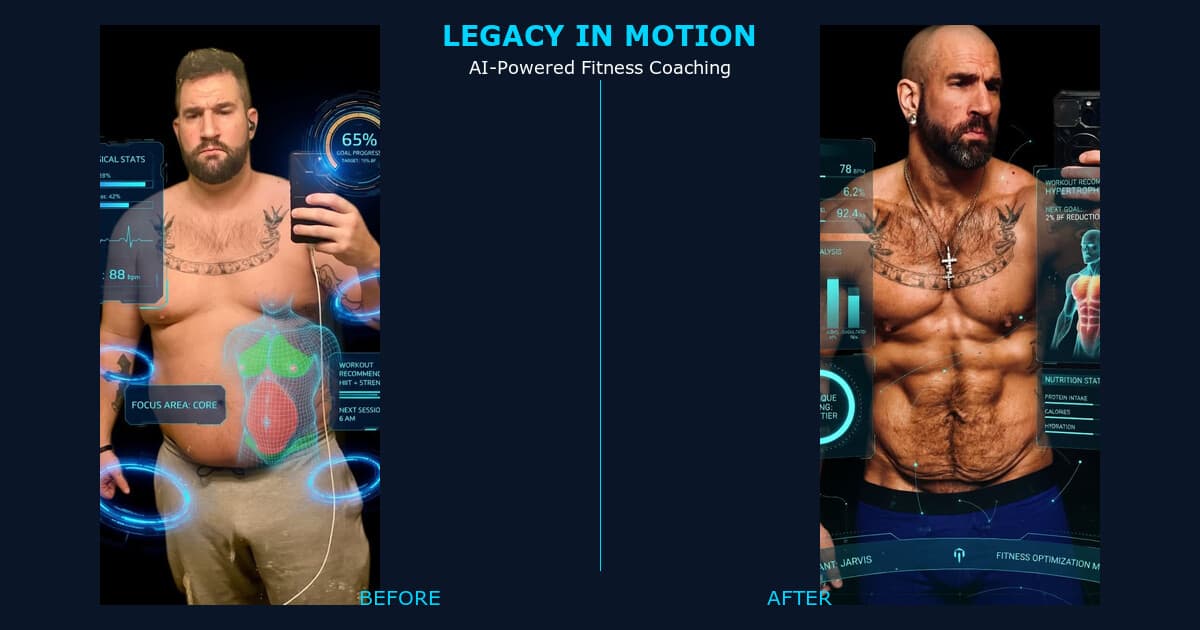
We built an AI coach that catches up for you, reads the new research as it drops, and programs your weeks around what the evidence actually supports, not what the 2019 TED talk said. Jake Long, who built this, lost 112 pounds working hospital security on 12-hour night shifts between ages 38 and 40, burning calories the old model said he should not have been able to burn. If any of this sounds like where you have been stuck, start the free 30-day trial at https://legacyinmotion.fit. The first 100 trial signups are free. After that, the free trial is gone. Our Discord is at https://discord.gg/8QBuFFA5Pf if you want to see how other clients are using the system.
☤
Comments (0)
Comments are reserved for Legacy In Motion members.
Free 30-day trial — first 100 customers only.
This won’t last.
Start Your Free TrialAlready a member? Sign in
Ready to Build a Plan That Fits Your Schedule?
I went from 308 to 196 lbs working 80-hour weeks. Our AI coaching adapts to your schedule, recovery data, and real-time progress — so every workout actually counts.
Start Your Free 30-Day TrialNo enrollment fee. No commitment.
Free Assessment
What's Holding Your Fitness Back?
Take our 60-second quiz and get a personalized breakdown of what's stopping your progress — plus how AI coaching solves it.
Take the QuizKeep Reading
2026-04-21
The Tuesday-Slump Pattern: Why Day 3 Kills More Fitness Programs Than Day 30
Most new programs don't die at the 30-day mark — they die on day 3. Here's what habit research actually shows about the Tuesday drop-off cliff, and the 15-minute reset that saves the week.
2026-04-15
Exercise Snacks: The Science Behind Micro Workouts That Actually Work for Busy Parents
A 2026 BJSM meta-analysis of 11 RCTs shows exercise snacks under 5 minutes improve cardiorespiratory fitness with 91% compliance. Here's why busy parents should pay attention.
2026-03-28
Why Your Metabolism Isn't Broken — It's Misunderstood
The latest research on metabolic adaptation and what it means for fat loss in 2026. Stop blaming your metabolism and start understanding it.
Join our free fitness community — get coaching tips, share wins, and stay accountable.
JOIN THE DISCORD →