


Before Menopause Hits
Perimenopause starts in your mid-30s. The decade before menopause sets the next thirty years of your body. Here's the protocol that matches the biology.
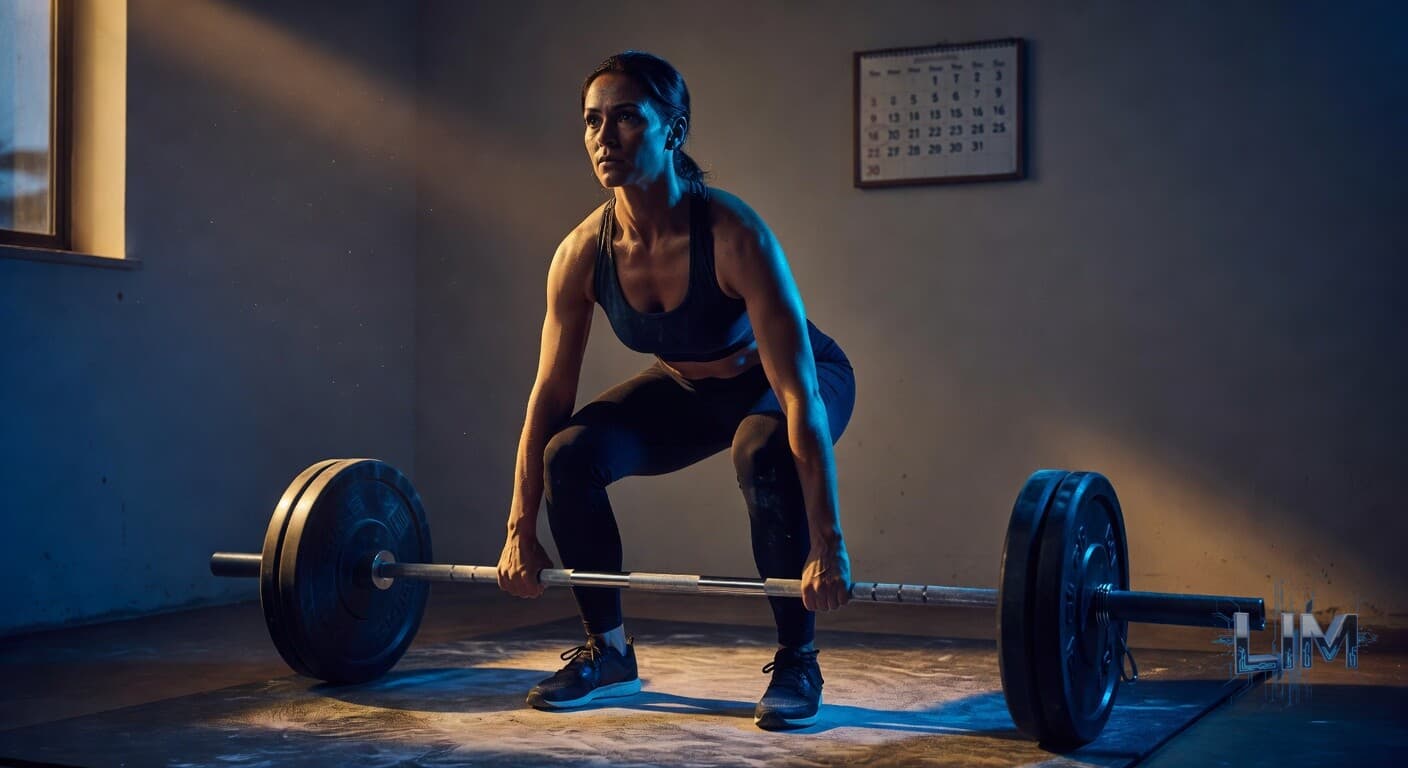
Beth is 42. Sales director, three kids in three different schools, husband travels Monday through Thursday.
Her period showed up nine days early in February. She blamed the deadline.
In April she woke at 3 a.m. in a sheet she had to peel off her skin. She blamed the room.
Last week she carried laundry up two flights and her quads burned the way they did after spin class in her twenties. She blamed her shoes.
Related Read
MRT for Busy Parents Over 40: Strength + Burn in 25 MinutesMetabolic resistance training (MRT) is the 2026 busy-parent default: compound strength circuits with short rest that build muscle and raise the metabolic cost of a short session. How over-40 adults and desk workers run it without wrecking recovery.
Nobody at her annual physical said the word.
TL;DR
- Perimenopause runs 5 to 10 years before your final period, usually starts mid-to-late 30s, and ends on average at 51.
- Women lose ~10% of total bone mass in the 5 years after their final period, but bone turnover markers start climbing a decade earlier.
- Two to three heavy lifting sessions per week, 30 to 45 minutes each, beat every non-hormonal intervention NAMS reviewed in 2024.
- Protein distributed across 3 to 4 meals at 30 to 40 grams each (≈2.5 to 3 grams of leucine) is what muscle actually responds to. Daily totals do not.
- The training you bank before 50 sets the floor for the next thirty years. Earlier is cheaper.
What estrogen actually does between 35 and 50
The Stanford Lifestyle Medicine program describes perimenopause as the phase when ovarian estrogen output goes erratic, not absent. The cycle still runs. It just stops running on time.
Tissues that evolved to expect a predictable monthly hormonal rhythm stop getting one. That erratic signaling is the problem, not the absence at the end.
Skeletal muscle feels it first. Estrogen modulates satellite cell activity, the stem-cell pool that repairs and builds muscle fibers after every training session.
Ovariectomized animal models consistently show estrogen withdrawal cuts satellite cell regenerative capacity. Human muscle biopsy work across the menopause transition tracks the same line: less circulating estrogen, fewer active satellite cells available for repair.
The practical read. Between 35 and 50, the repair signal after every workout is getting quieter. The session that gave Beth a clean response at 32 is, at 42, doing less work for the same effort.
Bone moves on the same curve. The canonical figure (~10% of total bone mass lost in the 5 years after the final menstrual period) hides the fact that bone turnover markers start climbing in perimenopause, not after it.
A DEXA scan at 52 catches the damage. A DEXA scan at 40 could have prevented half of it.
Joints follow the same pattern. Estrogen receptors in cartilage, synovial tissue, and tendon lose their regulatory signal during the transition.
The "sudden" knee pain that shows up at 47 is rarely sudden. It is the cumulative output of a decade of uneven signaling nobody named.
Why heavy lifting is the intervention with the most signal
The systematic review by Gonzalo-Encabo and colleagues (Maturitas, 2023) pooled the controlled trials on strength training across the menopause transition. Consistent improvements in lean mass, strength, bone mineral density at hip and spine, and in several trials, drops in vasomotor and psychological symptoms.
The effect sizes were larger when training ran 2 to 3 times per week, at intensities that demanded real effort near the last reps, for at least four months.
The North American Menopause Society's 2024 position statement on non-hormonal management lined up the same way. Resistance training is one of a small set of non-hormonal interventions with a meaningful evidence base for preserving musculoskeletal health across the transition.
NAMS specified the benefit is not confined to postmenopausal women. It begins when training begins.
The recent literature on middle-aged women has converged on a protocol-shaped consensus. Heavy compound lifts, 2 to 3 sessions per week, progressive overload tracked across months, protein structured per meal not per day.
The body at 42 responds to that input. The body at 62 also responds. The body at 62 just has less runway to compound the gains.
The window is narrowing while you read this
A woman who starts progressive heavy resistance training at 40 and trains for twelve years enters her postmenopausal decade with more lean mass, more bone density, and more tendon resilience than the version of herself who started at 52.
Every year banked before the steepest estrogen drop is a year of insurance against the years after.
The LIFTMOR trial out of Griffith University showed that even women already at osteopenia or osteoporosis could add bone density back with heavy resistance training. That is the corrective evidence.
The preventive evidence is narrower in absolute numbers, but it tilts the same way. Earlier is cheaper.
A perimenopausal woman does not need to reverse damage that has not happened yet. She needs to lay down the muscle, bone, and movement patterns that will still be there at 75.
This is the window. The pitch is not "lift to undo menopause." The pitch is lift because the next ten years are the steepest part of the curve you will ever face, and the work you do now sets the starting point for every year after.
What the protocol looks like when somebody actually runs it
The studies that move bone density, lean mass, and pain scores share the same shape. Two to three training days per week, 30 to 45 minutes each.
Heavy compound lifts — squat, deadlift, overhead press, row — in low-to-moderate rep ranges that demand concentration. Progressive loading tracked over months, not workouts.
Protein distributed across 3 to 4 meals, each hitting the leucine threshold (roughly 2.5 to 3 grams of leucine per meal, which maps to 30 to 40 grams of a high-quality protein source). Sleep and recovery protected as part of the training stimulus, not ignored.
None of those variables are new. The gap for most women in perimenopause is not knowledge.
The gap is an adaptive program that keeps up with a changing body, a changing schedule, and a changing recovery profile through a hormonal transition that does not run on a linear timeline. That is what the research is actually asking for, and it is the part nobody ships.
That is what Legacy In Motion was built to hold. Chiron, our AI head coach, runs the daily program review, so the squat target on Thursday already accounts for what you moved Tuesday and what your Apple Watch logged about last night's sleep.
When HRV reads poor recovery, the daily AI program update worker rewrites the session before you open the app. Target weight drops, rep quality moves to the foreground, volume gets pulled back. That is not a generic deload week. That is the morning your body is asking for, met that morning.
The in-app meal log plus barcode scan handles the leucine threshold without a spreadsheet. It watches per-meal protein, not the daily total, because muscle protein synthesis cares about distribution.
The voice-note check-in catches the cortisol tell in your voice on the weeks life is winning, before the scale moves. HERMES, the research engine, scrapes 12,000 fitness papers a week, so the moment a stronger perimenopause protocol lands in the literature, your program updates without you reading the abstract.
The schedule-adaptive training windows are the part that makes the biology workable for a woman juggling kids, a job, and a cycle that has gone off-pattern. Two to three sessions per week, dropped where your real week actually has room for them, at an intensity the system calibrates against your own trendline.
The last thing worth saying out loud
The narrative that menopause is what breaks women's bodies is backwards. Menopause finishes a process that starts in the mid-30s.
The women who walk through the transition strongest are not the ones with the best hormone therapy. They are the ones who spent the preceding decade lifting something heavy on a schedule.
That decade is right now for every woman between 35 and 50 reading this. If the window in this post is your window, this is exactly who we built it for: legacyinmotion.fit
---
The data behind this
- Stanford Lifestyle Medicine program — perimenopause framing and clinical course.
- Gonzalo-Encabo et al., Maturitas, 2023 — systematic review of strength training across the menopause transition.
- North American Menopause Society, 2024 position statement on non-hormonal management.
- LIFTMOR trial (Griffith University) — heavy resistance training in postmenopausal women with low bone mass.
- Ovariectomized animal model literature and human muscle biopsy work on estrogen and satellite cell activity.
---
Log tonight's shift. Wake up to an adjusted plan.
Most programs die in the gap between the plan and your real week. Chiron, our AI head coach, reads what you log (meals, workouts, skipped sessions) and rewrites tomorrow instead of waiting for you to fall off. HERMES, our research engine, keeps the coaching current with new science the week it publishes.
$29.99/month · $249.99/year · 7-day free trial · cancel anytime · no enrollment fee · no contract
Start coaching → · See the full app →
Jake Long built it after losing 112 lbs working hospital night shifts — when no human coach could keep up with his schedule. He wanted the system he wished he'd had at 308. Now you can use it too.
The Questions Readers Ask Most
When does perimenopause actually start and how long does it last?
Perimenopause runs 5 to 10 years before your final period, usually starts mid-to-late 30s, and ends on average at 51. The Stanford Lifestyle Medicine program describes it as the phase when ovarian estrogen output goes erratic, not absent — the cycle still runs, it just stops running on time.
How much heavy lifting do women in their 40s need to protect bone and muscle?
Two to three heavy lifting sessions per week, 30 to 45 minutes each, beat every non-hormonal intervention NAMS reviewed in 2024. The Gonzalo-Encabo review in Maturitas (2023) found effect sizes were largest when training ran 2 to 3 times per week at intensities demanding real effort near the last reps, for at least four months.
Why does protein timing matter more than daily total in perimenopause?
Muscle responds to protein distributed across 3 to 4 meals at 30 to 40 grams each, roughly 2.5 to 3 grams of leucine per meal. Daily totals do not drive the same response, because estrogen withdrawal is quieting satellite cell activity and the per-meal leucine threshold is what triggers repair.
Comments (0)
Comments are reserved for Legacy In Motion members.
$29.99/month. No contracts. Cancel anytime.
Get StartedAlready a member? Sign in
You read this far. Now do this.
Stop reading about it.
Start training around your real life.
I went from 308 to 196 lbs working 12-hour overnight shifts with two kids and zero personal trainer. The system I used is now an app that plans your training and meals around YOUR schedule — overnight, day shift, all of it.
Cancel anytime · No setup fee · No long contract
Free Assessment
Where's Your Training Stuck?
Take our 60-second quiz and get a personalized breakdown of what's stopping your progress — plus how AI coaching solves it.
Take the QuizFree PDF · No Credit Card
Download the Shift Worker AI Fitness Blueprint
The protocol Jake wishes he'd had at 308 lbs: sleep timing for rotating shifts, post-shift macros, and the AI deload trigger, from the run that took him to 196. Free, no card needed.
Built by someone who actually worked them. No fluff. Unsubscribe any time.
Keep Reading
2026-07-13
MRT for Busy Parents Over 40: Strength + Burn in 25 Minutes
Metabolic resistance training (MRT) is the 2026 busy-parent default: compound strength circuits with short rest that build muscle and raise the metabolic cost of a short session. How over-40 adults and desk workers run it without wrecking recovery.
2026-07-12
Hybrid Training After 40: Strength + Zone 2 Without Killing Either
Hybrid training is the 2026 default for capable humans — not just HYROX athletes. Here is how busy parents, desk workers, and over-40 transformations run strength and endurance in the same week without the interference effect eating the progress.
2026-05-14
The Six-Second Chair Test — The Buffalo Data That Beats The Step Count Renee Has Been Failing Since November
5,000 women, 8 years, JAMA 2026: grip strength and a chair-stand test predicted mortality better than aerobic minutes. The kitchen has the equipment.
Join our free fitness community — get coaching tips, share wins, and stay accountable.
JOIN THE DISCORD →