


Three Doctors, Three Probablys, One Body — The Syndrome Nobody Was Treating
Joint pain, muscle loss, bone loss in the menopause window aren't three problems. They're one syndrome. Heavy lifting twice a week is the reversal the office visit didn't mention.
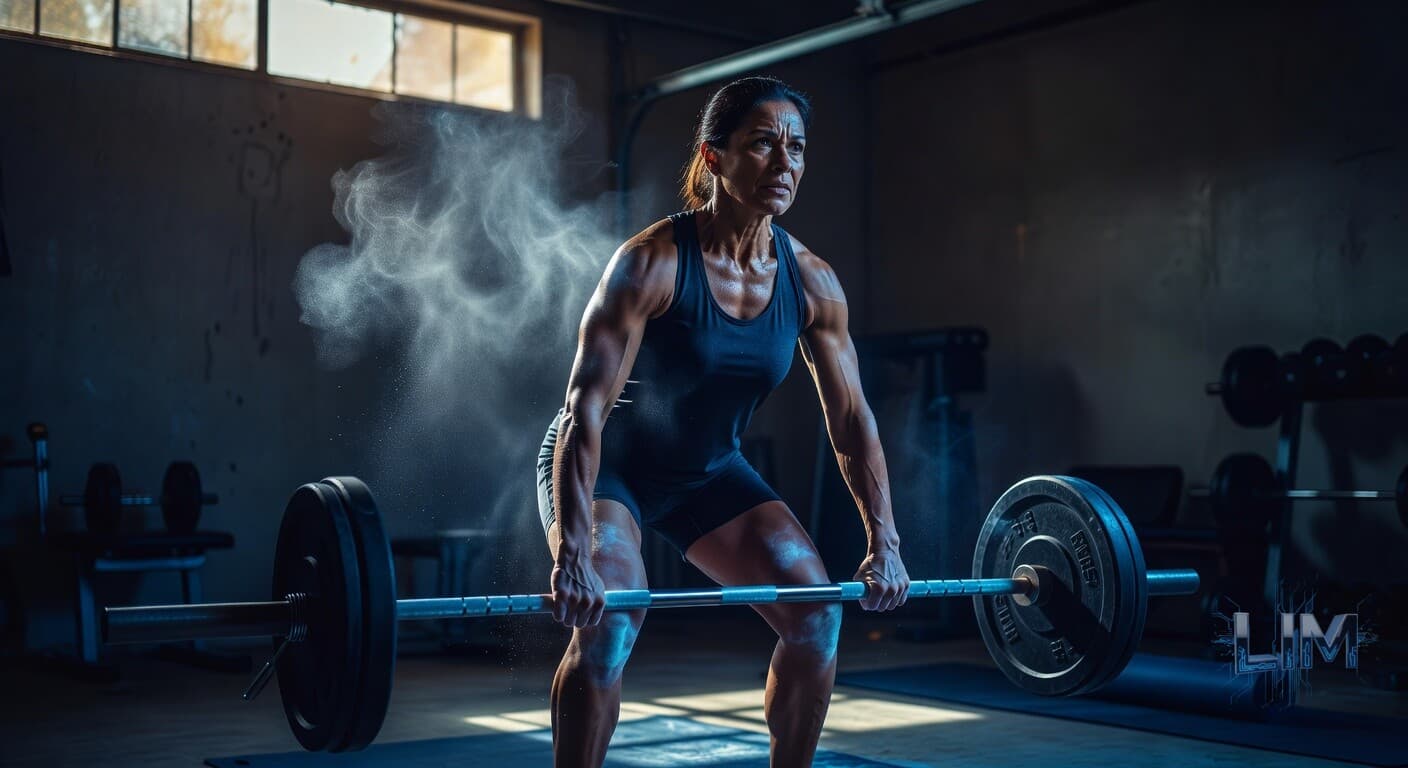
Diane is 55. She just walked out of her third specialist appointment in eighteen months holding a new prescription, a referral to a rheumatologist, and a DEXA report her primary care told her not to panic about.
The rheumatologist said the joint pain was probably just age. The PCP said the bone-density letter was probably just menopause. The orthopedist said the catch in her right hip was probably just wear and tear.
Three doctors. Three probablys. One body.
Diane is starting to suspect they are all the same problem, and nobody is treating it.
Related Read
The Six-Second Chair Test — The Buffalo Data That Beats The Step Count Diane Has Been Failing Since NovemberBuffalo's 5,000-woman JAMA study found two physical-function tests that predicted death better than aerobic minutes. The kitchen-chair protocol earns the number. The shame in the drawer is optional.
She is right.
What estrogen was quietly doing for forty years
Estrogen receptors live in cartilage, synovial tissue, ligaments, tendons, muscle fibers, and bone. Every one of those tissues relied on a hormone Diane's body has produced since she was twelve. Then, somewhere between forty-seven and fifty-two, the supply runs out.
In cartilage, estrogen helps maintain chondrocyte function and joint hydration. Pull it, and cartilage thins. Postmenopausal osteoarthritis climbs sharply in the knees, hips, and hands for exactly this reason — including the catch in Diane's right hip that three specialists called wear and tear.
In skeletal muscle, estrogen amplifies the protein-synthesis response to a meal. Pull it, and anabolic resistance stacks on top of the age-related anabolic resistance she was already developing in her late forties.
In bone, estrogen restrains osteoclast activity. Pull it, and resorption outruns formation. The standard estimate is roughly ten percent of total bone mass lost in the first five years after the final period.
Stack three losses on the same woman in the same five-year window and you have the syndrome. An orthopedic sports surgeon named it in 2024 — the musculoskeletal syndrome of menopause. Arthralgia, sarcopenia, accelerated bone loss, and progression of osteoarthritis. One hormonal event. Three tissues.
That is not aging. That is a syndrome with a name.
The most replicated reversal protocol for it is not a pill.
The cleanest trial in the literature
The Lifting Intervention For Training Muscle and Osteoporosis Rehabilitation trial — LIFTMOR — out of Griffith University was designed to answer one question. Can heavy lifting safely improve bone density in postmenopausal women who already have osteopenia or osteoporosis?
The answer was yes. The numbers were not subtle.
A hundred and one postmenopausal women with low-to-very-low bone mass were randomized to either a low-intensity home program or a supervised high-intensity resistance and impact training protocol. The intervention group trained twice a week, thirty minutes per session, for eight months.
The work was heavy. Five sets of five reps at greater than 85% of one-rep max on the deadlift, the overhead press, and the back squat. Jumping chin-ups for impact loading.
Eight months later, the lifting group's lumbar spine bone-density gain ran about four percent relative to controls. Back-extensor strength, leg press, vertical jump, timed-up-and-go — all in the right direction. Adherence above ninety percent. New or worsening vertebral fractures across the intervention: zero.
Two thirty-minute sessions a week. Heavy weight. Eight months. Bone density the medical system told these women was permanently lost, coming back.
Why most "menopause workouts" miss the lever
Walk into a midlife-women's fitness program and the prescription is some combination of yoga, light dumbbells, walking, and Pilates. None of those modalities are bad. None of them load the skeleton hard enough to drive the response LIFTMOR documented.
Bone responds to strain magnitude. The osteogenic threshold sits in the range of heavy compound lifts at 80–85% of one-rep max and above, plus impact. Sub-threshold stimulus produces sub-threshold adaptation.
Sixty minutes of walking does excellent things for cardiovascular health and mood. It does not move bone density the way two well-loaded barbell sessions do. The two are not interchangeable.
Same logic for muscle. The sarcopenia-resistance-training literature has converged on three weekly sessions as the optimal frequency. Two is statistically meaningful. Five is not better than three. The dose-response curve is real and the lower end is closer to "enough" than the fitness industry suggests.
The load just has to be heavy enough to actually count.
The protocol that addresses the syndrome
Frequency. Two to three strength sessions per week, with at least one full recovery day between heavy lower-body work.
Lifts. Compound, multi-joint, free weight or machine. Squat or leg press. Deadlift or hip hinge. Overhead press, row, loaded carry. Skip the curl-and-kickback isolation circuit — it does not load the spine or hip enough to trigger remodeling.
Intensity. Work toward sets of four to six reps at roughly 80–85% of one-rep max. The first eight to twelve weeks is a ramp. You do not start a previously untrained fifty-five-year-old at 85% on day one.
Impact. Add brief, controlled jumping, hopping, or low-box step-downs once tolerated. Bone responds to impact in a way it does not respond to smooth lifting alone.
Protein. Around 1.2 to 1.6 grams per kilogram per day, layered as roughly 0.4 grams per kilogram per meal to clear the per-meal anabolic resistance threshold. Spread across three to four meals. (We covered the per-meal mechanism in our over-40 leucine threshold post.)
Recovery. Sleep is non-negotiable. Estrogen withdrawal is already wrecking deep-sleep architecture. Under-recovered training piles joint pain on top of the existing arthralgia.
What you cannot run from a PDF
The reason most midlife women never run a LIFTMOR-style protocol is operational, not scientific. Diane does not know what 80% of her one-rep max is on a deadlift she has never done. She does not know which lifts to swap when the right hip flares. She does not know whether today is a push-through day or a back-off day.
The supervised LIFTMOR cohort had a coach in the room solving those problems in real time, twice a week, for eight months. Most women trying it at home do not.
Every LIM member runs a per-lift progressive-overload tracker. Every set logged, every target calibrated to a midlife training age — not a college athlete. The increments are deliberately conservative for the first twelve weeks, the way LIFTMOR ran them.
When the Apple Watch logs an overnight HRV drop, the daily AI program update worker rewrites that day's session before Diane wakes up. Target load comes down. The stimulus pivots toward rep progression so the joints get a break without losing the training rhythm.
The per-meal protein and leucine monitors flag any meal that lands below the 0.4-gram-per-kilogram threshold in real time, not as a daily total at midnight. The in-app meal log handles the "I don't have time to track" problem in one tap.
When a flare day shows up, the system does not cancel. It substitutes a lower-load session that keeps the rhythm alive. The women who collapse on this protocol are the ones who skip the bad week and never come back.
Diane doesn't need another patch
Three doctors gave Diane three patches for one problem. The patches were not wrong individually. They were wrong as a strategy for a syndrome that has a name and a published reversal protocol the medical system has not yet integrated into a fifteen-minute appointment.
Diane needs the lever the LIFTMOR cohort had. Heavy load. The right dose. A coach watching the recovery signal. A program that adapts the day a hip flares.
If your DEXA letter, your hips, and your sleep have been telling you the same story for a year, this is the protocol the literature actually supports. The trial is at legacyinmotion.fit.
---
The data behind this
- Wright VJ 2024 (*Climacteric*, DOI: 10.1080/13697137.2024.2380363) — orthopedic sports surgeon at the University of Central Florida; named the musculoskeletal syndrome of menopause as a single hormone-mediated event affecting cartilage, synovial tissue, muscle, and bone simultaneously. Estimated prevalence: >70% of women in the menopause transition; ~25% disabled by it.
- Watson SL et al. 2018 (*Journal of Bone and Mineral Research*, Vol 33 Issue 2, DOI: 10.1002/jbmr.3284) — LIFTMOR trial, n=101 postmenopausal women with low bone mass, randomized to supervised high-intensity resistance and impact training (HiRIT) or low-intensity home program. HiRIT: 2x/week, 30 min, 8 months, 5×5 at >85% 1RM on deadlift / overhead press / back squat plus jumping chin-ups. Lumbar BMD gain ~4% relative to controls; femoral neck gains; functional improvements across back extensor strength, leg press, vertical jump, timed-up-and-go. Adherence >90%. Zero new or worsening vertebral fractures.
- Postmenopausal bone-loss curve — ~10% of total bone mass lost in the first five years after the final menstrual period (composite from the menopause endocrinology literature).
- *Frontiers in Physiology* 2025 — network meta-analysis on resistance training for sarcopenia, converged on 3 weekly sessions as optimal for handgrip strength in older adults; 2 sessions statistically meaningful; 5 sessions not better than 3.
- Per-meal protein and leucine threshold for muscle protein synthesis in adults over 40 — Schoenfeld & Aragon review series; per-meal floor of ~0.4 g/kg cleared the anabolic resistance threshold.
- Jake's own numbers: 308 → 196 in 9.5 months on 12-hour overnight hospital security shifts (started May 2025). Sample of one — informed perspective, not population data, and not the cohort this protocol was built for first.
Comments (0)
Comments are reserved for Legacy In Motion members.
$29.99/month. No contracts. Cancel anytime.
Get StartedAlready a member? Sign in
You read this far. Now do this.
Stop reading about it.
Start training around your real life.
I went from 308 to 196 lbs working 12-hour overnight shifts with two kids and zero personal trainer. The system I used is now an app that plans your training and meals around YOUR schedule — overnight, day shift, all of it.
Cancel anytime · No setup fee · No long contract
Free Assessment
What's Holding Your Fitness Back?
Take our 60-second quiz and get a personalized breakdown of what's stopping your progress — plus how AI coaching solves it.
Take the QuizFree PDF · No Credit Card
Get the Shift Worker AI Fitness Blueprint
The exact 4-week protocol Jake used to lose 112 lbs working hospital security overnights — sleep timing, the four-minute REHIT window, post-shift macros, and the AI deload trigger. Drops in your inbox in 30 seconds.
Built by someone who actually worked them. No fluff. Unsubscribe any time.
Keep Reading
2026-05-14
The Six-Second Chair Test — The Buffalo Data That Beats The Step Count Diane Has Been Failing Since November
Buffalo's 5,000-woman JAMA study found two physical-function tests that predicted death better than aerobic minutes. The kitchen-chair protocol earns the number. The shame in the drawer is optional.
2026-04-22
Before Menopause Hits
Perimenopause starts in your mid-30s. The decade before menopause sets the next thirty years of your body. Here's the protocol that matches the biology.
2026-05-10
The Rotator Cuff Is The Tissue At Risk — Not The Knee. The JOSPT Paper Mark Should Have Seen Last Tuesday.
The pickleball injury narrative is upside-down for the over-40 player. Shoulder and lateral elbow are the load-bearing tissues. The fix is three lifts a week, a seven-minute warm-up, and not jumping from two hours of play to six in three weeks.
Join our free fitness community — get coaching tips, share wins, and stay accountable.
JOIN THE DISCORD →