


The 50 ng/mL Client Whose Spine Was Still Leaving
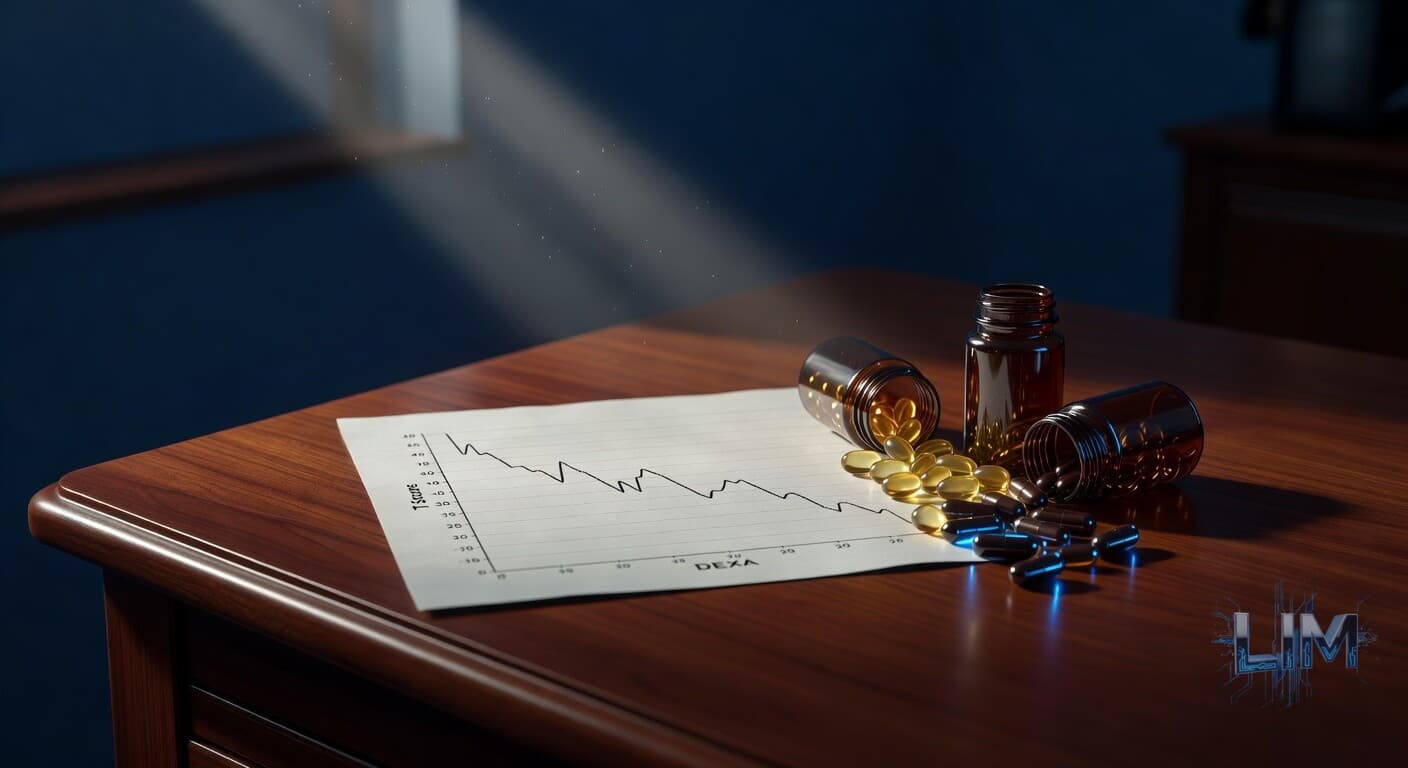
Marcus is 52. His endocrinologist called the D3 protocol "textbook" two weeks ago. 25-hydroxyvitamin D at 58 ng/mL on 5,000 IU daily for two years.
Then the DEXA landed in his inbox.
Lumbar T-score dropped from -0.4 to -1.3 in eighteen months. Hip density is trending the same way. The serum number is perfect, and the bone the protocol was supposed to be protecting is leaving the building.
TL;DR
Related Read
Before Menopause HitsPerimenopause starts in your mid-30s. The decade before menopause sets the next thirty years of your body. Here's the protocol that matches the biology.
- Ramagopalan (Genome Research, 2010) mapped 2,776 VDR binding sites and 229 genes that move on a single 2,000 IU D3 dose. D3 isn't a vitamin; it's a hormone.
- Schurgers (Blood, 2007): MK-7 has a 72-hour serum half-life. MK-4 clears in 1-2 hours. K1 in ~1.5. Form matters.
- Geleijnse Rotterdam Study (J Nutr, 2004, n=4,807, 7.2 yr follow-up): top-tertile menaquinone intake cut severe aortic calcification 50% and CV mortality 57%.
- Ohsaki (J Nutr Biochem, 2006): menaquinones reduce LPS-stimulated IL-6 about 30% in macrophages via NF-kB modulation.
- Kulakova (J Neurol Sci, 2014): correcting D status from 16.2 ng/mL toward 40-60 shifts T-cell profile from Th17 toward Treg dominance.
D3 opens the gate. K2 decides where the calcium goes.
Cholecalciferol hydroxylates to 25-OH-D in the liver, then to 1,25(OH)2D in the kidney. It binds the vitamin D receptor and cranks intestinal calcium absorption two to four times.
It is not a vitamin in any meaningful pharmacologic sense. Ramagopalan et al. (Genome Research, 2010) mapped 2,776 VDR binding sites genome-wide and documented 229 expression changes after a single 2,000 IU dose. That is a nuclear-receptor ligand with reach comparable to thyroid hormone.
What D3 does not do is tell the absorbed calcium where to land.
Two K-dependent proteins handle that routing. Osteocalcin grabs calcium and parks it in bone matrix. Matrix Gla protein lives in your vascular smooth muscle and actively blocks calcium from depositing in arterial walls.
Both proteins are synthesized inactive. They light up only when vitamin K2 donates a carboxyl group to specific glutamate residues.
No K2, no carboxylation. No carboxylation, no routing. The calcium goes somewhere; you do not get to decide where.
Why MK-7 specifically, not MK-4 or K1.
Schurgers et al. (Blood, 2007) clocked MK-7's serum half-life at roughly 72 hours. MK-4 clears in 1 to 2 hours. K1 hangs out for about 1.5 hours, mostly stuck in the liver doing coagulation work.
That half-life is the whole game. MK-7 is the only form that lingers long enough to carboxylate Gla proteins outside the liver. MK-4 is gone before it ever reaches your aorta.
The Rotterdam Study (Geleijnse et al., J Nutr, 2004) followed 4,807 adults for a mean of 7.2 years. Highest-tertile menaquinone intake correlated with 50% less severe aortic calcification and 57% lower cardiovascular mortality versus the lowest tertile.
Phylloquinone (K1) intake showed no such association. The effect was form-specific.
This is the kind of pattern Chiron, our AI head coach, flags inside the daily program review. Most "D3" supplements on shelves either skip K2 or use MK-4 because it is cheaper. Chiron reads your supplement log against your last lab and asks the question your endocrinologist did not.
The immune ledger most coaches miss.
The calcium story is half the picture.
Kulakova et al. (J Neurol Sci, 2014) studied vitamin D status in chronic inflammatory demyelinating polyneuropathy, a T-cell-mediated autoimmune neuropathy with a Th1/Th17 skew. The cohort sat at a mean 25-OH-D of 16.2 ng/mL, with elevated IL-17 and IFN-gamma alongside suppressed Treg function.
Repletion toward 40 to 60 ng/mL tracked with a shift toward Treg dominance and lower pro-inflammatory cytokine output. The mechanism is not CIDP-specific. 1,25(OH)2D binds VDR on CD4+ T cells, biases differentiation away from Th17, downregulates dendritic cell MHC-II, and upregulates IL-10.
The same axis runs through MS, Hashimoto's, type 1 diabetes, and IBD.
K2 enters the immune picture through a different door. Ohsaki et al. (J Nutr Biochem, 2006) showed menaquinones cut LPS-stimulated IL-6 about 30% in monocyte-derived macrophages via NF-kB modulation.
The D3 and K2 signals are not redundant. They converge on a lower-inflammation phenotype from different receptors. You are stacking two anti-inflammatory levers, not one.
Dose the pair, not the single.
Repletion if your 25-OH-D is under 30 ng/mL: 5,000 IU D3 daily for 8 to 12 weeks, then retest.
Maintenance for most adults at goal: 2,000 to 4,000 IU D3, adjusted for bodyweight, latitude, and sun. Target serum 40 to 60 ng/mL. Holick et al. (J Clin Endocrinol Metab, 2011) put the safe ceiling at roughly 80 ng/mL barring granulomatous disease or primary hyperparathyroidism.
Now the part most labels skip. Pair every 1,000 IU D3 with approximately 45 mcg MK-7. A 5,000 IU capsule should carry 180 to 200 mcg MK-7. Most off-shelf combo bottles run half that.
Take both with your fattest meal of the day. MK-7 absorption roughly doubles with dietary fat versus a fasted dose.
Warfarin caveat: K2 antagonizes the drug, so physician oversight is non-negotiable. DOACs like apixaban and rivaroxaban do not carry that interaction.
HERMES, our research engine, scrapes about 12,000 fitness and supplement papers a week. That is how this protocol updates the day Schurgers-grade pharmacokinetic data shifts. Your protocol should not be older than the science.
What we actually did with Marcus.
The LIM supplement column is short and surgical. D3 5,000 IU plus MK-7 200 mcg in a single softgel. Methylfolate, not folic acid. Methylcobalamin, not cyanocobalamin. Magnesium glycinate 300 to 400 mg at night.
The single-capsule call is adherence, not chemistry. Clients who carry two bottles take one of them inconsistently, and the bottle that gets skipped is almost always K2.
Marcus switched. Twelve months later: 25-OH-D at 62 ng/mL, undercarboxylated osteocalcin down 41%, lumbar T-score stabilized at -1.2. Coronary calcium score, pulled as insurance, unchanged from baseline.
The D3 alone had been mobilizing calcium for two years. The K2 was what started parking it where Marcus wanted it parked.
Jake ran a version of this same stack while dropping 112 pounds working hospital-security graveyard shifts. Night shift wrecks endogenous D synthesis because there is no sun on the schedule, ever. Without K2 in the mix, the repletion would have been pulling minerals out of the bone he was trying to rebuild at 4 a.m. in the gym after clock-out.
The close.
A serum D number in isolation is a spreadsheet victory. Where the calcium lands is the actual outcome.
Dose the pair. Track the lab. Read the DEXA, not just the protocol your doctor congratulates you on.
If you want a stack that updates the moment the evidence does, and a coach that reads your labs the way Marcus's should have been read for the last two years, we built it.
---
Get Chiron in your pocket — $29.99/month
Most programs die in the gap between the plan and your real week. Chiron, our AI head coach, reads what you log (meals, workouts, skipped sessions) and rewrites tomorrow instead of waiting for you to fall off. HERMES, our research engine, keeps the coaching current with new science the week it publishes.
$29.99/month · $249.99/year · 7-day free trial · cancel anytime · no enrollment fee · no contract
Start coaching → · See the full app →
Jake Long built it after losing 112 lbs working hospital night shifts — when no human coach could keep up with his schedule. He wanted the system he wished he'd had at 308. Now you can use it too.
Comments (0)
Comments are reserved for Legacy In Motion members.
$29.99/month. No contracts. Cancel anytime.
Get StartedAlready a member? Sign in
You read this far. Now do this.
Stop reading about it.
Start training around your real life.
I went from 308 to 196 lbs working 12-hour overnight shifts with two kids and zero personal trainer. The system I used is now an app that plans your training and meals around YOUR schedule — overnight, day shift, all of it.
Cancel anytime · No setup fee · No long contract
Free Assessment
Where's Your Training Stuck?
Take our 60-second quiz and get a personalized breakdown of what's stopping your progress — plus how AI coaching solves it.
Take the QuizFree PDF · No Credit Card
Your free Shift Worker AI Fitness Blueprint
The protocol Jake wishes he'd had at 308 lbs: sleep timing for rotating shifts, post-shift macros, and the AI deload trigger, from the run that took him to 196. Free, no card needed.
Built by someone who actually worked them. No fluff. Unsubscribe any time.
Keep Reading
2026-04-22
Before Menopause Hits
Perimenopause starts in your mid-30s. The decade before menopause sets the next thirty years of your body. Here's the protocol that matches the biology.
2026-04-21
The Plateau Was the Postprandial Curve, Not the Scale
Berberine cut HbA1c 2.0 pts in 12 weeks. Dihydroberberine hits 5x plasma. Where it earns a slot in your stack — and where it stops.
2026-04-20
3g Glycine, 60 Minutes Out
Join our free fitness community — get coaching tips, share wins, and stay accountable.
JOIN THE DISCORD →