


Pallof Press Over 40: The Anti-Rotation Core Desk Workers Skip
The Pallof press trains the anti-rotation brace most over-40 templates replace with crunches. McGill torso-stiffness context, band progressions for busy parents and desk workers, a 10-minute protocol, and how Chiron inserts it when kid-on-hip twists keep winning.
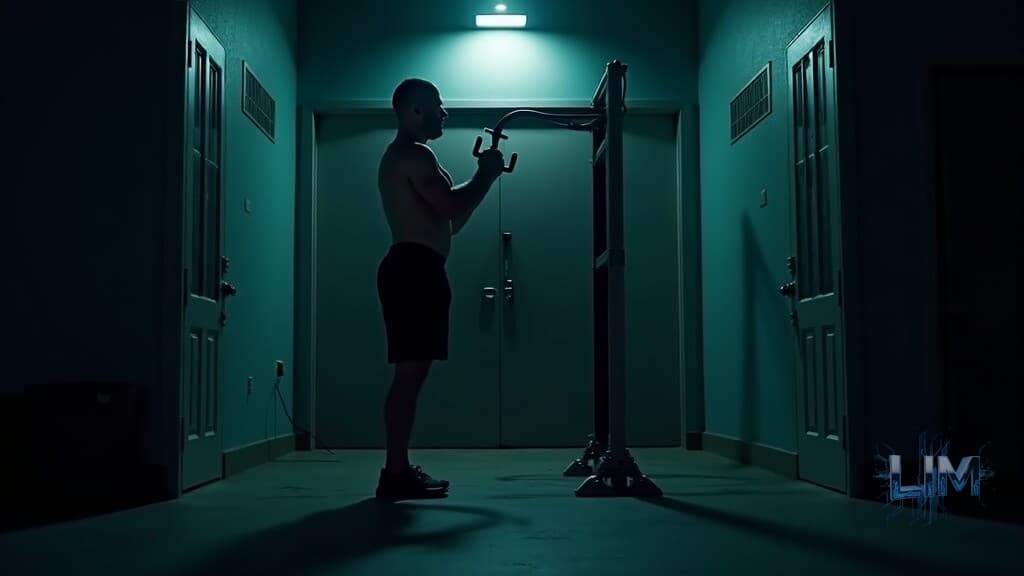
Marcus is 43. Friday, 6:40 p.m. The school lot smells like hot asphalt and juice boxes. His daughter hooks one arm around his neck and swings her whole backpack weight into his left hip while he fumbles the unlock. Keys jingle. The plant foot is fine. The ribs want to spin open toward the kid — a quiet threat in the low back, not a disc movie, just that flash that says the torso lost the anti-rotation fight before the seatbelt clicked.
He freezes half a second longer than a cool dad should. She laughs. He smiles with his mouth and does the math with his spine.
He does not need a six-pack photoshoot. He sits eight hours, carries groceries on one side because the other hand holds a child, and still needs to brace against spin like someone who trains that job on purpose.
His app wants core day: 3×20 Russian twists + crunch finisher. Last Tuesday he half-did it on the living-room rug while Slack buzzed on the coffee table. The twist contest does not feel like a backpack torque at the car door. The car door is the test.
Related Read
If You Sit 4 Hours, Swap 30 Minutes Off the CouchHuang 2026: 41,733 adults, 11.9 years. Sit 8 hours and death risk jumps. Sit 4-plus, swap 30 minutes. Week Zero couches, this is your file.
A static plan does not know his trunk fails in life before it fails on a mat. Chiron would — if he logged the spin and the skipped anti-rotation work. That is the gap: not more motivation. A coach that trains the anti-spin brace he already needs.
He is not too old to pick up a child. He is under-trained for torque that does not wait for a warm-up. Anti-rotation is not optional after forty. It is weekly.
The anti-spin job nobody programmed
Marcus sits in the driver seat for thirty seconds before he turns the key. He googles "low back twist picking up kid" like half the parents on his block. The internet wants more planks, more crunches, and a foam roller sermon. Flexion volume is not what failed him.
What failed him is a year of programs that trained abs like a show muscle while treating anti-rotation like advanced PT jargon. The backpack asked for a quiet spine under side load. His PDF sold him a seated twist race.
What a Pallof press actually is
The Pallof press is simple enough to insult your ego: stand or kneel sideways to a band or cable at about chest height, hold the handle at the sternum, brace, then press the arms straight out and resist the pull that wants to yank your torso into rotation. Arms move. Ribs stay. Hips stay. No circus.
What the research culture actually cares about is torso stiffness as a performance and spine-sparing skill — not a crunch PR.
- Pallof press = anti-rotation brace with limbs extending away from the body while the trunk refuses to spin. Named after physical therapist John Pallof; cable or band both count.
- Stuart McGill's long line of work on core training and injury prevention frames true spine stability as balanced stiffening from the whole wall — not endless isolated flexion. The "Big 3" (modified curl-up, side bridge, bird-dog) is the classic spine-sparing endurance set; the Pallof is the practical transverse-plane buttress most commercial templates still skip for Russian twists.
- Lee & McGill isometric torso work (including Pallof-style anti-rotation variants in stiffness protocols) is the reason coaches keep saying "brace, don't flop": short, honest isometrics can change how stiff the trunk behaves under challenge better than sloppy high-rep twist circuits. When a paper is a randomized controlled trial (RCT), treat the dose claims carefully — Marcus still only needs a brace he will repeat next Friday.
- Distinct from the Copenhagen adduction (medial hip brake), Nordic hamstring curl (posterior thigh eccentric), loaded carries (locomotion under load), and wall-sit blood-pressure work (lower-body isometric). This is the anti-spin trunk most over-40 PDFs replace with crunches.
- Default dose: 1–3 days/week, 2–3 sets per side, after a warm-up, progress by harder band, longer press-out holds, then half-kneeling / tall-kneeling — not max-twist death sets.
- Chiron should insert a Pallof progression when life keeps demanding one-sided kid torque — not leave him racing Russian twists he already ghosts.
Marcus is not writing a stiffness dissertation. He is chasing a trunk that does not open like a barn door when a backpack hits one hip.
Gym culture treats Pallofs like physical-therapy homework. Life treats them like seatbelts for the spine. You do not wait for the twist flash to train anti-rotation.
The week that set up the spin
Marcus's Friday did not start at the car. It started with eight hours of chair rotation to one monitor, a "standing meeting" that was just more rib flare, and a kid who treats every exit like a lateral load test. His anti-rotation system already paid a tax before the backpack.
Desk hours, then a sudden torque
Desk workers invent "tight lower back" and stretch into more flexion while never loading a quiet brace against spin. Stretching is not the same as owning force that wants to twist you. Marcus foam-rolled his thoracic spine twice this month. He still lost the car-door fight.
Busy parents invent "I just tweaked my back getting the kid in the car" as if parenthood is a freak accident instead of a weekly anti-rotation sport. Marcus is not unlucky. He is under-dosed for the job he already has.
Over-40 adults can still rotate when they choose to. What they cannot afford is a training week that only practices sit-ups and machines while life keeps handing them unplanned side loads. Travelers invent hotel "ab finishers" that are all crunches and zero anti-spin work, then wonder why a suitcase yank on day three feels like Russian roulette for the lumbar spine.
If your program only trains the abs to flex and never to refuse rotation, you are training half the core job. Marcus trained half the job. The backpack graded the missing half.
Friday night the house is finally quiet. One sock on the stairs. A half-empty water bottle by the door. Marcus is done ghosting the brace. He opens the app at 8:15 p.m. after bedtime and stares at the empty living-room floor like it owes him an explanation. He tags low back sensitive + short window + band only and voice-notes the near-miss: "ribs spun open loading kid into car, half-assed twists again."
Forge does not drop a forty-five-minute core apocalypse. HERMES already had the McGill-era stiffness and anti-rotation signal in the research layer — so the coaching copy does not sell him "you are broken after 40" or "heavy cable Pallof or nothing." Chiron inserts an anti-rotation block.
Ten minutes. That is the whole bet.
He laughs once under his breath. Ten minutes is the only length of honesty his week will fund.
The progression that does not destroy Saturday
Do not open with a heavy cable and a long press-out hold if you have not braced against rotation in years. That is how people create delayed onset muscle soreness so deep they ghost training for a week and blame the exercise instead of the dose. Marcus starts where control lives.
- Level 0 — Dead-bug anti-reach (6–8/side). On the floor, opposite arm and leg extend slowly while the low back stays quiet on the ground. Own the brace. No circus.
- Level 1 — Standing Pallof press (8–12/side). Light band at chest height, feet athletic, press out for a one-count, hold two, return. Ribs stacked. Glutes on. If the hips twist before the arms finish, the band is too hard.
- Level 2 — Tall-kneeling Pallof (6–10/side). Knees down removes some lower-body cheating. Same press-out. This is where desk posture lies get exposed.
- Level 3 — Half-kneeling Pallof (6–10/side). Inside knee down toward the band or outside — both teach hip-to-rib ownership. Prefer the version that stays honest.
- Level 4 — Longer isometric or march variations only if earned. Most busy parents never need a circus Pallof walk. If you get here, you already won the habit game.
Pain rules stay adult. Sharp lumbar, hip catch, shoulder pinch, dizziness → stop. Deep ab burn and next-day stiffness that settle are normal when the dose is new. Needing a handrail to twist out of the car for three days is a programming error.
Ten minutes against the rack
- 2-minute prep — easy march or bike, then two bird-dogs slow. Warm tissue first. Cold max bands are how desk spines file complaints.
- Pallof progression — 2–3 sets per side at the highest level he can control. Rest 45–75 seconds between sides. Film one set from the front once a month. If the ribs open and the low back takes over, regress.
- Companion spine-sparing work — 1× McGill curl-up pattern or side bridge short holds if time allows. Flexion and lateral endurance still matter; this article is not "never train abs." It is "stop pretending twists alone are the whole transverse story."
- Optional finisher if time remains: 2×20-second suitcase hold — trunk ownership after anti-rotation, same family as carry work without turning this into a farmer-walk sermon.
He logs level, band color or cable plate, seconds of clean press-out, and whether kid pickups felt honest the next day. Progressive overload here is harder band, longer quiet hold, cleaner knee position — not "I twisted more times than last week and my Instagram thinks I have a six-pack protocol."
This is not the same article as Copenhagen or Nordics. Those are limb brakes. Pallofs are the trunk anti-spin. You can share a week if recovery allows — different jobs. Do not stack max Nordics, max Copenhagens, and max heavy Pallofs the night before a beer-league game and call it science.
Apple Health / HealthKit already knew he slept five hours after a late project spiral. HealthKit-driven deloads keep Forge from stacking hard anti-rotation isometrics on a wrecked recovery day next to a heavy hinge day. When the readiness junk is red, Chiron cuts a set or swaps to Level 0 dead-bugs only — without a human coach texting during bath time.
If he only has a hotel room next month: door-anchor band at chest height if the door is solid, or tall-kneeling presses against a light tube. A fake "cable Pallof" yanking a wobbly chair is not toughness. It is a face plant with branding.
> Mid-article path if your program only trains crunches and never the anti-spin brace: $29.99/mo, cancel anytime → pricing
Who finishes this (and who does not)
Marcus finishes because he logs the spin instead of pretending it was bad luck. Busy parents already live in one-arm kid loads and uneven grocery carries. Practice controlled anti-rotation the same week you practice not being surprised by a backpack. A voice-note check-in after a clean Pallof block — "Level 1, 3×10/side, car load fine next day" — is more useful to the coach than silence.
Desk workers invent "my core is weak" and buy another ab wheel while never bracing against a side pull. Slot Pallofs when warm — not as the first cold movement after eight hours of sitting if you can help it. A five-minute walk-in still counts as adult programming.
Over-40 restarts do not need to "earn" Pallofs by surviving a bodybuilding core finisher. They need an anti-rotation progression that survives next Friday's pickup line. Start easier than ego. Film a set. If the ribs open at the halfway press, that is your range. Own it.
Travelers: lobby gyms sometimes have a cable nobody is using for anti-rotation. Two honest tall-kneeling sets on the road beat seven crunch sleepwalks. If there is no cable, a door band still trains the job — log the substitute so Forge does not pretend you had a stack you did not.
If the shoulder hates long press-outs, shorten the hold and lighten the band. If the low back takes over, you are not "bracing harder" — you are too far into the progression for today's strength. Regress. Related trunk work still lives next to trap bar hinges and unilateral legs; Pallofs are not a deadlift replacement. They are the missing anti-spin chapter.
Power work and Pallofs can share a week if recovery allows — intent-based speed on one day, brace work on another — without turning either into junk volume. See the power / RFD block for the other half of "be on time with force." Engines without a quiet trunk are how car doors become cautionary tales.
Copenhagens still matter for the medial hip. Do not let this article delete last week's brake. Own both planes when life asks for both.
Strength minutes that still count
None of this needs a two-hour "ab specialization" block. Large observational work keeps pointing at modest, repeated strength exposure as the habit that compounds — including Zhang et al., British Journal of Sports Medicine (2026), following roughly 147,000 adults across long-running U.S. cohorts for up to 30 years: about 90–120 minutes per week of resistance work sat near a practical sweet spot for lower all-cause mortality association (~13% lower at 90–119 minutes in fully adjusted models), with stronger patterns when strength and aerobic work shared the week. Observational, self-report, not a Pallof RCT. Still useful framing for Marcus: short anti-rotation blocks count as real strength minutes, not as fluff you skip when the schedule tightens.
The longevity literature does not demand a crunch contest. It demands that you keep loading muscle and owning force. A ten-minute Pallof block is that.
Where Jake's story fits (without the fairy tale)
I did not get from 308 to 196 by cosplaying a physique-core finisher after hospital security overnights. I got there by keeping trunk ownership alive when the schedule was ugly — including nights when "core" collapsed to whatever brace my body would still own after twelve hours on concrete. Long halls, sudden reaches, gear that does not wait for a warm-up: the job already asked for anti-rotation without a perfect prep. Training that only shortened the abs under crunches left me fine on paper and hesitant when something yanked sideways in real time. Shift-aware programming is not a brochure line. It is why a static plan failed me and a system that rewrites still works.
If your program cannot insert a Pallof progression the week life keeps asking for side torque your PDF never trained, you do not have a coach. You have a PDF with a logo.
How the coaching stack actually uses this
When Marcus logs "back twinge loading kid," "skipped core," "ribs opened on suitcase," or a voice note about car-door torque feeling sketchy, Chiron does not moralize about aging. It inserts a Pallof progression: band matched to control, sets kept short, next-day pickups used as feedback.
Forge rebuilds the block for a cable, a door band, tall-kneeling only, or Level 0 dead-bugs — and keeps progressive overload on the version he will actually do so the anti-spin brace does not freeze at baby presses forever. When Apple Health / HealthKit shows a wrecked recovery night, Forge downshifts the other way — lighter band, fewer sets — instead of pretending he is still on a perfect athlete template.
HERMES keeps the coaching layer honest: McGill-era torso stiffness and anti-rotation logic, not TikTok "1,000 twists for oblique shred" culture and not "just stretch your low back" desk mythology. Log the meal, log the workout, flag the near-miss — the daily AI program update should move the same day. The iOS app is where that log lives when he is not at a desk.
In-app meal logging still matters here. A high-tension brace block on an under-fueled day is how people invent injuries and call them destiny. Protein across the day is not a separate religion from training the anti-spin brace. It is the repair budget.
That is the product promise, not a brochure paragraph: you log, we adapt. Static plans age out the day your life demands a torque your PDF never trained.
The research and the coaching line up. Train the trunk to refuse unwanted spin. Dose it like strength. Stay quiet enough under side load that kid pickups stop feeling like coin flips.
Join the people who train for the week they actually live: https://discord.gg/8QBuFFA5Pf
The Pallof is not physical-therapy homework. It is a seatbelt for chaotic Fridays. You cannot crunch your way into anti-rotation strength. A quiet press-out beats an ugly twist race. Marcus does not need a new ab wheel. He needs a brace that survives the car door.
Two weeks later Marcus is back in the same parking lot. Same daughter. Same backpack swing into the left hip. He plants. The ribs stay honest — not heroic, not Instagram, just present. He sets the band that night. Tall kneeling. Ten slow press-outs per side. Logs the session. The Russian-twist circuit still exists in every generic app. It does not own the week. Next time the kid loads uneven, the program has already trained the anti-spin instead of only the crunch. That is the whole arc: same chaos, better trunk brace, coach that rewrites.
---
Your plan should change the day your week does
Most programs die in the gap between the plan and your real week. Chiron, our AI head coach, reads what you log (meals, workouts, skipped sessions) and rewrites tomorrow instead of waiting for you to fall off. HERMES, our research engine, keeps the coaching current with new science the week it publishes.
$29.99/month · $249.99/year · 7-day free trial · cancel anytime · no enrollment fee · no contract
Start coaching → · See the full app →
Jake Long built it after losing 112 lbs working hospital night shifts — when no human coach could keep up with his schedule. He wanted the system he wished he'd had at 308. Now you can use it too.
Common Questions, Answered
Is the Pallof press safe over 40?
Safe enough when you start with light band tension, keep ribs stacked, and stop for sharp lumbar, hip, or shoulder pain. Most desk workers need short presses and tall-kneeling setups before long isometric holds or heavy cable stacks. Next-day deep ab fatigue is normal; walking like you lost a bar fight is a dosing error.
How often should busy parents do Pallof presses?
Most over-40 parent and desk schedules do well with 1–3 short anti-rotation blocks per week, 2–3 sets per side after a warm-up. More is not better if every twist the next day feels fragile instead of owned.
Do I need a cable machine for Pallof presses?
No. A loop band or tube band anchored at chest height on a rack, door anchor, or sturdy post is enough. Cables are optional. Log the tool so Forge keeps progressive overload honest when you travel.
What is the difference between Pallof presses and Russian twists?
Russian twists train rotation under load. The Pallof press trains the opposite job: resist rotation so the spine stays quiet while limbs move. Busy parents and desk workers fail more often on anti-spin braces than on seated twist contests.
How does AI coaching use Pallof press work?
When you log low-back twinges on kid pickups, desk twists that seize, skipped core days, or voice notes about 'twisting wrong,' Chiron can insert a short Pallof progression. HealthKit recovery flags cut volume after wrecked sleep. HERMES keeps the layer on torso-stiffness and anti-rotation literature, not endless crunch circuits.
Comments (0)
Comments are reserved for Legacy In Motion members.
$29.99/month. No contracts. Cancel anytime.
Get StartedAlready a member? Sign in
You read this far. Now do this.
Enough reading about it.
Time to train around the life you actually live.
I went from 308 to 196 lbs working 12-hour overnight shifts with two kids and zero personal trainer. The system I used is now an app that plans your training and meals around YOUR schedule — overnight, day shift, all of it.
Cancel anytime · No setup fee · No long contract
Free Assessment
What's Really Stopping Your Progress?
Take our 60-second quiz and get a personalized breakdown of what's stopping your progress — plus how AI coaching solves it.
Take the QuizFree PDF · No Credit Card
Your free Shift Worker AI Fitness Blueprint
The protocol Jake wishes he'd had at 308 lbs: sleep timing for rotating shifts, post-shift macros, and the AI deload trigger, from the run that took him to 196. Free, no card needed.
Built by someone who actually worked them. No fluff. Unsubscribe any time.
Keep Reading
2026-08-29
If You Sit 4 Hours, Swap 30 Minutes Off the Couch
Huang 2026: 41,733 adults, 11.9 years. Sit 8 hours and death risk jumps. Sit 4-plus, swap 30 minutes. Week Zero couches, this is your file.
2026-08-22
Six Stair Flights a Day Cut Heart-Death Risk 39%
Paddock 2026: regular stair climbers had 39% lower heart-death risk. One cohort pointed at about six flights a day.
2026-08-19
Sprints Hit 32 Protective Proteins Easy Cardio Misses
Olsen 2026: six 30-second sprints changed 32 protective blood proteins. Ninety easy minutes changed three.
Join our free fitness community — get coaching tips, share wins, and stay accountable.
JOIN THE DISCORD →