


Sprints Hit 32 Protective Proteins Easy Cardio Misses
Olsen 2026: six 30-second sprints changed 32 protective blood proteins. Ninety easy minutes changed three.
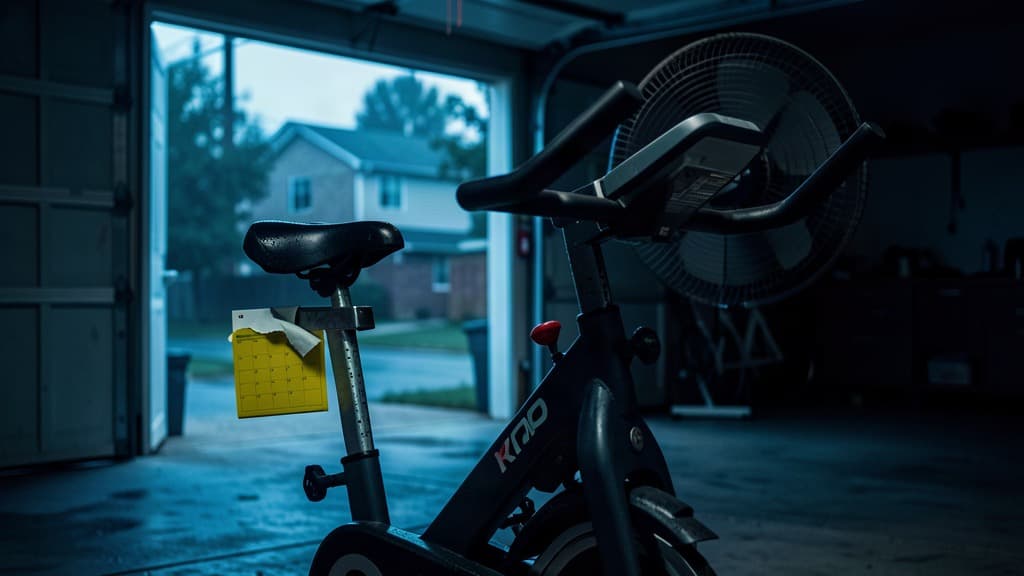
Owen is 44. Wednesday, 6:38 a.m. Week three of school. Two backpacks already arguing with the door.
His calendar still says 90 minutes zone two. The block is yellow. It will stay yellow.
National Potato Day is all over his phone. Fries. Leftovers. A reel that wants him to celebrate a tuber while he misses drop-off.
He says it to the empty garage.
Related Read
Silent Atherosclerosis in 57% of Healthy AdultsBundgaard 2026 found silent atherosclerosis in 57.1% of 16,808 adults with no known disease. This Saturday, feeling fine was the entry rule, not a clearance.
"If I cannot find 90 minutes, I am not training."
Chiron already pinged at 6:11: Kill the 90. After drop-off, six 30-second bike bursts. Full easy between. That is the session. He left it unread. Static apps never send that text. This one did.
If that is your August — busy parent, desk spine, over-forty midsection that treats every skipped long ride like a character flaw — sit with me. You do not need a bigger calendar. You need a harder three minutes.
Quick take - Olsen and colleagues, 2026, Cell Reports Medicine (Rockefeller, Cohen lab) compared exercise intensity in 19 healthy young men. Six 30-second all-out sprints versus 90 minutes of moderate continuous cycling. A moderate treadmill run sat in the middle and still lagged the sprint. - Sprint work changed about one quarter of the blood proteins they measured immediately. Moderate cycling changed fewer than 0.25 percent. Sprint also moved more than 200 metabolites. - The sprint blood was loud: proteins for vessel growth, tissue remodeling, hormone signaling. Some of that was ectodomain shedding — pieces of proteins already sitting on cell surfaces, clipped into circulation, not newly printed. - Fat cells exposed to post-sprint blood changed how they handle fuel and hormones. Fat cells exposed to post-easy-ride blood barely shrugged. The easy ride's fatty acids and liver proteins showed up about three hours later. - They still saw the sprint signal after eight weeks of training. Not a first-day panic. - Crosswalk to more than 53,000 people in the UK Biobank: of 33 proteins tied to lower obesity and type 2 diabetes risk, sprinting altered 32. Moderate work altered 3. More than a quarter of those proteins also tracked with slower biological aging. - This is not an over-forty fat-loss trial. It is a signal trial. Translate the intensity. Do not steal the sample.
The 90 that never starts
Owen stares at the yellow block like it owes him money.
Ninety minutes is a moral object. It looks like health. It dies at 7:40 when the second kid cannot find a shoe.
He mutters the line every fitness app trained him to say.
"Short does not count."
Then he reads the methods. Same lab. Same blood draw. One condition is three minutes of actual work. The other is an hour and a half of polite spinning.
The polite spin almost does not touch the protein list.
Your watch counts minutes. Your organs count intensity.
I learned this the ugly way. Jake. Hospital security. Night shifts. 308 to 196. After a 12-hour tour I did not have 90 minutes of anything. I had a garage fan bike and a window before the next badge swipe. The long easy ride lived in a PDF. The hard 30s lived in the room I actually owned.
What the blood did after three minutes
Owen squints at the age column. Young men. Nineteen of them. Not the pickup line.
Fine. Read the blood anyway.
Six times 30 seconds. All-out. Then they looked at the plasma. Nearly a quarter of the measured proteins moved. Two hundred-plus metabolites. A surge in the messages that tell vessels to grow, tissue to remodel, hormones to talk.
The easy 90? Fewer than a quarter of one percent.
He writes that on a sticky note and slaps it on the bike seat.
Easy miles are quiet in the blood.
That is the line his old tracker cannot see. It only counts duration. Duration lied to him for a decade.
The researchers have a name for the sprint dump: exercise-responsive proteins, the secretome, interorgan talk. You do not need the lab name. You need the sequence: warm up. Go hard for 30 seconds. Recover until you can talk. Repeat.
Paul Cohen, the senior author, told Medical News Today the point is design. Different intensities write different programs in the blood. Luke Olsen, the first author, called those messengers exerkines — proteins and metabolites that leave the working muscle and tell the liver, the fat, the vessels what just happened.
Owen says it simpler, standing in the driveway after drop-off.
"The long ride is a story I tell myself. The sprint is a text the organs actually read."
The 32 that easy cardio missed
Here is the number that should bother you if your plan is only conversational pace.
They took the proteins that moved and walked them into the UK Biobank. More than 53,000 records. Thirty-three of those proteins sit on the low-risk side of obesity and type 2 diabetes. Sprint work hit 32. Moderate work hit three.
More than a quarter of that protective set also lined up with slower biological aging.
That is not "sprints melt fat." That is "sprints flip a switch easy minutes leave off."
A cardiologist who was not on the paper, Socrates Kakoulides, said the honest thing out loud: do not read this as a license to cancel regular movement. The study measured molecules, not ten-year heart attacks. Joshua Scott, a sports-medicine physician also outside the trial, asked the same translation question. Association is not a promise.
Hold both. The signal is real. The sample is young. Your knees are 44.
Ninety minutes is a calendar lie. Three hard minutes is a signal.
What Owen actually did after pickup
He does not sprint on a track. That is how 44-year-old Achilles tendons write sad emails.
He sits on the garage bike. Five minutes easy. Then 30 seconds where talking dies. Then two to four minutes so easy it feels like cheating. Six rounds. Fan on. Door open. One kid still arguing about a water bottle in the back seat for the first two.
He finishes in 22 minutes, including the shame.
Thursday the plan dies anyway. A coworker moves drinks to 5:15. Late pickup. The January PDF still wants the yellow 90. Chiron does not. The live note is already four hard 30s on the bike, then protein, then bed. Static programs cannot see a school-night ambush. This one can.
That is the whole product, if I am being blunt. Not a new personality. A rewrite the same day the week breaks.
How Legacy In Motion actually uses this
HERMES pulled the Rockefeller paper the morning it landed. Chiron does not wait for a quarterly PDF reprint.
If you log a 90-minute cardio you never start, the coach treats that as a failed duration, not a failed person. The rewrite is brief hard work on a tool you already own — bike, hill, elliptical — plus the walking floor you still need and the strength minutes that cut death risk. After a short-sleep night, the next session drops to four rounds or swaps to brisk hill walks. After a leftover-pasta school night, volume stays honest instead of stacking a hero ride on a full gut.
Night-shift version is the same math on a flipped clock. Jake's garage bursts were this protocol with worse lighting.
If three gym days keep dying, the once-weekly hard session plus walking still exists. Today's paper is not that paper. That one was frequency. This one is the blood.
The free version of this argument — parents comparing real Wednesday sessions — lives on Discord: https://discord.gg/8QBuFFA5Pf.
If you want a plan that kills the yellow 90 before it kills the week, start at https://legacyinmotion.fit.
Steal this before you protect a dead block
- Warm up five minutes easy. Then six times 30 seconds hard. Hard means you cannot talk. Recover fully between.
- Bike, hill, or elliptical. Not a cold track sprint if you are over 40 and new to this.
- Two sessions a week is enough when you are building the skill. Strength and easy walking stay on the calendar. See the 6-6-6 walking rule if mornings keep losing.
- Get cleared if you have heart history, chest pain, or you have not done hard work in years. Intensity is a tool, not a dare.
- Log completed hard intervals, not the 90 you imagined. The duration counter is half-blind.
- Stop calling a 22-minute burst session a cop-out. The quiet 90 was the cop-out.
Owen peels the yellow block off the calendar and writes six times 30, then protein. The kids still complain. The 90 stays dead.
The proteins do not care that the block said zone two.
Your move. Not a longer Saturday. The 30 seconds you can actually finish.
---
Coaching that works the same shifts you do
Chiron, our AI head coach, coaches the week you actually have: overnights, doubles, rotation flips, kid pickups. Log the change and tomorrow's plan already knows. No static program that assumes you sleep at 10pm and train at 6.
$29.99/month · $249.99/year · 7-day free trial · cancel anytime · no enrollment fee · no contract
Start coaching → · See the full app →
Jake Long built it after losing 112 lbs working hospital night shifts — when no human coach could keep up with his schedule. He wanted the system he wished he'd had at 308. Now you can use it too.
Common Questions, Answered
Do short sprints do more than a long easy ride?
In Olsen 2026, six 30-second all-out sprints changed about a quarter of the blood proteins measured right after. Ninety minutes of moderate cycling changed fewer than a quarter of one percent. This is a molecular signal, not a claim that easy cardio is useless.
How many protective proteins changed after sprinting?
Researchers matched the exercise proteins to more than 53,000 UK Biobank records. Of 33 proteins tied to lower obesity and type 2 diabetes risk, sprinting altered 32. Moderate cycling altered 3.
I am over 40. Should I sprint on a track?
No. Use a bike, a hill, or an elliptical. Hard for 30 seconds means you cannot talk. Recover fully. Get cleared if you have heart history. Two sessions a week is plenty when you are new to intensity.
Does this replace walking or lifting?
No. The paper measured the secretome, not years of follow-up. Keep your walking floor and your strength dose. Add brief hard efforts when the 90-minute block keeps dying.
Will this make me lose fat?
It is a communication signal, not a fat-loss drug. Pair the bursts with protein, sleep, and a week that actually happens.
Comments (0)
Comments are reserved for Legacy In Motion members.
$29.99/month. No contracts. Cancel anytime.
Get StartedAlready a member? Sign in
You read this far. Now do this.
You've read the theory.
Now put it to work in your real week.
I went from 308 to 196 lbs working 12-hour overnight shifts with two kids and zero personal trainer. The system I used is now an app that plans your training and meals around YOUR schedule — overnight, day shift, all of it.
Cancel anytime · No setup fee · No long contract
Free Assessment
What's Holding Your Fitness Back?
Take our 60-second quiz and get a personalized breakdown of what's stopping your progress — plus how AI coaching solves it.
Take the QuizFree PDF · No Credit Card
Get the Shift Worker AI Fitness Blueprint
The exact 4-week protocol Jake used to lose 112 lbs working hospital security overnights — sleep timing, the four-minute REHIT window, post-shift macros, and the AI deload trigger. Drops in your inbox in 30 seconds.
Built by someone who actually worked them. No fluff. Unsubscribe any time.
Keep Reading
2026-10-03
Silent Atherosclerosis in 57% of Healthy Adults
Bundgaard 2026 found silent atherosclerosis in 57.1% of 16,808 adults with no known disease. This Saturday, feeling fine was the entry rule, not a clearance.
2026-09-30
Supersets Cut Session Time 36% With Similar Muscle
Burke 2026 found supersets cut session time 36% with similar muscle changes. The clock moved. The trophy did not.
2026-09-25
Doubling Weekly Sets Did Not Grow More Muscle
Camargo 2026 found no extra quad growth from a 120 percent volume jump versus 20 percent. The protocol main effect is not a bigger change.
Join our free fitness community — get coaching tips, share wins, and stay accountable.
JOIN THE DISCORD →