


The Six-Second Chair Test — The Buffalo Data That Beats The Step Count Renee Has Been Failing Since November
5,000 women, 8 years, JAMA 2026: grip strength and a chair-stand test predicted mortality better than aerobic minutes. The kitchen has the equipment.
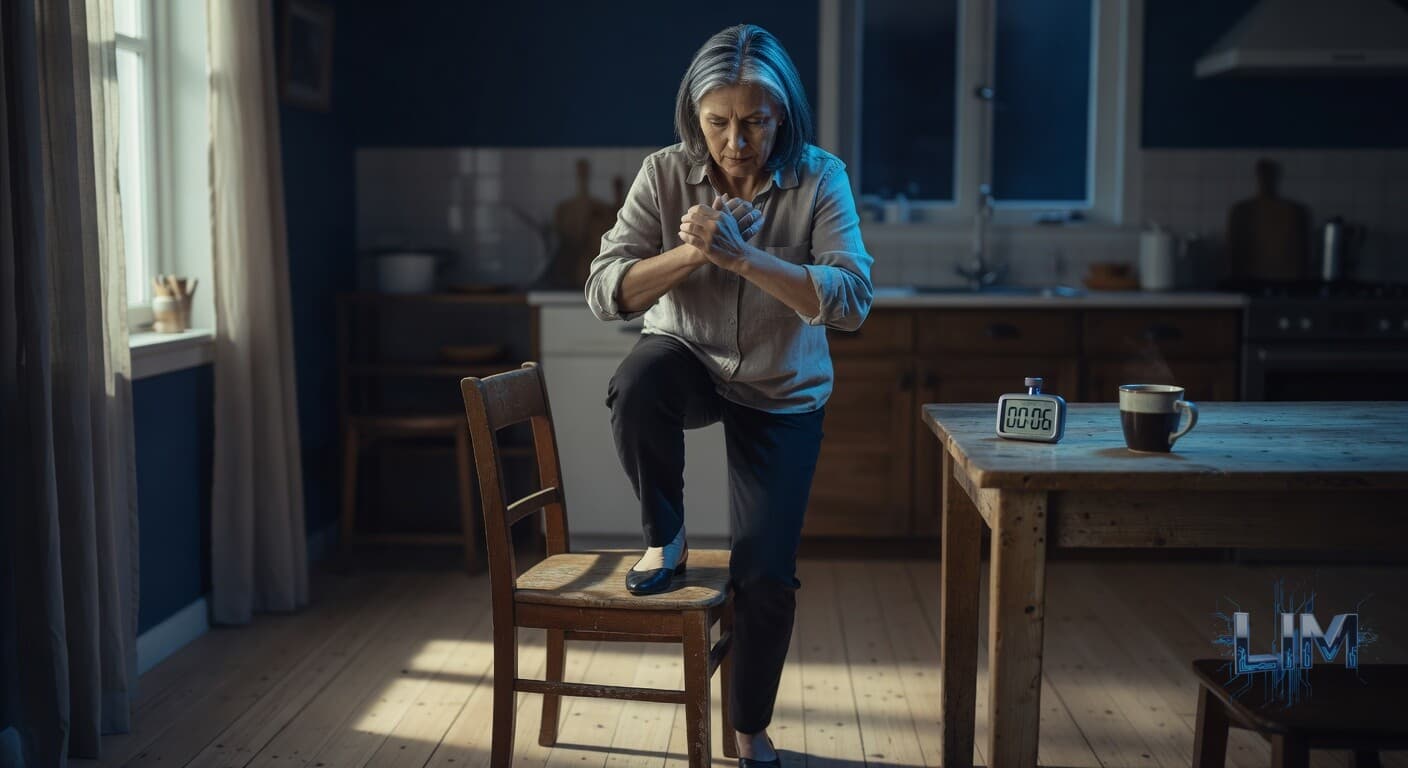
Renee is 64, three years out from a thirty-one-year run in hospital administration, autoimmune flare she's managed mostly through diet and walks that kept getting shorter. Thursday, 11:14 a.m. Second cup of coffee. The morning show is on with the sound down.
A Wegovy ad just played for the second time this hour. The walking log her doctor printed in October is in the bottom drawer with the receipts and the rubber bands. She has been carrying around a low-grade shame about 150 minutes a week for seven months.
The chyron scrolls. 5,000 Women, Eight Years, Two Tests That Beat Step Count. Renee picks up her phone.
TL;DR - University at Buffalo followed 5,000+ women aged 63-99 for a median 8 years (JAMA Network Open, 2026) — strength tests beat aerobic minutes as a mortality predictor. - Every 7 kg of grip strength → 12% lower all-cause mortality. Top-quartile grip → 33% lower vs bottom quartile. - Every 6-second improvement in five-times-sit-to-stand → 4% lower mortality, independent of aerobic activity. - A 12-minute kitchen-chair circuit, three days a week, trains both signals without a gym, shoes, or an audience. - The 150-minute aerobic guideline isn't wrong. For women over 60, it's just downstream of the variable that actually moves the needle.
Related Read
Five Extra Minutes and Half a Vegetable ServingKoemel 2026: 5 more minutes of sleep, about 2 minutes of harder movement, and half a vegetable serving tracked with one extra year. Not a new fall reset.
What Buffalo actually measured
A team at the University at Buffalo (Department of Epidemiology) tracked 5,000+ community-dwelling women aged 63 to 99 for a median of eight years. Three baseline numbers. Grip strength on a handheld dynamometer. Five-times-sit-to-stand time. Self-reported aerobic minutes.
They controlled for age, BMI, smoking, comorbidities — and, critically, aerobic activity itself.
Every 7 kg of grip strength tied to 12% lower all-cause mortality. Top-quartile grip strength tied to 33% lower mortality versus the bottom quartile. Every 6-second improvement in the chair-stand test tied to 4% lower mortality.
The strength signals held independent of cardio. Women who never hit the 150-minute aerobic guideline (HHS Physical Activity Guidelines, 2018, still current) still got most of the protective effect from being in the top half of grip or chair-stand.
The morning-show translations this week are framing it as "add strength to your cardio." Wrong. Buffalo found the strength signal was protective on its own, in a population where most women weren't hitting the cardio guideline anyway.
Renee has been carrying a printed walking log around since November like a sin. The Buffalo data says — wrong religion.
The kitchen-chair test, right now
You can do this before you finish reading this paragraph. No stopwatch needed — your phone has one. No shoes.
Sturdy kitchen chair, no wheels. Back not touching the chair back. Feet flat. Arms crossed over your chest. Start the timer. Stand all the way up, sit all the way down. Five reps. Stop the timer when your bottom touches on the fifth rep.
Reference ranges for women 60+ (geriatric functional-assessment literature):
- Under 11 seconds — healthy
- 11 to 15 seconds — middle bucket where most of the cohort lived
- Over 15 seconds — high-risk range
If you can't complete five without using your hands, that is data, not a failure. Write the number down. We're training it.
Why a chair stand predicts when you die
The five-times-sit-to-stand looks ridiculous. It isn't.
It's a composite of quad strength, hip-flexor function, balance, motor control, joint range of motion, and — quietly — cardiovascular reserve. A 64-year-old standing five times in nine seconds is moving roughly 60 kg of bodyweight through full hip-and-knee flexion-extension at a sustained tempo. That is a load.
The 6-second improvement Buffalo associates with a 4% mortality drop is not 6 seconds of willpower. It's the downstream signal of an entire physiological system that's been retrained.
The test is the symptom. The protocol is the cure.
This is the kind of cross-paper integration HERMES — our research bot — runs against 12,000 fitness papers a week so the protocol you're handed today still reflects what landed in JAMA on Tuesday.
The 12-minute kitchen-chair protocol
No gym. No trainer. No shoes. You need a sturdy chair, a counter, two grocery bags filled to 5-10 lb each, and 12 minutes three days a week. Four movements as a circuit. Four rounds, three minutes per round.
Chair stands — 5 reps. Stand normally. Lower yourself over 4 seconds. No hands. If five unassisted is too many, do three unassisted and two with fingertip support on the counter. The 4-second eccentric is the strongest published stimulus for muscle and tendon adaptation per minute of training in older adults (Nosaka et al., eccentric-training literature).
Counter push-aways — 10 reps. Stand arm's length from the counter, hands flat, lean in until your nose almost touches, push back over 3 seconds. Scaled push-up. Loads chest, triceps, anterior deltoid, serratus anterior — the muscles that catch you when you trip.
Grocery-bag carry — 30 seconds. Two bags, 5-10 lb each, walk slow around the kitchen island. Posture tall. This is your grip-strength piece — the variable with the biggest published mortality effect (the 33% top-quartile finding).
Single-leg balance — 30 seconds each side. Next to the counter, fingertips light on the edge, lift the opposite foot two inches. Soften the standing knee. Vestibular-visual-proprioceptive integration — the thing that drops fall risk faster than any single-muscle exercise.
The four-week build. Weeks 1-2 — two rounds, three days. Weeks 3-4 — three rounds. Week 5+ — four rounds. Re-test the chair-stand every four weeks. The 6-second improvement window typically lands between week 8 and 12 in previously untrained women.
Walking is good. Walking does not rebuild the chair-stand.
The shame in the drawer is optional
The 150-minute guideline isn't wrong. It's incomplete — and for many women over 60, it's downstream of the variable that actually moves the needle.
Buffalo doesn't say skip cardio. It says, in a population of women 63 to 99, the strength signals predicted death better than self-reported aerobic activity, and the effect held after controlling for aerobic activity. Said plainly — if you have 30 minutes a week and have to choose between a 30-minute walk and three 12-minute strength sessions, the strength sessions matter more. Per Buffalo.
The clean weekly framework if you can do both:
- Monday / Wednesday / Friday — 12-minute kitchen-chair circuit
- Tuesday / Thursday / Saturday — 25-30 minute brisk walk (see our Mayo Clinic walking-pace piece for what "brisk" actually means)
- Sunday — off, or one slow grocery-bag walk
Roughly two hours fifteen minutes a week. Not heroic. Sustainable.
The shame attached to "I didn't hit 150 minutes" — Renee's drawer-buried walking log — is the wrong shame. The right question is what was your chair-stand time last week, and what is it this week.
What the system does for Renee on Monday morning
The protocol is public. The chair-stand test takes 30 seconds. The 12-minute circuit is above.
The reason most women over 60 still won't run it three times a week is the same reason the walking log went in the drawer. Nobody knew which twelve minutes they had this week. Nobody was going to know if they did it.
That's where Chiron — our AI head coach — earns the seat. Chiron doesn't ask on Sunday night whether you trained. He pings Monday morning at the time you've actually had 12 minutes free for the last six weeks — after the coffee, before the daughter's morning call. He logs your chair-stand at week one, week four, week eight. When you hit a 6-second improvement, he tells you what Buffalo says that means for your eight-year mortality curve.
If the autoimmune flare blows up your Wednesday, the daily AI program update worker rewrites your week before you ask it to. Two rounds Thursday instead of four. Bags down to 3 lb. Chair-stand re-test pushed a week. The plan adapts; the shame doesn't get a seat.
Jake himself ran a strength-first version of this thinking when he dropped 112 pounds working 12-hour overnight hospital-security shifts (308 → 196, started May 2025). Sample of one — informed perspective, not population data, and not the cohort this protocol was built for. But the principle that the strength signal beats the cardio signal when the schedule is brutal — that's the through-line.
The doctor's office is not going to give you any of this in a 12-minute appointment. The AI doesn't replace the doctor. It replaces the shame you carry between visits.
Take the test before the day gets away from you
Take the chair-stand test. Right now. Time it. Write the number down.
Schedule three 12-minute slots this week — Monday, Wednesday, Friday — in whatever calendar you trust. Re-test in four weeks. Three seconds faster, you're on the Buffalo curve. Six seconds faster, the paper says you've measurably dropped your mortality risk.
If you want a program built around your kitchen, your joint history, your autoimmune pattern, and your actual week — not the imaginary week the guidelines were written for — start the 7-day free trial at legacyinmotion.fit.
The walking log in the drawer is the shame. The chair-stand time on Monday morning is the data.
---
Get Chiron in your pocket — $29.99/month
This is what Chiron, our AI head coach, does on every meal and workout you log: catches the small wrong detail before it costs you years. HERMES — our research engine — surfaces new science the morning it publishes, so your coaching moves with the literature instead of trailing it by quarters. You log; we adapt your plan that day. No PDF reprints, no static plan that ages out the day your shift changes or you have a kid.
$29.99/month · $249.99/year · 7-day free trial · cancel anytime · no enrollment fee · no contract
Start coaching → · See the full app →
Jake Long built it after losing 112 lbs working hospital night shifts — when no human coach could keep up with his schedule. He wanted the system he wished he'd had at 308. Now you can use it too.
Comments (0)
Comments are reserved for Legacy In Motion members.
$29.99/month. No contracts. Cancel anytime.
Get StartedAlready a member? Sign in
You read this far. Now do this.
Close the tab.
Go train the plan that fits your life.
I went from 308 to 196 lbs working 12-hour overnight shifts with two kids and zero personal trainer. The system I used is now an app that plans your training and meals around YOUR schedule — overnight, day shift, all of it.
Cancel anytime · No setup fee · No long contract
Free Assessment
What's Blocking Your Results?
Take our 60-second quiz and get a personalized breakdown of what's stopping your progress — plus how AI coaching solves it.
Take the QuizFree PDF · No Credit Card
Your free Shift Worker AI Fitness Blueprint
If your training keeps dying by week two, start here: the 4-week shift-worker protocol behind Jake's 112 lb loss, with the sleep timing and post-shift macros that made it stick.
Built by someone who actually worked them. No fluff. Unsubscribe any time.
Keep Reading
2026-09-22
Five Extra Minutes and Half a Vegetable Serving
Koemel 2026: 5 more minutes of sleep, about 2 minutes of harder movement, and half a vegetable serving tracked with one extra year. Not a new fall reset.
2026-08-31
Waist Plus Low Vitamin D Raised Death Risk 123%
Milliati 2026: 5,520 adults, 6 years. Waist plus low vitamin D raised death risk 123%. Last day of August, tape first.
2026-08-30
One-Leg Stance Cut Death Risk in Half After 65
Wu 2026: 13,423 adults, 7 years. Best one-leg stance cut death risk 50%. NFL cut day, this is your kitchen tryout.
Join our free fitness community — get coaching tips, share wins, and stay accountable.
JOIN THE DISCORD →