


Stable CIDP, Twelve Weeks of Training, Zero Flares
Diego, 58, retired contractor, is sitting on the tile bench at the YMCA pool deck at 9:18 on a Wednesday. Water beads down his shins. The towel is bunched around his shoulders and his eyes are on the clock the lifeguards never reset for daylight saving.
Lane four just lapped him three times. Lane four is 71. Diego has been pool-walking for a year because his neurologist circled "stay active" on the discharge summary and handed him a pamphlet. His last EMG (electromyography) came back worse anyway.
He wants the honest answer to one question. Will training help him, or will it land him back in the conduction lab.
TL;DR (too long, didn't read): - The Markvardsen 2018 trial put stable CIDP (chronic inflammatory demyelinating polyneuropathy) patients on 12 weeks of supervised aerobic plus resistance work. Zero deteriorations. - Aerobic arm: cycle ergometer, 3x/week, 70-80% of VO2peak (peak oxygen uptake). Your VO2peak can climb 11-17%. - Resistance arm: progressive isokinetic and isotonic at 70-80% 1RM (one-rep max). Knee extensor torque rose ~14% on the trained side. - Heavy load belongs in days 4-14 post-infusion. The wear-off week gets zone 2 and technique, not PR (personal record) attempts. - "Stay active" without a protocol is the same as no advice at all.
Related Read
PEA 600-1200mg for Shift-Worker NeuropathyPain Physician 2016 pooled 12 RCTs, n=1,484: PEA's NNT for 50% pain reduction was 1.5. Gabapentin sits at 6-8. Here's the protocol.
The cable is broken in one specific place
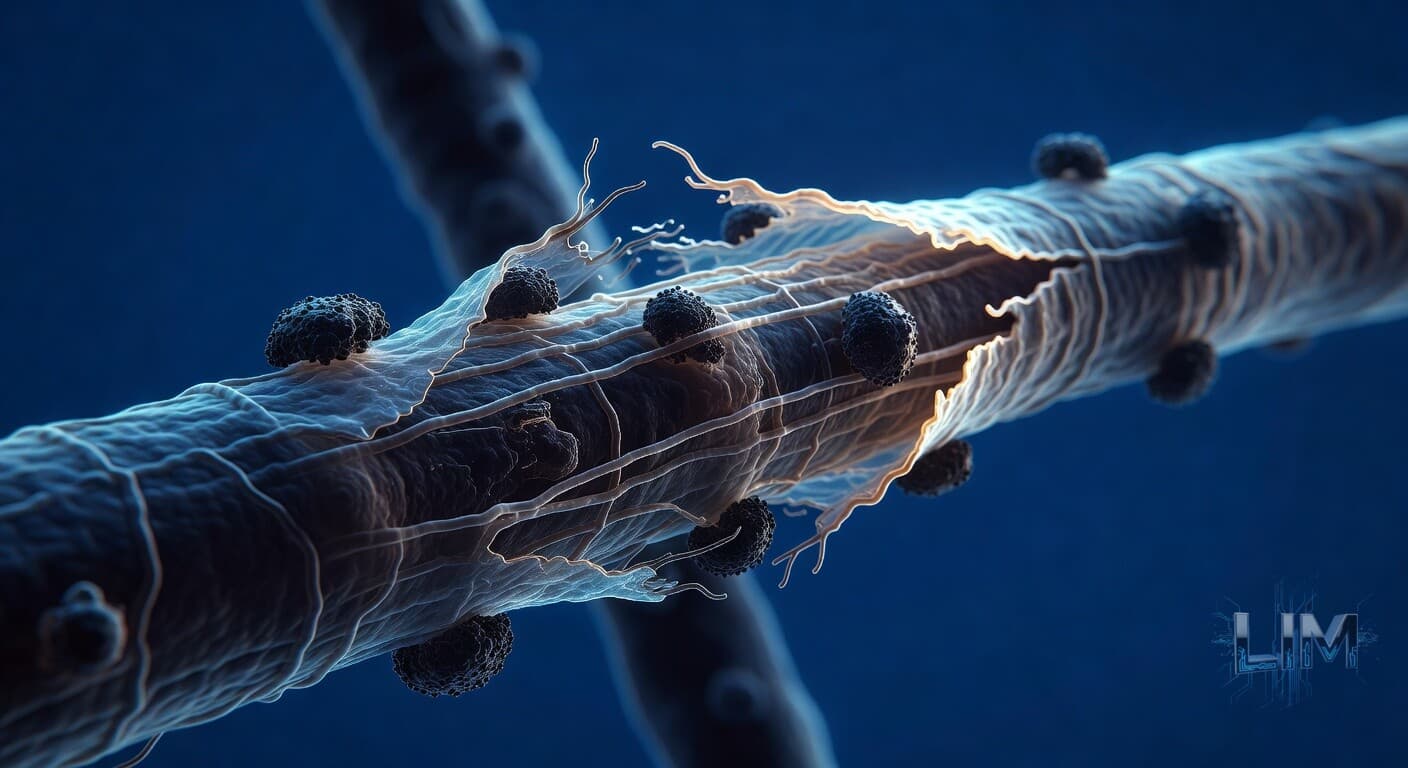
Your peripheral nerve is a cable. Schwann cells wrap each axon in lipid-rich myelin, and that insulation is what makes signals jump node-to-node fast enough for your grip to feel precise.
CIDP is your immune system deciding the insulation is foreign. Macrophages chew the paranodal region. In some cases, autoantibodies hit neurofascin-155, contactin-1, or CASPR1 (contactin-associated protein 1), and the axo-glial junction collapses.
Conduction slows. Diego's legs file for divorce by lap eight. The real question is not whether exercise is good — it is what training does to that exact failure mode.
Five mechanisms, none speculative
The cellular machinery for nerve repair responds to load. That is the through-line.
Aerobic exercise upregulates BDNF (brain-derived neurotrophic factor), GDNF (glial-derived neurotrophic factor), and NGF (nerve growth factor) — the three growth factors your Schwann cells need to do repair work. In rodent demyelination models, treadmill training accelerated remyelination versus sedentary controls (Bobinski et al, Neuroscience 2018).
Progressive resistance forces motor-unit recruitment per the Henneman size principle. In partially denervated muscle, surviving neurons sprout collateral axons to reinnervate orphaned fibers. You are not regenerating the failed axon. You are training every one that still works.
Cycling drives PGC-1 alpha (peroxisome proliferator-activated receptor gamma coactivator 1-alpha), your master switch for mitochondrial biogenesis. More mitochondria per surviving fiber means more usable torque per motor unit. That is why your VO2peak climbs in CIDP cohorts even when your nerve conduction velocity does not.
Acute exercise also spikes IL-6 (interleukin-6) from contracting muscle as a systemic anti-inflammatory that suppresses TNF-alpha (tumor necrosis factor alpha) (Pedersen, Physiological Reviews 2020). Chronic training shifts your regulatory T-cell to effector T-cell ratio. In an autoimmune demyelinating disease, that is noise reduction at the level of the process driving the disease.
Aerobic conditioning improves capillary density in the vasa nervorum. Better perfusion means faster clearance of inflammatory debris and better substrate to the Schwann cells doing the repair.
Walking is good. Walking does not rebuild mitochondria.
What Copenhagen actually proved
Markvardsen et al (Neurology, 2018) ran two linked interventions in stable CIDP patients on maintenance IVIG (intravenous immunoglobulin).
The aerobic arm sat on a cycle ergometer three times a week, progressing toward 70 to 80 percent of VO2peak. VO2peak rose 11 to 17 percent depending on the expression. Lactate threshold workload climbed in parallel.
The resistance arm ran progressive isokinetic and isotonic work three sessions a week — knee extensors, knee flexors, elbow flexors. Isokinetic knee extensor peak torque rose roughly 14 percent on the trained side. Fatigue Severity Scale scores dropped meaningfully.
The safety readout is the part that closed the debate. Zero participants crossed the deterioration threshold on the ONLS (Overall Neuropathy Limitations Scale), the MRC (Medical Research Council) sum score, or the nerve conduction panel. No training-attributable flares. The 2021 systematic review in the Journal of the Peripheral Nervous System pooled the field and the signal held.
That is not a cautious "might help." That is a hard number with a hard safety ceiling.
Rest was the slow road to decline
The traditional caution came from post-polio overwork-weakness theory and a handful of case reports. That extrapolation does not survive contact with CIDP data.
In stable disease, detraining gets you there faster than training does.
A sedentary CIDP patient loses cardiorespiratory capacity on top of the neural deficit. Fatigue compounds. Falls risk compounds. The neurological disease is immunological — the deconditioning is trainer-addressable, and conflating them is a programming error.
This is the pattern Chiron — our AI head coach — flags in the daily program review. When you log three consecutive sub-target walking days, the system pings you before your strength numbers regress, not after.
Program around the infusion, not the calendar
Maintenance IVIG patients live in a predictable arc. Days 1 to 3 post-infusion can include headache and flu-like residue. Days 4 to 14 are your functional peak. The final 3 to 7 days before the next infusion are the wear-off window with returning weakness (Hughes et al, Brain 2008).
Your heavy loading belongs in the peak window. The wear-off window takes low-intensity work and technique practice — not PR attempts.
For Diego, that means two in-peak sessions on the days his autonomic morning is stable and one active-recovery ride on the day after. Recumbent cycle over treadmill, because the fall-risk math on a sensory-ataxic patient is not a debate.
This is what HERMES is built for. HERMES — our research engine — scrapes 12,000 fitness and rehab papers a week so your protocol updates the moment new evidence on demyelinating disease and exercise lands. Your calendar bends to the infusion cycle, not the other way around.
Load like an adult, not a porcelain figurine
Neuropathy patients get under-loaded routinely because trainers confuse sensory ataxia with fragility.
The Markvardsen protocol used 70 to 80 percent of 1RM, three sets, supervised, progressing every two weeks. That is not a gentle protocol.
Knee extension, leg press, hip hinge, seated row, chest press, and a loaded carry that doubles as autonomic stress. Balance work goes at the end of the session. Proprioceptive training under fatigue is where you rehearse the falls you do not want.
Cap at two resistance sessions per week on flare-risk weeks. Three on stable weeks. The daily AI program update worker rewrites your week the moment your HealthKit logs a poor overnight, so a missed REM (rapid eye movement) block does not quietly turn Tuesday's leg press into a face-plant.
Substrate, sleep, sodium
Myelin is lipid. Remyelination needs substrate. Alongside your neurologist's plan:
- Methylcobalamin 1,000 mcg sublingual, not cyanocobalamin
- Methylfolate 400-800 mcg, not folic acid, to dodge the unmetabolized-folic-acid issue in MTHFR (methylenetetrahydrofolate reductase) variants
- D3 5,000 IU with K2 MK-7 100 mcg for regulatory T-cell function
- Magnesium glycinate 400 mg at night for sleep consolidation and cramp reduction
- Alpha-lipoic acid 600 mg — reasonable mechanistic carryover from the diabetic neuropathy literature (Ziegler et al, Diabetes Care 2006, NNT (number needed to treat) ~6)
Hydration and sodium get programmed, not suggested. A post-infusion day in dry HVAC (heating, ventilation, and air conditioning) can pull two to three liters out of you before you notice.
Monitoring and the red flags
Every four weeks: timed 10-meter walk, 30-second sit-to-stand, grip dynamometry, Fatigue Severity Scale.
Two consecutive sessions of regression is a call-the-neurologist signal — not a push-harder signal. Subjective weakness outpacing the DOMS (delayed-onset muscle soreness) window pauses training. So does any new sensory level, bowel or bladder change, or cranial nerve involvement.
None of those are training-induced in stable CIDP. The coach's job is to notice them before you do.
What twelve weeks actually buys you
A well-programmed replication of Markvardsen in a stable CIDP client buys you a 50 to 70 meter gain on the six-minute walk. A sit-to-stand jump from the low double digits to the high teens. Grip that holds steady in a progressive disease.
And a morning where Diego finishes his pool block without the mid-lap bench retreat.
That is the ceiling rehab offers in a demyelinating disease. It is not nothing.
Jake, who built LIM, is a hospital security supervisor who dropped 308 to 196 on 12-hour overnight shifts using the same autonomic-first, schedule-aware framework — minus the immunology. The neuropathy population needs that framework more, not less.
If you are a CIDP patient, a neurologist sending one, or a trainer who got handed one and went pale, start here.
---
Coaching that works the same shifts you do
This is what Chiron, our AI head coach, does on every meal and workout you log: catches the small wrong detail before it costs you years. HERMES — our research engine — surfaces new science the morning it publishes, so your coaching moves with the literature instead of trailing it by quarters. You log; we adapt your plan that day. No PDF reprints, no static plan that ages out the day your shift changes or you have a kid.
$29.99/month · $249.99/year · 7-day free trial · cancel anytime · no enrollment fee · no contract
Start coaching → · See the full app →
Jake Long built it after losing 112 lbs working hospital night shifts — when no human coach could keep up with his schedule. He wanted the system he wished he'd had at 308. Now you can use it too.
Questions Worth Asking
Is exercise safe for people with CIDP on IVIG?
Yes, in stable disease and supervised. The Markvardsen 2018 protocol ran 12 weeks of aerobic plus resistance training in stable CIDP patients on maintenance IVIG with zero deteriorations. The aerobic arm lifted VO2peak 11 to 17 percent and the resistance arm lifted knee extensor peak torque about 14 percent.
When in the IVIG cycle should CIDP patients lift heavy?
Heavy work goes in days 4 to 14 post-infusion, when the immune modulation has settled and conduction is at its functional best. The Markvardsen protocol used three weekly sessions on a cycle ergometer toward 70 to 80 percent of VO2peak, plus progressive isokinetic and isotonic resistance work.
Why does VO2peak go up in CIDP patients even when nerve conduction does not?
Cycling drives PGC-1 alpha, the master switch for mitochondrial biogenesis, so each surviving fiber produces more usable torque per motor unit. Aerobic training also raises capillary density in the vasa nervorum and upregulates BDNF, GDNF, and NGF, which Schwann cells use for repair. Output climbs even when conduction velocity stays flat.
Comments (0)
Comments are reserved for Legacy In Motion members.
$29.99/month. No contracts. Cancel anytime.
Get StartedAlready a member? Sign in
You read this far. Now do this.
Enough reading about it.
Time to train around the life you actually live.
I went from 308 to 196 lbs working 12-hour overnight shifts with two kids and zero personal trainer. The system I used is now an app that plans your training and meals around YOUR schedule — overnight, day shift, all of it.
Cancel anytime · No setup fee · No long contract
Free Assessment
What's Blocking Your Results?
Take our 60-second quiz and get a personalized breakdown of what's stopping your progress — plus how AI coaching solves it.
Take the QuizFree PDF · No Credit Card
Get the Shift Worker AI Fitness Blueprint
If your training keeps dying by week two, start here: the 4-week shift-worker protocol behind Jake's 112 lb loss, with the sleep timing and post-shift macros that made it stick.
Built by someone who actually worked them. No fluff. Unsubscribe any time.
Keep Reading
2026-04-22
PEA 600-1200mg for Shift-Worker Neuropathy
Pain Physician 2016 pooled 12 RCTs, n=1,484: PEA's NNT for 50% pain reduction was 1.5. Gabapentin sits at 6-8. Here's the protocol.
2026-04-22
The Hip Problem Hiding in Every Twelve-Hour Shift on Concrete
Fishman 2017 cleared symptoms in 79% versus 38% sham. For workers on concrete with a duty belt, the cause is mechanical and so is the fix.
2026-04-22
Benfotiamine at 600mg: The B-Vitamin Your Gut Cannot Absorb
Join our free fitness community — get coaching tips, share wins, and stay accountable.
JOIN THE DISCORD →