


Weight Loss Plateau? Here's What Your Program Isn't Adjusting For
Hit a weight loss plateau? It's not your willpower. Your program stopped adapting. Here's the science behind plateaus and how adaptive coaching breaks through.
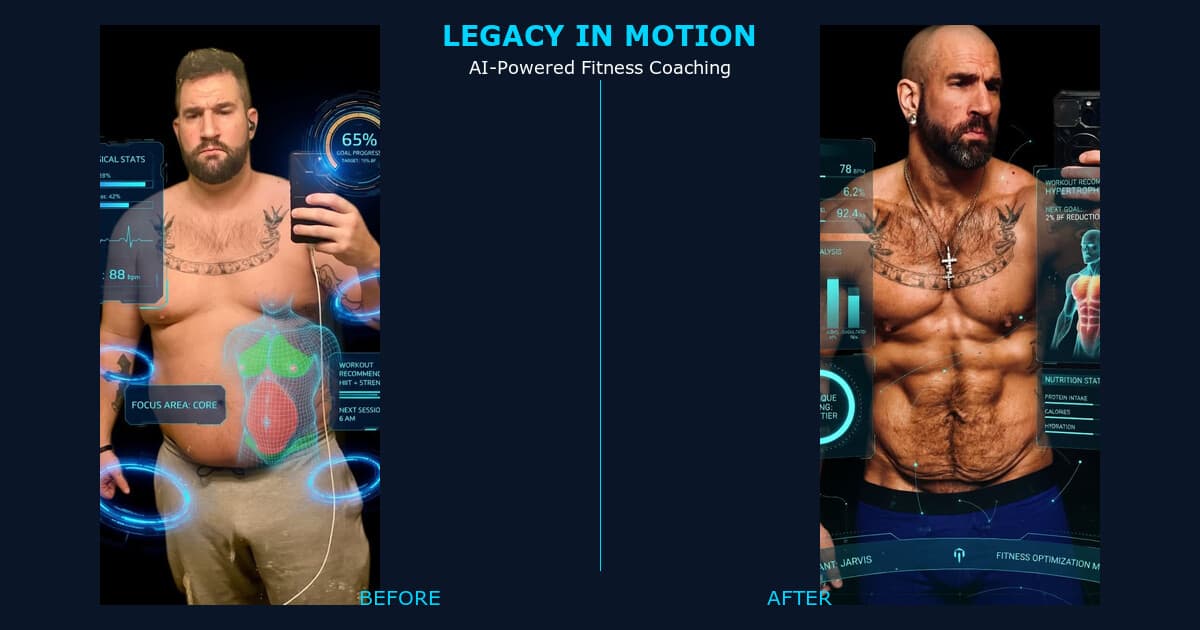
You did everything right for ten weeks. The scale moved, your jeans fit different, the protocol was working. Then it stopped. The same calories, the same workouts, the same discipline, and the weight loss plateau hit like a wall. You're not broken. Your program is.
A weight loss plateau is not a willpower problem. It's a math problem your program never solved. Every diet and training plan in existence was built for the body you had on day one. The body you have on day 70 is a different machine. Lighter, more efficient, hormonally adapted, and burning fewer calories at rest than it did when you started. If the program never recalculates, the math collapses. That's stuck weight loss in one paragraph.
I lost 112 pounds working hospital security. 308 to 196. I hit four real plateaus on the way there, and every single one of them broke the same way: I stopped trusting the original numbers and started trusting current ones. Here's what your program almost certainly isn't adjusting for, and what to do about it.
Why Weight Loss Stopped: The Three Things That Changed Without You Noticing
When people ask why weight loss stopped, they usually want a single answer. There isn't one. There are three changes happening simultaneously, and any one of them can stall progress on its own.
Related Read
5 Minutes of Lowering Beats 45 Minutes of Lifting: ECU's 2026 Eccentric Protocol for Desk Workers, Busy Parents, and Anyone Over 40 Without Gym TimeEdith Cowan University's 2026 trial in the Journal of Sport and Health Science (Vol. 15, 101126) found that four bodyweight eccentric exercises — chair squats, chair reclines, wall push-ups, heel drops — performed for five minutes a day produced measurable gains in strength, flexibility, strength-endurance, and mental health in sedentary adults. No gym, no equipment, no soreness. Here is the protocol, the mechanism, and the way we are wiring it into AI coaching for desk-bound parents over 40.
1. Your Maintenance Calories Dropped
Lose 30 pounds and you're carrying 30 fewer pounds up every flight of stairs, into every workout, around every grocery store. Less mass to move means fewer calories burned moving it. A 250-pound person might maintain at 2,800 calories. That same person at 220 might maintain at 2,450. If your "deficit" was 500 calories below your starting maintenance, after 30 pounds it's only 150 calories below your current one. That's not a deficit. That's a slow stall.
The Cell Metabolism work on energy expenditure (Pontzer et al., 2021) confirms total daily energy burn drops faster than body weight loss accounts for, because your body actively downregulates non-exercise activity. You fidget less. You take the elevator without thinking. Your watch still says you walked 8,000 steps, but the intensity dropped.
2. Adaptive Thermogenesis Kicked In
This is the part nobody warns you about. After roughly 8 to 12 weeks in a deficit, your body starts spending fewer calories on the same tasks. The Biggest Loser follow-up study (Fothergill et al., Obesity, 2016) found participants were burning around 500 fewer calories per day than predicted six years post-show. The number is dramatic in extreme cases, but the principle applies to anyone losing meaningful weight: metabolic adaptation is real and your program needs to plan for it.
3. Your Training Stopped Producing the Same Stimulus
Your first 8 weeks of squats built muscle and torched calories because the movement was new and hard. By week 12, the same weight is your warm-up. Same movement, same load, smaller hormonal and metabolic response. If your program is repeating the same lifts at the same loads, your body has already adapted. That's the entire definition of plateau after losing weight: your stimulus stopped scaling with your capacity.
The Real Reason Programs Stall: They Were Never Built To Adapt
Here's the uncomfortable truth about most fitness programs, including the expensive ones. They are static documents. A PDF. A 12-week template. A trainer's stock split. They were written before they ever met you, and they get rewritten every 8 to 12 weeks if you're lucky.
Your body recalculates daily. The program recalculates quarterly. That gap is where every plateau lives.
When I was figuring this out on hospital security shifts, I had no coach. No app that adapted. I had a notebook, a food scale, and a willingness to do math at 3 a.m. on lunch break. Every two weeks I recalculated my maintenance from actual data: weight trend, sleep quality, training output, mood. Then I adjusted protein, carbs, training volume, and step targets accordingly. Not because I read it in a book. Because the alternative was being stuck.
That manual loop is what we built into AI coaching at Legacy In Motion. The idea isn't that the AI is magic. The idea is that it never forgets to recalculate.
How To Break A Weight Loss Plateau (Without Doing Something Stupid)
Most plateau advice is bad. Cut more calories, do more cardio, fast longer, eliminate carbs. That's how you torch your metabolism, your sleep, and your dignity. Here's what actually works.
Recalculate Maintenance From Current Weight, Not Starting Weight
Use the Mifflin-St Jeor equation with your current weight, not the one on your driver's license. Multiply by your honest activity factor (1.4 if you mostly sit, 1.55 if you train 3 to 4 times a week, 1.7 if you're on your feet for work). That number is your new maintenance. Your deficit should be 15 to 20 percent below it. Not 500 calories below the old one.
Add A Diet Break
Counterintuitive but proven. The MATADOR trial (Byrne et al., International Journal of Obesity, 2018) found participants who alternated 2 weeks of dieting with 2 weeks at maintenance lost more fat and kept more of it off than continuous dieters. The maintenance weeks reset leptin, restore training capacity, and break the adaptive thermogenesis spiral. Two weeks at your new maintenance is not "falling off." It's strategy.
Hit Protein Hard
If you've been losing weight for more than 12 weeks, your protein target should be 2.0 to 2.4 grams per kilogram of your goal weight, not your current weight. Protein protects lean mass during a deficit (Helms et al., Journal of the International Society of Sports Nutrition, 2014), and lean mass is what keeps your metabolism from collapsing further. Most stuck-weight-loss cases I see are eating 0.8 g/kg and wondering why progress stopped.
Change The Stimulus, Not Just The Volume
Don't add a fourth weekly session. Change one variable in the three you're already doing. Switch from straight sets to clusters. Add a tempo. Drop the load 10 percent and add 4 reps. Add a top set above your normal working weight. Your nervous system needs new information, not more of the same input.
Audit Sleep And NEAT
Sleep under 6 hours a night cuts fat loss by 55 percent compared to 8.5 hours on the same calorie deficit (Nedeltcheva et al., Annals of Internal Medicine, 2010). And NEAT, the calories you burn fidgeting and walking and existing, drops silently in a deficit. If your daily steps fell from 9,000 to 6,000 without you noticing, that's 200 to 300 calories of disappeared deficit per day. Track it. Defend it.
For more on the training side of this, see our breakdown on adaptive training and the deeper AI personal trainer post.
What Adaptive Coaching Actually Adjusts For
The reason a weight loss plateau is rarer with adaptive AI coaching isn't that the AI knows secrets a good coach doesn't. It's that the AI doesn't get tired, doesn't forget, and doesn't have 40 other clients diluting its attention.
A program built to adapt is checking, every week:
- Is your current weight trending in the direction we want at the rate we predicted?
- If not, is the cause calorie intake, training output, sleep, stress, or NEAT?
- Does protein scale to your current goal weight or has it drifted?
- Has any lift stalled for two consecutive weeks (a training plateau, not a weight one)?
- Are recovery markers (resting heart rate, HRV, sleep quality) telling us to deload or push?
- Is the deficit still 15 to 20 percent below your current maintenance, or did your maintenance drop?
When any of those flags trip, the protocol updates. Calories, macros, training variables, step targets, recovery work. Not next quarter. This week.
That's what your static PDF can't do. Not because PDFs are bad, but because plateaus are dynamic problems and PDFs are frozen solutions.
The Honest Catch
AI coaching that adapts isn't magic, and it isn't a replacement for showing up. You still have to lift the weights. You still have to eat the protein. You still have to sleep. The system removes the math problem and the second-guessing, not the work. Anyone selling you a program that doesn't require effort is selling you a plateau.
What the system does remove is the feeling of being stuck and not knowing why. That feeling is what kills transformations, more than the plateau itself. People don't quit because the scale stopped moving. They quit because they don't know what to do next, and the silence is worse than the work.
If You're Stuck Right Now
Here's the short version. Today:
- Weigh yourself, calculate current maintenance from current weight, set a 15 to 20 percent deficit.
- Lock protein at 2.0 to 2.4 g/kg of goal weight.
- Audit your last two weeks of training. If load and volume are flat, change one variable this week.
- Count steps. If they dropped, set a daily floor and defend it.
- Sleep 7 to 9 hours, no negotiation.
- If you've been in deficit for 12+ weeks, plan a 2-week diet break at maintenance. Then resume.
If that feels like a lot to track manually, it is. I did it on a paper notebook for 18 months because I had to. You don't have to. That's the entire reason Legacy In Motion exists.
See What Coaching That Actually Adjusts Looks Like
Most programs hand you a plan. We built one that updates with you. Adaptive AI coaching that recalculates your protocol every week based on real data, not the assumptions made on day one.
Take the 90-second quiz to see what your protocol would look like, or start the 30-day free trial at legacyinmotion.fit and watch a program that actually moves with you.
Plateaus aren't proof you failed. They're proof your program stopped paying attention. Find one that doesn't.
Comments (0)
Comments are reserved for Legacy In Motion members.
Free 30-day trial — first 100 customers only.
This won’t last.
Start Your Free TrialAlready a member? Sign in
Ready to Build a Plan That Fits Your Schedule?
I went from 308 to 196 lbs working 80-hour weeks. Our AI coaching adapts to your schedule, recovery data, and real-time progress — so every workout actually counts.
Start Your Free 30-Day TrialNo enrollment fee. No commitment.
Free Assessment
What's Holding Your Fitness Back?
Take our 60-second quiz and get a personalized breakdown of what's stopping your progress — plus how AI coaching solves it.
Take the QuizFree PDF · No Credit Card
Get the Shift Worker AI Fitness Blueprint
The exact 4-week protocol Jake used to lose 112 lbs working hospital security overnights — sleep timing, the four-minute REHIT window, post-shift macros, and the AI deload trigger. Drops in your inbox in 30 seconds.
Built by someone who actually worked them. No fluff. Unsubscribe any time.
Keep Reading
2026-05-11
5 Minutes of Lowering Beats 45 Minutes of Lifting: ECU's 2026 Eccentric Protocol for Desk Workers, Busy Parents, and Anyone Over 40 Without Gym Time
Edith Cowan University's 2026 trial in the Journal of Sport and Health Science (Vol. 15, 101126) found that four bodyweight eccentric exercises — chair squats, chair reclines, wall push-ups, heel drops — performed for five minutes a day produced measurable gains in strength, flexibility, strength-endurance, and mental health in sedentary adults. No gym, no equipment, no soreness. Here is the protocol, the mechanism, and the way we are wiring it into AI coaching for desk-bound parents over 40.
2026-05-10
Pickleball Over 40: The JOSPT 2026 Paper Saying Your Shoulder Is the Tissue at Risk, Not Your Knee
JOSPT Open 2026 (0171), n=2,055, the SPRINT-Pickleball cohort: upper-extremity injuries are the prevalence story nobody is telling pickleball players over 40. Shoulder and lateral elbow are the load-bearing tissues, and the fix is not a brace. It's three lifts a week, a 7-minute warm-up, and a coach who knows the paper landed.
2026-05-09
Mayo Clinic Proceedings 2026: Walking Pace Reclassified Mortality Risk Better Than Blood Pressure or Cholesterol in 407,569 Adults
Wang/Yates UK Biobank cohort (Mayo Clinic Proceedings, 23 March 2026, n=407,569): walking pace was the single strongest mortality predictor. Swapping BP + cholesterol for self-reported pace reclassified people into more accurate risk bands. The over-40 desk worker who's been treadmilling at 2.7 mph for nine months has been training the wrong variable.
Join our free fitness community — get coaching tips, share wins, and stay accountable.
JOIN THE DISCORD →