


The Wednesday Office Reset: 4 Movements, 5 Minutes, and Why Your Standing Desk Has Been Lying to You Since Monday
By Wednesday at 10:14 a.m. the gym ambition is dead. The Tuesday excuse is dead. The standing desk has been up for 96 hours and the calves have not moved. Here is the four-movement, five-minute eccentric office protocol — built on the ECU 2026 paper (JSHS Vol. 15, 101126) — and the AI coach who knows when to push it into your inbox.
It is Wednesday, 10:14 a.m. Marcus is 46, a director of finance, two kids in middle school, the standing desk has been up since Monday morning, and the calves have not moved in 96 hours. He is on his third Zoom of the day. Monday's gym ambition died at 7:42 a.m. when the daycare drop-off line was twelve cars deep. Tuesday's "I'll go after work" excuse died at 6:38 p.m. when his nine-year-old asked for help with a science fair display board. He has now spent three full workdays standing in roughly the same square foot of carpet, told by every wellness blog he has read since 2018 that this is the upgrade.
It is not the upgrade. Marcus's HRV at 10:14 a.m. is identical to what it was at 10:14 a.m. on Tuesday. His grip strength is unchanged. His lumbar erectors have been holding the same isometric contraction for the better part of three days and his hip flexors are at the most-shortened position they have been in all year. He is upright, and his physiology has registered no difference between that and sitting.
Marcus does not need a 45-minute lunch workout he will not take. He does not need another posture lecture. He needs five minutes, four movements, and a coach who knows that Wednesday at 10:14 is the actual recovery window — not "later this week." That is the wedge.
TL;DR
- **Standing desks correct one variable (spinal flexion) and miss the one that matters: movement volume under eccentric load.** Three days of standing changes nothing the body is actually waiting for.
- The four-move office protocol comes out of the same paper that anchored our [eccentric piece on Sunday](/blog/five-minute-eccentric-protocol-ecu-2026-nosaka-desk-worker-busy-parent-over-40-no-gym) — **Kirk, Nosaka, et al., Journal of Sport and Health Science 2026, Vol. 15, Article 101126**. Five minutes a day, four bodyweight eccentric movements, four weeks, measurable strength + flexibility + mental-health gains in sedentary adults.
- **The four movements re-keyed for an office, in clothes you already have on:** slow chair lower (eccentric squat), wall press-down (eccentric push-up), heel drop on a step or curb, and the desk-edge eccentric row using your bodyweight against the desk. 10 reps each, 4-second lowering phase, zero equipment, zero shower.
- **Wednesday is the recovery day that works**, not because of anything mystical about midweek — but because Monday and Tuesday have already failed, the rest of the week is going to look like Wednesday, and the workout you do at your desk at 10:14 is the only one that will actually happen.
- This is not "instead of" a real program. It is the floor. The 5-minute protocol is what holds the line while the AI builds you the program that fits the *actual* week you have, not the imaginary one.
---
Related Read
5 Minutes of Lowering Beats 45 Minutes of Lifting: ECU's 2026 Eccentric Protocol for Desk Workers, Busy Parents, and Anyone Over 40 Without Gym TimeEdith Cowan University's 2026 trial in the Journal of Sport and Health Science (Vol. 15, 101126) found that four bodyweight eccentric exercises — chair squats, chair reclines, wall push-ups, heel drops — performed for five minutes a day produced measurable gains in strength, flexibility, strength-endurance, and mental health in sedentary adults. No gym, no equipment, no soreness. Here is the protocol, the mechanism, and the way we are wiring it into AI coaching for desk-bound parents over 40.
What the standing desk got wrong
The standing-desk movement was sold on a clean idea: sitting compresses the lumbar discs, shortens the hip flexors, and reduces overall caloric expenditure compared to standing. All true. What got papered over is what standing — without eccentric loading, without ankle/calf motion, without hip motion — actually does for you.
It does very little. Stationary standing changes posture but not muscle activation patterns in the lower body in any meaningful way. Calves, hamstrings, glutes, hip flexors — every muscle that needed motion is now holding a slightly different isometric and still not lengthening or shortening under load. EMG studies on prolonged standing show the same low-grade tonic activation as prolonged sitting, just in slightly different fibers. The downstream signals — venous return, HRV recovery, lymphatic flow, mitochondrial turnover — are nearly indistinguishable.
What actually moves those needles is eccentric loading in short bouts, repeated through the day. Five minutes of slow lowering does more for HRV at the 4 p.m. mark than four hours of standing at a desk. That is not a hot take. That is what falls out of every well-controlled trial on movement snacks and brief eccentric protocols going back a decade.
The standing desk is not bad. It is just oversold. The 96 hours Marcus has spent on his feet by Wednesday at 10:14 are not the upgrade his body has been waiting for. The five minutes between 10:14 and 10:19 are.
---
The four-move office protocol
Each movement is 10 reps, 4-second eccentric (lowering) phase, no rest between. Total time: ~5 minutes including transitions. Wear what you have on. If you keep flat shoes under your desk, swap into them. If not, the protocol works in socks.
1. Slow chair lower (eccentric squat). Stand in front of your chair, feet shoulder-width. Reach your hips back as if to sit, but take four full seconds to lower yourself until your seat just touches the chair. Stand back up at normal speed. That's one rep. Ten reps. This is your quad/glute eccentric — the single most-leveraged movement in the protocol for tendon resilience after 40.
2. Wall press-down (eccentric push-up). Stand arm's length from the wall, palms flat at shoulder height. Lower yourself toward the wall over four seconds until your nose is about an inch from the surface. Push back at normal speed. Ten reps. This is your chest/shoulder/anterior-core eccentric — and the one that quietly trains the scapular control most desk workers have lost by Wednesday.
3. Heel drop on a step or curb. Step or stair edge, balls of feet on the edge, heels hanging off. Push up to the top of the heel raise. Then lower your heels over four seconds until they're below the level of the step. Push back up. Ten reps each side, or twenty total if you're doing both feet simultaneously. This is your gastroc/soleus eccentric — the one the 96-hour standing desk has been pretending to provide and has not.
4. Desk-edge eccentric row. Grip the front edge of your desk with both hands. Walk your feet forward so your body angles back, arms straight. (If your desk is heavy enough — most are. If you have a flimsy desk, use a sturdy bookshelf or door frame.) Pull your chest toward the edge. Then lower yourself back to straight-arm hang over four seconds. Ten reps. This is the only pulling movement most desk workers will do all week. It is also the single fastest fix for the shoulder-rolled-forward Wednesday posture.
Total: 40 reps, ~5 minutes, no equipment, no clothes change, no shower. Done at 10:14 you are back on your 10:30 call with no one the wiser, and your physiology has just registered the first eccentric loading it has seen since Sunday.
---
Why eccentric (and why this protocol works for the over-40 desk-bound)
Every muscle contraction has two phases: concentric (shortening under load — standing up from the chair) and eccentric (lengthening under load — lowering yourself into the chair). For most of the strength-training era the eccentric was treated as the bored half of the rep — the part you got through to set up the next contraction.
That was always backwards. Three things about eccentric work matter especially for adults over 40 who do not have an hour:
Eccentric contractions produce ~1.3 to 1.8× the force of concentric at the same load. That is why you can lower more than you can lift. It is also why a four-second lowering phase against your own bodyweight is a real stimulus — not a watered-down version of "lifting."
Eccentric work has a lower metabolic cost per unit of force. You don't end the session needing a shower. Heart rate barely climbs. The 10:14 session does not bleed into the 10:30 call.
Eccentric loading is the strongest signal we have for tendon collagen turnover. Over 40, tendon resilience — Achilles, patellar, shoulder cuff, lumbar fascia — is the variable that determines whether your next decade of training is uninterrupted or punctuated by six-week rehab blocks. Five minutes a day of eccentric loading builds that resilience. Hours of standing do not.
The ECU paper that anchors all of this — Kirk, Nosaka, et al., Journal of Sport and Health Science 2026, Vol. 15, Article 101126 — found measurable gains in muscle strength, flexibility, strength-endurance, and mental health markers in sedentary adults using exactly this approach. Four weeks. Five minutes a day. No gym.
---
The Wednesday-specific case
Most blog protocols treat days of the week as interchangeable. They are not. Wednesday is its own animal.
Monday is the day the week's plan still feels possible. Tuesday is the day you tell yourself you'll start "tomorrow." By Wednesday at 10:14 a.m. both of those stories have collapsed. The gym shoes are still where you put them Sunday night. The week's macros are off track. The standing desk is up because you read a wellness article in 2019 and you have not actually moved your lower body in 96 hours.
The Wednesday office reset is not about heroics. It is about admitting that the workout you keep promising yourself you'll do "later" — at lunch, after work, on Friday morning — is not going to happen. The workout that will happen is the one you do at 10:14 between Zooms, in business casual, in five minutes, at your desk. Wednesday is when you switch from optimizing for the workout you want to do to the workout that exists.
If the protocol holds for the rest of the week — Wednesday 10:14, Thursday 10:14, Friday 10:14 — you have logged 15 minutes of eccentric loading by EOD Friday. That is more than most desk workers over 40 are doing on purpose. It is the difference between "I didn't train this week" and "I trained four times this week." Same nervous system. Different story you tell yourself going into Saturday.
---
The internal cluster — why this site keeps writing about the desk-bound over-40 wedge
This is the fourth piece in a four-node cluster aimed at exactly this niche:
- **[ECU 2026 eccentric protocol](/blog/five-minute-eccentric-protocol-ecu-2026-nosaka-desk-worker-busy-parent-over-40-no-gym)** — the foundational paper. If you read one piece, read that one first.
- **[Mayo Clinic Proceedings 2026: walking pace as a mortality reclassifier](/blog/walking-pace-mayo-clinic-proceedings-2026-vital-sign-over-40-desk-workers)** — what the treadmill speed should actually be.
- **[Weekend warrior workouts for busy parents (JAMA 89573)](/blog/weekend-warrior-workouts-jama-89573-study-busy-parents-saturday-morning)** — what the Saturday session looks like when Monday–Friday is wrecked.
- **This piece** — what the workday floor looks like when even the weekend session is in jeopardy.
The point of the cluster: every adult over 40 who tells me they "don't have time to train" actually has four 5-minute windows on a Wednesday and one 45-minute window on a Saturday. The job of the program is not to invent time you do not have. It is to find the time you already have and put the highest-leverage stimulus inside it.
---
What the AI coach actually does with this
I've written the protocol out here so anyone can run it. The reason most desk workers over 40 still won't is the same reason they didn't run the ECU protocol from two days ago: nobody nudged them at 10:14.
That is the part the AI does. Architect (our head coach bot) knows your schedule — your worst-Zoom-density window, your meeting-free buffers, your Monday-Tuesday-Wednesday miss pattern. He doesn't ask "did you work out today?" at 9 p.m. when the answer is locked. He sends the cue at 10:13 a.m. on a Wednesday, two minutes before the buffer ends, when the workout can still actually happen. The five-minute protocol turns the rest of the day around. The 9 p.m. check-in is a postmortem; the 10:13 nudge is a save.
That's the wedge. Not a better workout. A coach that knows the paper, knows your week, and knows that Wednesday at 10:14 a.m. is the point of intervention — not Saturday morning when the damage is already three full days deep.
If you want the program built around your week — including the 5-minute office windows the protocol fits into — start the 30-day free trial. Architect will pull the protocol into your week 1 and adjust the timing based on your actual calendar by Friday.
---
— Jake
Free 30-day trial → legacyinmotion.fit. After trial: $99.97/month. Founding members: $999.70/year or $4,998.50 lifetime.
Comments (0)
Comments are reserved for Legacy In Motion members.
Free 30-day trial — first 100 customers only.
This won’t last.
Start Your Free TrialAlready a member? Sign in
Ready to Build a Plan That Fits Your Schedule?
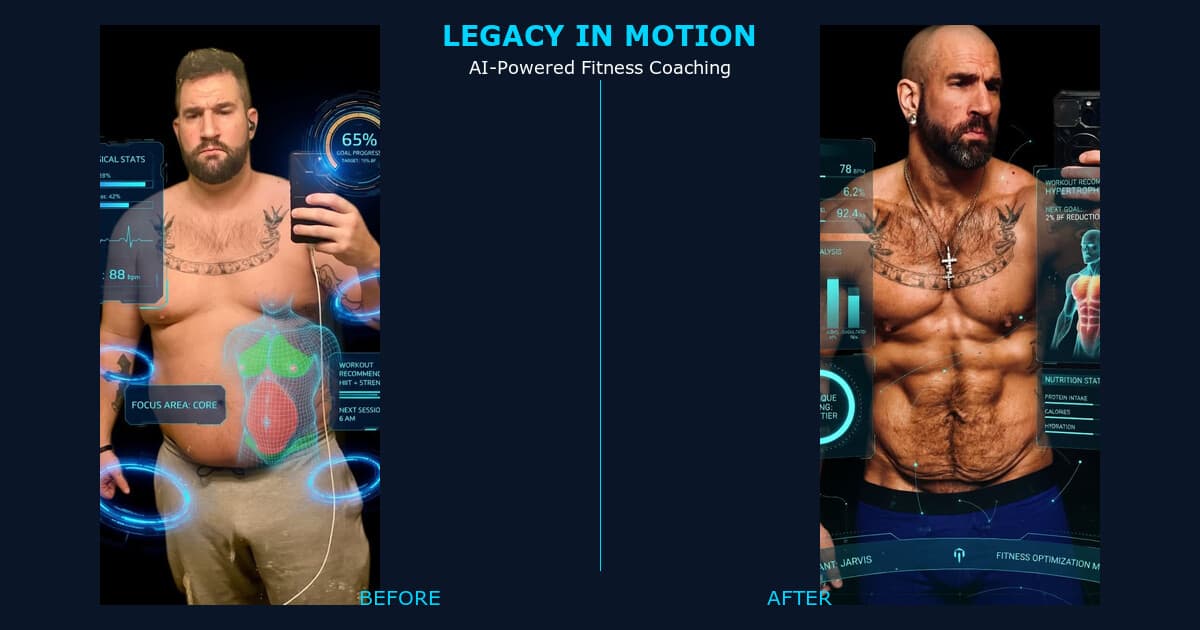
I went from 308 to 196 lbs working 80-hour weeks. Our AI coaching adapts to your schedule, recovery data, and real-time progress — so every workout actually counts.
Start Your Free 30-Day TrialNo enrollment fee. No commitment.
Free Assessment
What's Holding Your Fitness Back?
Take our 60-second quiz and get a personalized breakdown of what's stopping your progress — plus how AI coaching solves it.
Take the QuizFree PDF · No Credit Card
Get the Shift Worker AI Fitness Blueprint
The exact 4-week protocol Jake used to lose 112 lbs working hospital security overnights — sleep timing, the four-minute REHIT window, post-shift macros, and the AI deload trigger. Drops in your inbox in 30 seconds.
Built by someone who actually worked them. No fluff. Unsubscribe any time.
Keep Reading
2026-05-11
5 Minutes of Lowering Beats 45 Minutes of Lifting: ECU's 2026 Eccentric Protocol for Desk Workers, Busy Parents, and Anyone Over 40 Without Gym Time
Edith Cowan University's 2026 trial in the Journal of Sport and Health Science (Vol. 15, 101126) found that four bodyweight eccentric exercises — chair squats, chair reclines, wall push-ups, heel drops — performed for five minutes a day produced measurable gains in strength, flexibility, strength-endurance, and mental health in sedentary adults. No gym, no equipment, no soreness. Here is the protocol, the mechanism, and the way we are wiring it into AI coaching for desk-bound parents over 40.
2026-05-09
Mayo Clinic Proceedings 2026: Walking Pace Reclassified Mortality Risk Better Than Blood Pressure or Cholesterol in 407,569 Adults
Wang/Yates UK Biobank cohort (Mayo Clinic Proceedings, 23 March 2026, n=407,569): walking pace was the single strongest mortality predictor. Swapping BP + cholesterol for self-reported pace reclassified people into more accurate risk bands. The over-40 desk worker who's been treadmilling at 2.7 mph for nine months has been training the wrong variable.
2026-05-10
Pickleball Over 40: The JOSPT 2026 Paper Saying Your Shoulder Is the Tissue at Risk, Not Your Knee
JOSPT Open 2026 (0171), n=2,055, the SPRINT-Pickleball cohort: upper-extremity injuries are the prevalence story nobody is telling pickleball players over 40. Shoulder and lateral elbow are the load-bearing tissues, and the fix is not a brace. It's three lifts a week, a 7-minute warm-up, and a coach who knows the paper landed.
Join our free fitness community — get coaching tips, share wins, and stay accountable.
JOIN THE DISCORD →