


Grip Strength and the 30 to 50 Mortality Window
A $40 dynamometer beats your blood pressure cuff at predicting how you die. 641,984 adults agree. Here's the 12-minute fix.
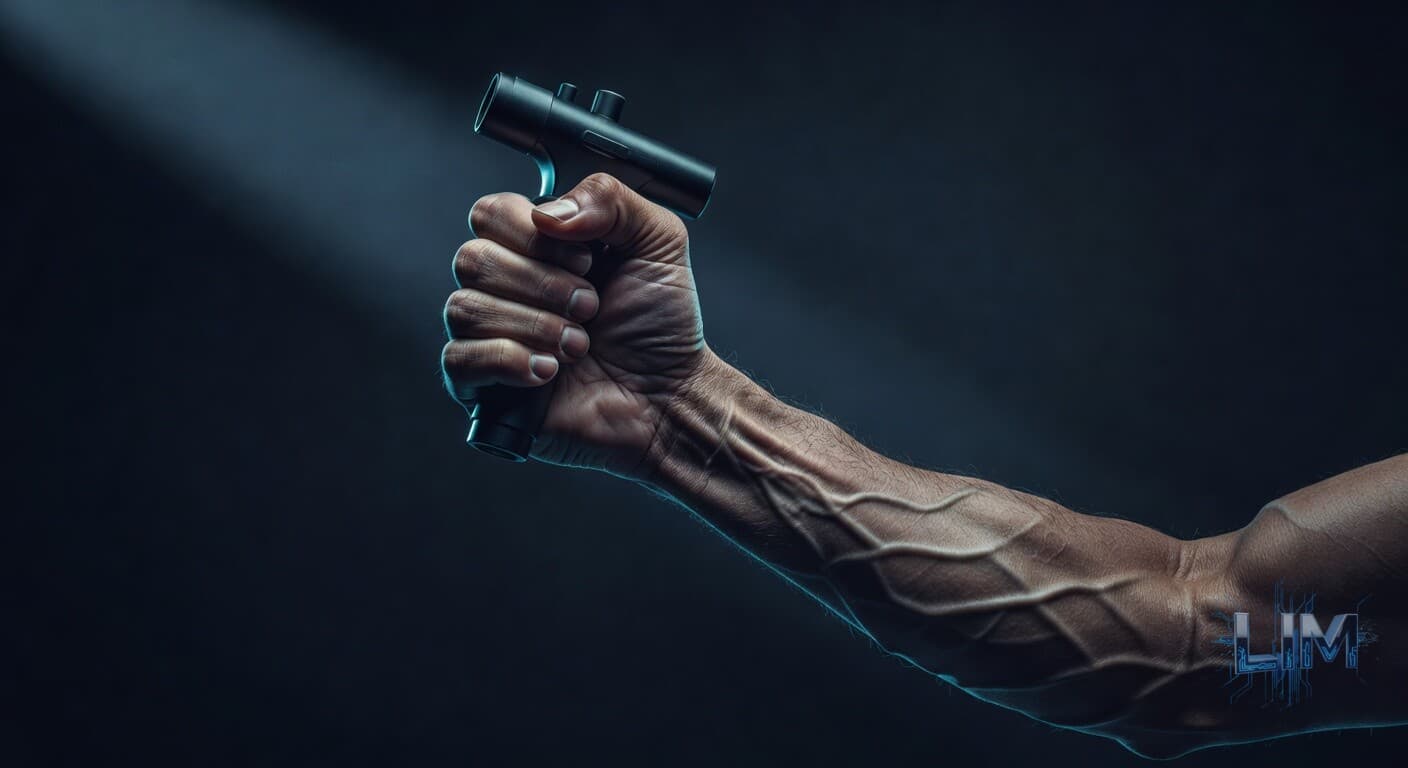
Renee, 47, ICU tech, two grown kids, 6:42 AM in her kitchen in a tied-back ponytail and yesterday's hoodie. She is trying to open a jar of green olives before her shift. She has been at it for ninety seconds. The jar is winning.
She is not weak. She lifts heavy three days a week. She moves sedated 220-lb patients off ventilators for a living. She is losing to a jar because her grip — the specific output of her thumb adductor and finger flexors — has been bleeding for two years, and nobody on her team has been measuring it.
TL;DR - Every 5 kg of grip lost = 17% higher all-cause mortality (Leong, Lancet 2015, PURE, n=139,691). - UK Biobank (Celis-Morales, BMJ 2018, n=502,293): grip beats systolic blood pressure as a cardiovascular death predictor. - Bohannon 2019 dominant-hand means: ~45 kg (men 40-49), ~28 kg (women 40-49). - Probable-sarcopenia floor: 27 kg men / 16 kg women. A lot of 45-year-olds are camped there. - Three lifts, twelve minutes, twice a week. The dynamometer tells you it's working.
The Cheapest Biomarker In Medicine Costs $40
A handheld dynamometer runs about the price of one lab draw. Squeezed correctly, it out-predicts the cuff Renee's doctor straps on every visit.
Related Read
Longevity Biomarkers Meet AI Coaching: The 2026 Protocol Busy Parents and Desk Workers Can Actually Run DailyEveryone's chasing longevity in 2026, but the real edge isn't another supplement stack. It's AI that reads your actual biomarkers and calendar, then builds metabolic-prevention protocols busy parents and desk workers can execute between meetings and school runs. Here's the part the retreats and generic apps miss.
That isn't a hot take. It's a 502,293-person prospective cohort in The BMJ.
Every 5 kg drop in handgrip carries roughly 17% higher all-cause mortality — and 17% higher cardiovascular mortality (Leong et al, Lancet 2015, n=139,691, 17 countries). The signal holds across income tiers, both sexes, and after excluding deaths in the first two years.
The kicker: adding grip to a baseline cardiovascular model improves prediction more than adding systolic blood pressure does (Celis-Morales, BMJ 2018).
A cuff measures one second of arterial pressure. A dynamometer measures the decade behind you.
Both matter. Only one usually gets measured.
This is the kind of pattern Chiron — our AI head coach — flags in the daily program review the moment your dynamometer log trends sideways.
Where The Number Should Be
Dominant-hand means, the windows that matter (Bohannon, J Geriatr Phys Ther 2019).
Men: - 30 to 39: ~46 kg - 40 to 49: ~45 kg - 50 to 59: ~41 kg
Women: - 30 to 39: ~28 kg - 40 to 49: ~28 kg - 50 to 59: ~25 kg
The European Working Group on Sarcopenia in Older People sets probable-sarcopenia at 27 kg (men) and 16 kg (women). A 47-year-old camped there isn't "low normal." She's carrying the mortality signal both cohorts quantified.
No dynamometer? Use the dead-hang proxy. A 40-year-old man in the green zone holds 45 to 60 seconds passive on a cold attempt. A 40-year-old woman, 30 to 45 seconds.
Capped under 20 seconds inside the 30-to-50 window? Act this week.
HERMES — our research engine — scrapes roughly 12,000 fitness and longevity papers a week, so the cut points the program trains against update the moment the literature does.
Why The 30-To-50 Window Is The Slope-Setter
Renee's job is twelve hours of intermittent maximal output. A combative patient takes her from resting heart rate to lifting another adult off the floor in under sixty seconds.
The grip is the rate-limiting input on every transfer, every IV bag, every locked drawer, every jar.
And it declines silently. The first time most adults find out is when something exposes it — a restraint call, a fall, an olive jar at 6:42 AM.
Jake, who built this app, was a 308-pound hospital security supervisor working graveyard shifts. He's 196 now. The scale got the credit; the grip was the quieter signal. Late in the cut, around 214, he carried eight grocery bags from the truck to the kitchen in one trip. At 308 the same haul took three trips and a tailgate lean.
What he noticed wasn't the weight he'd lost. It was the weight he could hold.
Three Lifts, Twelve Minutes, Twice A Week
This is the whole intervention. Twelve minutes. Two sessions. Done.
Dead Hangs
Pull-up bar, doorframe bar, any sturdy edge. Shoulder-width, palms forward, shoulders packed, feet off the ground.
- Week 1-2: 3 sets max hold, 90s rest. Most untrained 40-year-olds start at 12-25 seconds.
- Week 3-6: 3 sets, target 45 seconds.
- Week 7+: 3 sets of 60, then add a 5-10 lb belt and drop back to 30.
Sixty seconds at bodyweight is the floor for any adult under 50.
Farmer Carries
Two heavy dumbbells, kettlebells, or a trap bar. Tall posture, ribs down, nose breathing, straight line.
- Week 1-2: 3 rounds of 40 m at ~50% bodyweight total load.
- Week 3-6: 3 rounds at 75%.
- Week 7+: 3 rounds at 100% bodyweight.
Carry to grip failure on the last set. The forearm pump that arrives around 30 seconds is the adaptation.
Plate Pinches
Two smooth-sided 10 lb plates, smooth sides out, pinched between thumb and four fingers. One hand at a time.
- Week 1-2: 3 sets of 20 seconds per hand.
- Week 3-6: 3 sets of 30 seconds; progress to two 10s plus a 5 per hand.
- Week 7+: Two 25 lb plates per hand for 20 seconds.
Pinch grip isolates the thumb adductor and finger flexor complex that every pulling movement systematically undertrains. It's also the exact grip for a jar, a radio, a restraint strap, a key in a locked door.
When your Apple Watch logs sub-target hangs three sessions running, the daily AI program update worker rewrites the week before the coffee finishes brewing.
What To Stack, What To Measure
Forearm tissue lives and dies on connective-tissue turnover. The minimum useful stack:
- Magnesium glycinate, 300-400 mg PM. Forearm flexors cramp under fatigue.
- Methylated B complex (methylfolate, methylcobalamin, P-5-P). Bypasses the MTHFR bottleneck affecting roughly 40% of the population.
- D3 5,000 IU paired with K2 MK-7 100 mcg.
- 1.6 to 2.2 g protein per kg bodyweight, with at least 40 g in the post-training meal.
Then buy a Jamar-style dynamometer. Dominant hand, peak of three trials, every six weeks.
The Leong and Celis-Morales effect sizes are linear. Every 5 kg you add subtracts 17 to 20% from the mortality hazard the data assigned to your old number.
The voice-note check-in catches the cortisol-tell in your sleep before the scale moves, so a stressed week doesn't sabotage the hangs.
The Slope Is Set Now
Weight loss is legible. Scale moves, clothes fit, people notice.
Grip is invisible until you test it. Then it's the clearest single signal you have about whether the next twenty years track the PURE curve up or down.
The 30-to-50 window is when the slope is set. ICU floor, hospital security, shift driving, sedentary office work, autoimmune disease, parenting — all of it converges on the same outcome if grip stays untrained.
Renee bought the dynamometer Tuesday. By Friday she had a number. By the Friday after that, she had a protocol.
Three lifts. Twelve minutes. Twice a week. Your turn.
---
Your plan should change the day your week does
Start logging and Chiron, our AI head coach, starts adjusting: protein targets per meal, training volume after short sleep, a deload when your numbers call for it instead of when the calendar does. HERMES, our research engine, feeds new research into your coaching the morning it publishes.
$29.99/month · $249.99/year · 7-day free trial · cancel anytime · no enrollment fee · no contract
Start coaching → · See the full app →
Jake Long built it after losing 112 lbs working hospital night shifts — when no human coach could keep up with his schedule. He wanted the system he wished he'd had at 308. Now you can use it too.
Common Questions, Answered
How much does a 5 kg drop in grip strength raise mortality risk?
Every 5 kg of grip lost carries a 17% higher all-cause mortality risk (HR 1.17, 95% CI 1.15 to 1.19), per Leong's 2015 Lancet PURE study across 139,691 people in 17 countries. Cardiovascular mortality moves the same 17%, with MI risk up 7% and stroke risk up 9%.
What grip strength should a 40 year old man have?
Bohannon's 2019 normative synthesis puts the dominant-hand mean for men 40 to 49 at about 45 kg, and women 40 to 49 at about 28 kg. The probable-sarcopenia floor sits at 27 kg for men and 16 kg for women, so a 45-year-old hovering there is carrying the mortality signal, not sitting at low-normal.
Is grip strength really a better predictor than blood pressure?
In the UK Biobank cohort of 502,293 adults (Celis-Morales, BMJ 2018), the C-index improvement from adding grip to a baseline cardiovascular model exceeded the improvement from adding systolic blood pressure. Per 5 kg lower grip, all-cause mortality ran HR 1.20 in women and 1.16 in men over 7.1 years of follow-up.
Comments (0)
Comments are reserved for Legacy In Motion members.
$29.99/month. No contracts. Cancel anytime.
Get StartedAlready a member? Sign in
You read this far. Now do this.
You've read the theory.
Now put it to work in your real week.
I went from 308 to 196 lbs working 12-hour overnight shifts with two kids and zero personal trainer. The system I used is now an app that plans your training and meals around YOUR schedule — overnight, day shift, all of it.
Cancel anytime · No setup fee · No long contract
Free Assessment
What's Holding Your Fitness Back?
Take our 60-second quiz and get a personalized breakdown of what's stopping your progress — plus how AI coaching solves it.
Take the QuizFree PDF · No Credit Card
Your free Shift Worker AI Fitness Blueprint
If your training keeps dying by week two, start here: the 4-week shift-worker protocol behind Jake's 112 lb loss, with the sleep timing and post-shift macros that made it stick.
Built by someone who actually worked them. No fluff. Unsubscribe any time.
Keep Reading
2026-06-30
Longevity Biomarkers Meet AI Coaching: The 2026 Protocol Busy Parents and Desk Workers Can Actually Run Daily
Everyone's chasing longevity in 2026, but the real edge isn't another supplement stack. It's AI that reads your actual biomarkers and calendar, then builds metabolic-prevention protocols busy parents and desk workers can execute between meetings and school runs. Here's the part the retreats and generic apps miss.
2026-06-27
Semaglutide Slows Biological Aging — But Only If You Protect the Muscle
New UCSD RCT in Nature Communications shows semaglutide slows epigenetic aging clocks across inflammation, brain, heart, and metabolic systems. For over-40 desk workers and busy parents on GLP-1s, the real win comes when AI coaching locks in resistance training and protein so you keep the muscle while the drug does its work.
2026-05-31
Midlife Fitness Doesn't Buy You Many Extra Years. It Buys You More Years Without Disease.
A 24,576-person study published in the Journal of the American College of Cardiology in April 2026 linked cardiorespiratory fitness in your 40s and 50s to a longer health span, the years you live free of major chronic disease, more than to a dramatically longer life. The lifespan edge was small. The disease-free edge is the real story. Here is what the data actually shows, why it lands hardest on the over-40 crowd starting over, and what it does not say.
Join our free fitness community — get coaching tips, share wins, and stay accountable.
JOIN THE DISCORD →