


Wednesday 06:30: The Cinco de Mayo Salvage Protocol That Refuses to Lecture
Two margaritas, three meetings, a noon lift you swore you'd hit. Here's the four-lever salvage that respects the mechanism, not your willpower.
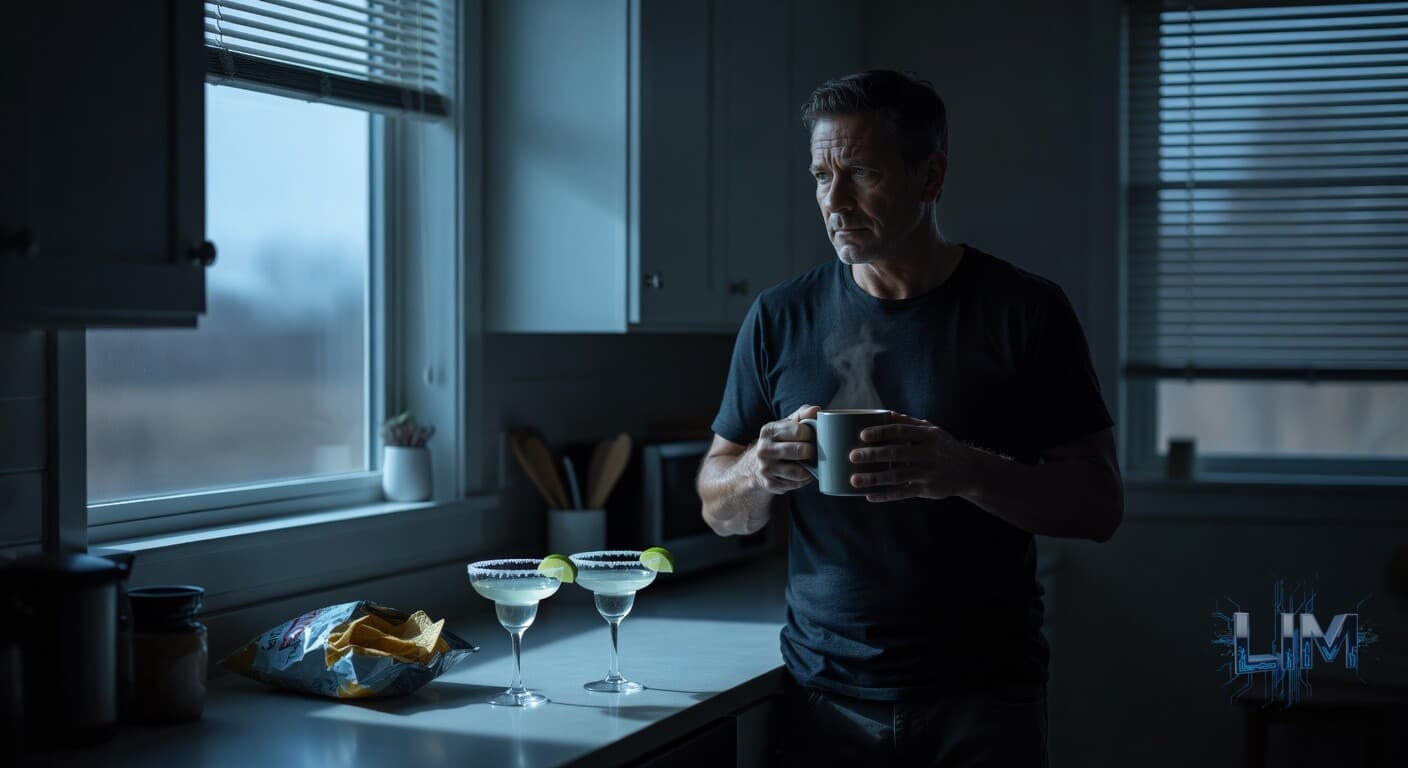
Beth is 42. Sales director. Three kids in three different schools. Husband travels Monday through Thursday. Last night was the neighbor's Cinco de Mayo thing. She had two margaritas. They tasted like nothing.
It is 06:30 Wednesday. Her oldest is asking where the cereal went. Her phone has a 09:00 standup, a 13:00 one-on-one, a school pickup at 14:45, and a noon Peloton lift she committed to on Sunday when her Tuesday self felt invincible.
She feels like she got hit by a bus that was driven by a smaller bus.
The internet is going to swing two ways this morning. The bro-science crew will tell her to sweat it out. The moralism crew will tell her she knew better.
Related Read
Adaptive Training: Why Your Plan Should Change With Your LifeStatic 12-week templates fail real adults the moment life moves. Here's what adaptive training actually means and why it's the 90% use case.
Both are wrong. Both miss what is actually happening in her liver, her immune system, and her quads right now.
What is actually broken at 06:30
The alcohol is gone. The average drinker clears one standard drink per hour, so two margaritas finished at 21:00 cleared the bloodstream by 23:00.
What Beth feels at 06:30 is the cleanup crew the alcohol left behind.
Ethanol metabolism produces acetaldehyde, a Group 1 carcinogen roughly 30 times more toxic than the ethanol that made it. Aldehyde dehydrogenase clears it, but the cofactor pool runs dry on a heavy bolus. Two drinks at 42 feel like four drinks did at 28. The math has not changed. The throughput has.
Layer on the cytokine cascade. The immune cleanup peaks 12 to 16 hours after the last drink. That is Beth's 06:30 to 09:00 window, exactly.
Tylenol does not touch a hangover. Wrong target. NSAIDs sometimes do. Right target.
Why your sleep did not actually count
Beth slept seven hours. Her watch says recovery is 41 percent. She blames the watch.
The watch is right.
Even moderate alcohol doses cut second-half REM by 18 to 24 percent. Adenosine rebounds. Cortisol overshoots its normal 06:00 peak. You wake at 04:48 staring at the ceiling.
That is not tired-from-no-sleep. That is tired-from-broken-sleep. Different physiology. Different lever.
The lift at noon is already in trouble
Alcohol blunts post-exercise muscle protein synthesis by 37 percent even with a 25-gram protein clamp in place. If Beth trains at noon without restoring the MPS signal, she absorbs the stress of the session without the adaptation. She pays tax on a session that builds nothing.
The fix is an hour-12 leucine bolus. 30 to 40 grams of whey isolate clears the MPS-restart threshold for most adults under 250 pounds.
The clock matters more than the brand. Hour-12 from your last drink is the inflection point. Last drink at 21:00 puts the bolus at 09:00. Coffee, breakfast, kids out the door, done.
The bro-science trap: do not sweat it out
The instinct is to crush a hard run at 06:30. Stack the misery. Feel virtuous. Earn the margaritas back.
Wrong mechanism.
The inflammatory load is already elevated from the alcohol cleanup. High-intensity work stacks more on top. You feel worse at 11:00, train worse at 12:00, and Thursday's recovery debt is meaningfully higher.
Walking is good. Sprinting on a hangover is borrowing from Thursday at 28 percent APR.
Zone 2, the heart rate where you can hold a conversation but only just, does the opposite. It increases lymphatic clearance. It supports lactate buffering for the noon session. It accelerates the cytokine return-to-baseline curve without adding to it.
25 minutes is the floor. A walk to the coffee shop. A light bike. An elliptical at the lowest setting that still moves the legs.
If the watch shows heart rate above 70 percent of max, slow down.
This is the lever that buys back the noon lift.
The 16:00 caffeine wall
Tonight, Beth's body will try to rebound. She owes REM to the brain. She owes deep sleep to the body. The homeostatic drive runs hot if you let it.
The single biggest lever protecting that rebound is caffeine half-life. Five to six hours in a fast metabolizer. Seven to nine in the slow CYP1A2 carriers, which is roughly half of adults over 40.
A 200-milligram coffee at 14:00 still has 100 milligrams circulating at 22:00 in a fast metabolizer. 140 milligrams in a slow one. That dose flattens deep sleep on a normal night. On a rebound night, it converts a 6-hour repair window into 4 hours. Thursday wakes up paying interest on Tuesday's margaritas.
The rule is plain. Last caffeine at 16:00. No exceptions. No "I'll just have one."
If you need a 15:00 boost, switch to green tea or yerba maté. If you need a 17:00 boost, you do not need caffeine. You need a 12-minute nap.
The Wednesday calendar, mechanism-targeted
| Time | Action | Lever | |---|---|---| | 06:30 | 16 oz electrolyte water before standing up | Hydration | | 07:00 | Second electrolyte serving, coffee #1 | Hydration | | 07:30 | 25-min Z2 walk: kids to school, dog around the block | Cytokine clearance | | 09:00 | 30 to 40g whey + 1g leucine + coffee #2 | MPS restart | | 12:00 | Lift at RPE 7. Do not chase PRs today. | — | | 13:00 | Real lunch, 40g protein floor, nothing fried | — | | 16:00 | LAST caffeine of the day. Hard line. | Sleep rebound | | 22:00 | Lights down, no alcohol tonight | — |
Plain water is not the play. Alcohol is a vasopressin antagonist. Beth peed out sodium, potassium, and magnesium overnight. Topping up with pure water at 06:30 dilutes serum sodium further before the kidney can rebalance.
LMNT, Liquid IV's lower-sugar line, or half a teaspoon of salt plus one lemon plus a touch of real maple in 16 ounces of water all clear the bar.
If you are over 40 and on blood-pressure medication, halve the sodium and check with your prescriber.
What this is not
This is not "how to drink more without consequences."
Two margaritas at 35 is a minor cytokine event. Two margaritas every Tuesday at 35 is a chronic inflammation problem that no protocol will outrun. The salvage works because it is the salvage. Used occasionally. Applied to mechanism.
If you are running this protocol every Wednesday, the protocol is not the issue.
It is also not for anyone in active sobriety, pregnancy, on metronidazole or anti-epileptics, or with ALDH2-deficient genetics. Default to your prescriber.
The wider point
We do not coach willpower. We do not coach guilt. We coach mechanism.
The body did a specific thing overnight. There is a specific stack of levers that addresses it. Knowing which lever does what is the difference between salvaging Wednesday and writing it off.
If you want a system that catches the cortisol-tell in your voice on the morning check-in, rewrites your session the moment your wearable logs a busted sleep, and never once tells you that you knew better, we built it for you at legacyinmotion.fit.
Wednesday afternoon, you will be glad you ran it.
---
The data behind this
- Verster JC 2010 (Current Drug Abuse Reviews) — synthesized 13 hangover studies; IL-6, IL-10, TNF-alpha, and CRP peak 12-16 hours after last drink and track symptom load more reliably than prior-night BAC.
- Parr EB et al 2014 (PLOS One) — n=8 resistance-trained men; 25g post-exercise protein with vs without 1.5 g/kg alcohol produced 37% blunting of myofibrillar protein synthesis even with the protein clamp.
- Ebrahim IO et al 2013 (Alcohol: Clinical and Experimental Research) — meta-analysis of 24 controlled sleep studies; alcohol suppresses REM dose-dependently, even moderate doses cut second-half REM by 18-24%.
- CYP1A2 caffeine half-life: 5-6 hours in fast metabolizers, 7-9 hours in slow CYP1A2 carriers (~50% of adults over 40).
- Karadayian AG et al 2017 (Alcohol) — chronic-use alcohol-induced mitochondrial dysfunction; the protocol does not address chronic intake.
- Jake's n=1: 308 to 196 across 12-hour overnight hospital security shifts; the 16:00 caffeine wall was the lever that protected sleep rebuild on shift-disrupted nights.
---
Log tonight's shift. Wake up to an adjusted plan.
This is what Chiron, our AI head coach, does on every meal and workout you log: catches the small wrong detail before it costs you years. HERMES — our research engine — surfaces new science the morning it publishes, so your coaching moves with the literature instead of trailing it by quarters. You log; we adapt your plan that day. No PDF reprints, no static plan that ages out the day your shift changes or you have a kid.
$29.99/month · $249.99/year · 7-day free trial · cancel anytime · no enrollment fee · no contract
Start coaching → · See the full app →
Jake Long built it after losing 112 lbs working hospital night shifts — when no human coach could keep up with his schedule. He wanted the system he wished he'd had at 308. Now you can use it too.
The Questions Readers Ask Most
Why does a hangover feel worst between 6am and 9am?
Inflammatory cytokines (IL-6, IL-10, TNF-alpha, CRP) peak 12 to 16 hours after the last drink, which lands directly in the 06:30 to 09:00 window. Verster 2010 in Current Drug Abuse Reviews synthesized 13 hangover studies and found symptom load tracks cytokine elevation more reliably than the prior night's blood alcohol.
How much protein do I need after drinking to save a workout?
30 to 40 grams of whey isolate delivers 3 to 3.5 grams of leucine and clears the MPS-restart threshold for most adults under 250 lb. Add 1 gram of free leucine on top if you are over 60 or fasted overnight, and dose it before the noon lift, not after.
Does alcohol still wreck muscle growth if I hit my protein target?
Yes. Parr 2014 in PLOS One fed eight resistance-trained men 25g of post-exercise protein with and without 1.5 g/kg alcohol and measured a 37 percent blunting of myofibrillar protein synthesis in the alcohol group, even with the protein clamp in place.
Comments (0)
Comments are reserved for Legacy In Motion members.
$29.99/month. No contracts. Cancel anytime.
Get StartedAlready a member? Sign in
You read this far. Now do this.
You've read the theory.
Now put it to work in your real week.
I went from 308 to 196 lbs working 12-hour overnight shifts with two kids and zero personal trainer. The system I used is now an app that plans your training and meals around YOUR schedule — overnight, day shift, all of it.
Cancel anytime · No setup fee · No long contract
Free Assessment
What's Blocking Your Results?
Take our 60-second quiz and get a personalized breakdown of what's stopping your progress — plus how AI coaching solves it.
Take the QuizFree PDF · No Credit Card
Your free Shift Worker AI Fitness Blueprint
The protocol Jake wishes he'd had at 308 lbs: sleep timing for rotating shifts, post-shift macros, and the AI deload trigger, from the run that took him to 196. Free, no card needed.
Built by someone who actually worked them. No fluff. Unsubscribe any time.
Keep Reading
2026-05-04
Adaptive Training: Why Your Plan Should Change With Your Life
Static 12-week templates fail real adults the moment life moves. Here's what adaptive training actually means and why it's the 90% use case.
2026-05-02
The 35-Minute Window — Why The Same Peloton Class Stopped Working In Year Two
You do not need more time. You need less repetition inside the time you already have. The four-modality rotation for the busy parent who has been on the same Peloton class library since 2022.
2026-04-24
The Best Fitness App for Shift Workers in 2026
Honest comparison of MyFitnessPal, Fitbod, Future, Trainerize for shift workers. What a night-shift fitness app actually needs.
Join our free fitness community — get coaching tips, share wins, and stay accountable.
JOIN THE DISCORD →