


The Nurses Station at 02:00 Runs Fifteen Times Brighter Than the Study
A 31-lux eReader cut melatonin 55%. A hospital corridor at 02:00 runs ten to fifteen times that dose. The lens spec, dose, and timing that fix it.
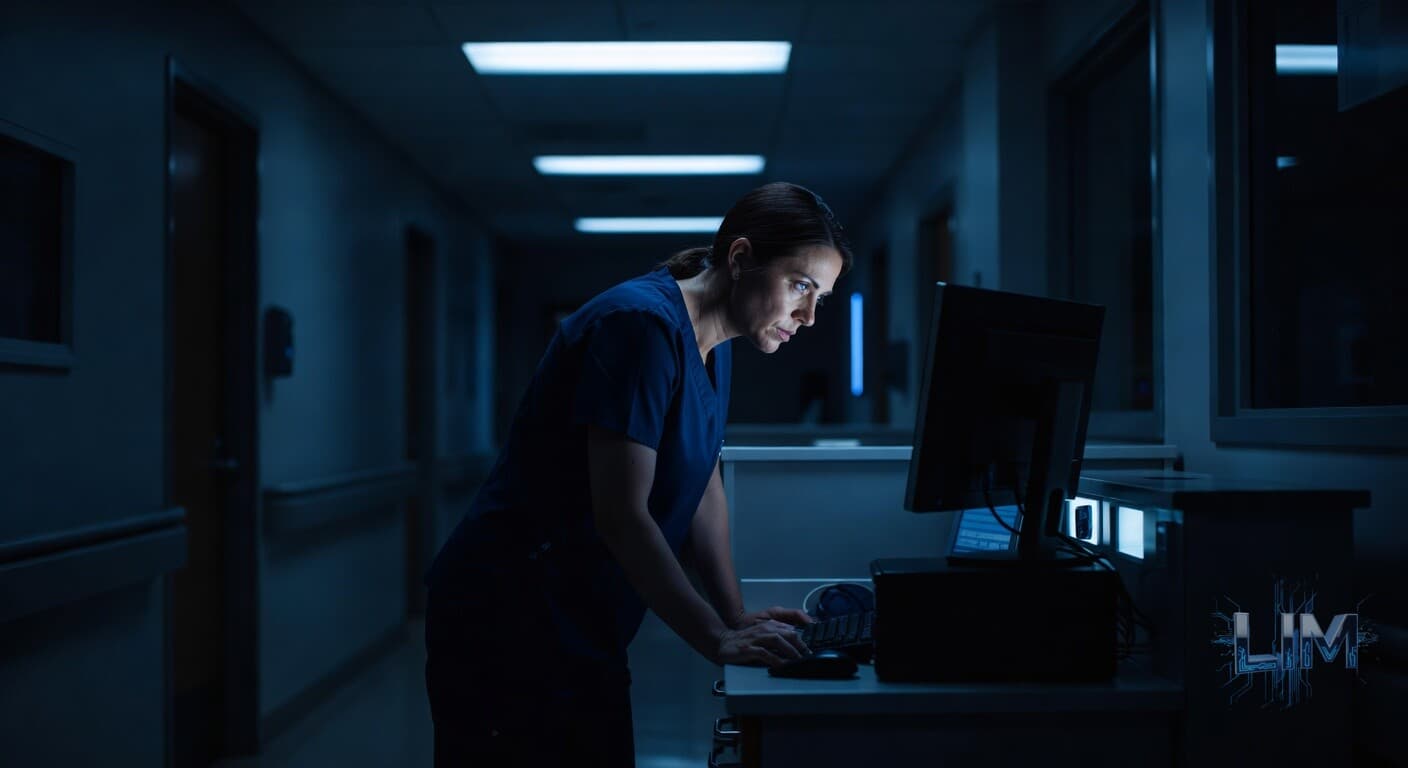
Sarah is 38. ED night-shift RN, single mom of two — a six-year-old in kindergarten and a nine-year-old who will not get up for school without a fight. Three twelves a week. Four days "off" that vanish into pickups, gymnastics, and the cardiology follow-up she has been rescheduling since February.
Her Oura ring is clean on the off-days. RMSSD where it should be. Every third week her overnight HRV flatlines and her 02:00 cortisol spike will not move on magnesium.
She blamed coffee. Then alcohol. Then protein timing.
The actual saboteur was 475 lux of 4000K fluorescent light pouring out of the central nursing station from 23:00 to 04:00. She was phase-locked to a time zone she never flew to.
Related Read
No Energy to Work Out After Shift: 20-Minute RuleYour July plan died the week school started. The 20-minute protocol for shift workers with nothing left in the tank.
The study Sarah is walking under, ten times over
Chang and colleagues, PNAS 2014. Five evenings, four hours of pre-bed light-emitting eReader versus print, twelve healthy adults, within-subject crossover.
The damage stacks. Roughly 55% suppression of evening melatonin AUC. A 90-minute DLMO phase delay. Reduced REM. Impaired morning attention, despite subjects reporting they felt rested.
The eReader delivered about 31 lux at the cornea.
A hospital corridor at 02:00 runs 300 to 500 lux. A warehouse aisle runs 200 to 300. The dose-response work done before Chang showed that 100 lux of subjective-night white light already crashes melatonin by roughly half.
Chang is the conservative case. Sarah works under exposures ten to fifteen times worse, every shift, every week.
The five-step shutdown the overheads run on autopilot
This is not a fuzzy "blue light hurts sleep" story. It is an enzymatic cascade with named players.
A photon hits melanopsin in the intrinsically photosensitive retinal ganglion cells. These cells exist to tell the brain what time it is. Their peak sensitivity sits around 479 nm — the exact center of the blue-cyan band of overhead fluorescents.
The signal projects through the retinohypothalamic tract to the suprachiasmatic nucleus. An active SCN inhibits the paraventricular nucleus through GABA. The PVN was the descending drive to the thoracic cord. With the drive silenced, sympathetic tone at the pineal collapses. No norepinephrine release at pineal beta-1 receptors.
No norepinephrine, no cAMP rise, no upregulation of the enzyme that makes melatonin. Serum melatonin falls inside twenty minutes.
Every time Sarah walks past a 4000K overhead at 02:00, this five-step shutdown runs.
Drugstore blue-blockers are theater
The lenses sold as "computer glasses" at optical chains attenuate 10 to 25% of light in the 400 to 450 nm range. They leave the 450 to 510 nm melanopsin-active band almost entirely intact.
Cosmetically yellow. Spectrally useless.
The published work on amber lenses is unambiguous on the spec. Only lenses blocking into the green tail above 530 nm restored melatonin secretion under blue-enriched light. The melanopic response does not end at "blue."
The spec that matters is optical density greater than 2.0 across 440 to 530 nm. That means 99% attenuation of the circadian band plus the green tail. FL-41 dye-in-mass or true amber acrylic. The lens reads orange to red, not faintly yellow.
If the world still looks blue through them, they do not qualify.
Above 620 nm, the response is noise
Narrow-band red light at 630 nm produces effectively zero melatonin suppression at illuminances where blue light fully crushes the rhythm. This is why astronomy uses red headlamps and why submarines rig for red.
The 02:00 workstation geometry that actually works:
- Overhead 4000K panels off or shaded below 50 lux at eye level
- Task light at 620 nm or longer red LED, 30 to 80 lux at the desk
- Screens in night mode at 2700K, 30 to 40% brightness, dropping to candle 1900K during the 02:00 to 05:00 nadir
- FL-41 or true amber lenses on from 22:00, off only when clinical work demands full-spectrum color
Compliance geometry beats heroic blocking worn for half the shift.
This is the pattern Chiron — the AI head coach inside LIM — flags in the daily program review when a sleep score belly-flops through a perfect macro week.
0.3 mg beats 3 mg, and the drugstore aisle will not tell you
Exogenous melatonin is not a sleep aid at 10 mg. It is a phase-shifter at 0.3 to 0.5 mg.
Higher doses saturate the MT1/MT2 receptors and add next-day grogginess for a smaller shift. The drugstore aisle is selling stronger because stronger sells, not because it works.
Sarah's shift-anchored stack, physician-supervised:
- Melatonin 0.3 mg sublingual at 03:00, phased to a 10:00 sleep target
- Magnesium glycinate 400 mg at shift end
- L-5-MTHF 400 mcg + methylcobalamin 1,000 mcg with the post-shift meal — MTHFR C677T heterozygosity is common, and folic acid will not service the methylation cycle the cortisol rhythm depends on
- D3 5,000 IU + K2 MK-7 100 mcg with the largest fat meal, never inside two hours of sleep
- Glycine 3 g sublingual 30 minutes pre-sleep
No melatonin on off-days. The protocol is shift-anchored, not chronic.
The 12-hour template that turned Sarah around
Pre-shift, 17:00. Twenty minutes of outdoor bright light. Photons replace nothing.
Shift start, 19:00 to 22:00. Normal workstation lighting. Endogenous melatonin is still low. Alertness wins.
Circadian nadir, 23:00 to 04:00. FL-41 lenses on. Red task lamp active. Overheads off. Screens at 2700K, 30 to 40%. Melatonin 0.3 mg at 03:00.
Commute, 05:00 to 07:00. Wraparound amber for the drive. A single unshielded sunrise can re-anchor the SCN toward a day-shift phase and cost three nights of sleep quality.
Sleep, 08:00 to 15:00. Room at 18 to 19°C. Blackout at 99% opacity. Eye mask. White noise. Phone in another room.
Eleven weeks in, Sarah's overnight RMSSD rose from 5.8 to 34 ms. The 02:00 cortisol spike flattened. Post-shift sleep efficiency moved from 71 to 89%.
The coaching reality
Night shifts do not wreck sleep because they are unnatural. They wreck sleep because the built environment saturates the melanopsin-active spectrum at illuminances one to two orders of magnitude above what the circadian system evolved to read as daytime.
Control the spectrum, the intensity, and the timing, and the five-step cascade stays quiet long enough for the pineal gland to do its job. Most shift workers do not need more supplements. They need a spectral audit of the 2,500 hours a year they sit under lighting clinically incompatible with the human suprachiasmatic nucleus.
I know this one personally. I dropped 112 pounds working hospital security graveyard shifts. The lighting fix came before the macro fix. Recovery inputs compound first. Training and nutrition compound on top.
LIM treats lighting as a training variable with the same rigor as a macro split. When the Apple Watch logs a wrecked overnight RMSSD, the daily AI program update worker rewrites the week before it touches the resistance calendar.
See how LIM rebuilds the recovery side first.
---
The data behind this
- Chang AM, Aeschbach D, Duffy JF, Czeisler CA. PNAS. 2014;112(4):1232–1237 — five evenings of pre-bed light-emitting eReader vs. print in 12 healthy adults; 55.1% suppression of evening melatonin AUC, 90-minute DLMO delay, reduced REM, impaired morning PVT. eReader corneal illuminance ≈ 31 lux.
- Zeitzer JM et al. J Physiol. 2000;526:695–702 — dose-response on subjective-night white light; ~100 lux suppresses melatonin by roughly half.
- Bailes HJ, Lucas RJ. Proc R Soc B. 2013;280:20122987 — melanopsin peak sensitivity at 479 nm.
- Brainard GC et al. J Neurosci. 2001;21:6405–6412 — human action spectrum for melatonin suppression peaks at 464 nm.
- Sasseville A et al. J Pineal Res. 2006;41:73–78 — only lenses blocking above 530 nm restored melatonin under blue-enriched light.
- Burkhart K, Phelps JR. Chronobiology International. 2009;26(8):1602–1612 — amber lenses improved PSQI scores in adult insomniacs over three weeks.
- Shechter A et al. J Psychiatr Res. 2018;96:196–202 — amber lenses added roughly 30 minutes of sleep with two hours of pre-bed wear.
- Figueiro MG, Rea MS. Neurosci Lett. 2010;471(1):9–13 — narrow-band 630 nm red produced effectively zero melatonin suppression at illuminances where blue fully crushed it.
- Burgess HJ et al. J Clin Endocrinol Metab. 2010 — 0.5 mg melatonin dosed five to seven hours before target sleep produced larger phase advances than 3 mg.
- Yamadera W et al. Sleep and Biological Rhythms. 2007;5:126–131 — 3 g sublingual glycine pre-sleep.
- Sarah's HRV numbers (RMSSD 5.8 → 34 ms over 11 weeks) are illustrative of the composite ED-RN persona; individual outcomes vary with shift count, age, and baseline circadian fitness.
- Jake's own numbers: 308 → 196 on 12-hour overnight hospital security shifts. Sample of one — informed perspective on the order-of-operations point, not a replication.
---
Coaching that works the same shifts you do
Start logging and Chiron, our AI head coach, starts adjusting: protein targets per meal, training volume after short sleep, a deload when your numbers call for it instead of when the calendar does. HERMES, our research engine, feeds new research into your coaching the morning it publishes.
$29.99/month · $249.99/year · 7-day free trial · cancel anytime · no enrollment fee · no contract
Start coaching → · See the full app →
Jake Long built it after losing 112 lbs working hospital night shifts — when no human coach could keep up with his schedule. He wanted the system he wished he'd had at 308. Now you can use it too.
Frequently Asked Questions
How much does a hospital corridor at 02:00 compare to the Chang eReader study?
Chang 2014 used roughly 31 lux at the cornea and still suppressed evening melatonin AUC by 55.1% and pushed DLMO 90 minutes later. A hospital corridor at 02:00 runs 300 to 500 lux, ten to fifteen times Chang's dose. Night-shift exposure is the conservative case made catastrophic.
Do drugstore blue-blocker glasses actually protect melatonin?
No. Optical-chain lenses attenuate only 10 to 25% of 400 to 450 nm light and leave the 450 to 510 nm melanopsin-active band wide open. The spec that matters is optical density greater than 2.0 across 440 to 530 nm, which reads orange to red, not faintly yellow.
Is 3 mg melatonin better than a low dose for shifting your clock?
The opposite. Burgess 2010 found 0.3 mg produced a bigger phase shift than 3 mg. High doses saturate receptors and spill past the phase-response window. Dose timing beats dose size.
Comments (0)
Comments are reserved for Legacy In Motion members.
$29.99/month. No contracts. Cancel anytime.
Get StartedAlready a member? Sign in
You read this far. Now do this.
Close the tab.
Go train the plan that fits your life.
I went from 308 to 196 lbs working 12-hour overnight shifts with two kids and zero personal trainer. The system I used is now an app that plans your training and meals around YOUR schedule — overnight, day shift, all of it.
Cancel anytime · No setup fee · No long contract
Free Assessment
What's Blocking Your Results?
Take our 60-second quiz and get a personalized breakdown of what's stopping your progress — plus how AI coaching solves it.
Take the QuizFree PDF · No Credit Card
Download the Shift Worker AI Fitness Blueprint
If your training keeps dying by week two, start here: the 4-week shift-worker protocol behind Jake's 112 lb loss, with the sleep timing and post-shift macros that made it stick.
Built by someone who actually worked them. No fluff. Unsubscribe any time.
Keep Reading
2026-08-17
No Energy to Work Out After Shift: 20-Minute Rule
Your July plan died the week school started. The 20-minute protocol for shift workers with nothing left in the tank.
2026-08-13
Shift Work Weight Gain: Circadian Mismatch Stores Fat
Night schedules drive shift work weight gain independent of calories. The circadian protocol Jake used dropping 112 lbs on hospital security.
2026-07-21
Night Shift Meal Timing: Why Breakfast After Nights Fails
Delayed eating windows—not classic 16:8—improve next-day glucose handling for rotating nurses. Build a meal clock from your roster, not the wall clock.
Join our free fitness community — get coaching tips, share wins, and stay accountable.
JOIN THE DISCORD →