


Why First Responders Can't Out-Train Chronic Under-Recovery
Firefighters, cops, and paramedics train through sleep debt, then plateau and blame willpower. The 2026 research says the limiter is recovery, not effort. Here is what HRV-guided training (Javaloyes, J Strength Cond Res, n=20) and the firefighter shift-work data actually show, why a wearable on your wrist does nothing until you act on the recovery signal, and how to program around a rotation instead of pretending you have a normal week.
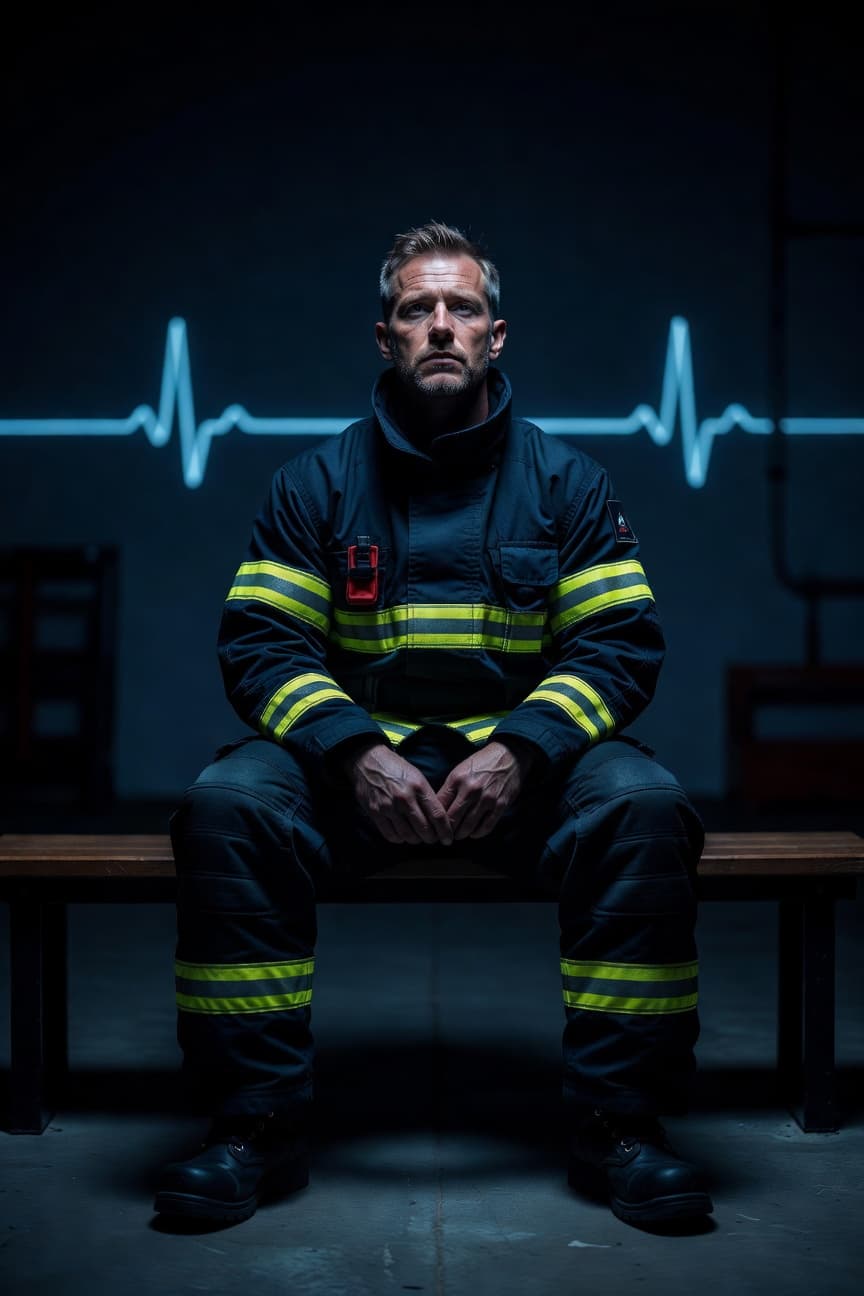
Ray is 41 and has been a firefighter for sixteen years. He works a 24 on, 48 off rotation, which means his week does not look like anyone else's week. On shift days he lifts before the alarms start, because if he waits he might be pulling someone out of a stairwell at 2 a.m. instead. He trains hard. He has always trained hard. That is the whole identity.
For the last year his numbers have not moved. His bench is stuck, his back hurts in a way it did not used to, and he is more tired at month's end than at the start. Ray's read on this is the read every firehouse gives him: push harder, you are getting soft. So he adds a day. He adds volume. He gets worse.
Nobody in that building asks the question that would actually help him, because it sounds like an excuse: not how hard are you training, but what is your body recovering from when you do.
TL;DR (too long, didn't read)
Related Read
The 3,000 Data Points Your Watch Captures — And the Four You Actually Look AtAn ER nurse's watch logs thousands of metrics. She only checks four. Here's how an AI agent turns the flood into a plan that actually fits night shifts, kids, and real life.
- The American College of Sports Medicine's 2026 Worldwide Fitness Trends report (Health & Fitness Journal, Nov/Dec 2025, survey of roughly 2,000 fitness professionals) put Wearable Technology at #1 for the third year running. More than 70% of wearable users in 2024 said they used the data to guide their exercise or recovery. The wrist hardware is already mainstream. Acting on the recovery half of the signal is the part most people skip.
- In a 2020 Journal of Strength and Conditioning Research trial (Javaloyes et al., 34(6):1511-1518; PubMed 31490431), 20 well-trained cyclists trained for 8 weeks. One group followed a fixed block plan; the other was prescribed by daily heart-rate variability (HRV), doing a hard session only when their morning reading said the body had absorbed the last one. The HRV group improved peak power and threshold as much or more, with fewer hard sessions.
- Firefighters and rotating-shift workers are the population this hits hardest. More than half of firefighters report disturbed sleep (IAFF shift-work data), a 72-hour-shift case series found disrupted diurnal cortisol in sleep-deprived crews, and reaction time and vigilance measurably decline across consecutive duty days.
- The mechanism is not mysterious. Chronic sleep loss keeps cortisol elevated and recovery hormones suppressed, so the repair that is supposed to happen between sessions does not finish. You keep making the withdrawal and never make the deposit.
- The honest version: you cannot out-train a sleep debt, but you also cannot always fix the sleep, because the job is the job. What you can fix is the training load, by matching it to the recovery you actually have on a given day instead of the recovery a normal schedule would give you.
What "recovery as programming" actually means
For years the industry sold recovery as a product. A massage gun, a cold plunge, a $400 ring. The 2026 framing is sharper and less marketable: recovery is not a thing you buy after training, it is an input that decides what the training should be in the first place.
That is the real shift behind the wearable-technology trend. A device that tells you your HRV was low last night is a novelty. A plan that reads that number and pulls your squat volume back before your knees start aching is programming. The hardware has been mainstream for a while now. The intelligence that turns the number into a decision is the part still missing for most people, and it is exactly the part a first responder cannot do reliably by feel, because the job has trained them to ignore how they feel.
We have written before about how poor sleep on weekends alone is enough to blunt training adaptations and how cortisol can stall fat loss even when the training is right. For someone on a rotation, those are not occasional problems. They are the baseline.
The cycling study that should be taped to every firehouse fridge
Start with the cleanest piece of evidence, because it is small and tightly controlled. Javaloyes and colleagues took 20 well-trained cyclists and split them into two groups for eight weeks. One group followed a predetermined block-periodization plan: hard days on the calendar, hit them regardless. The other group's hard days were prescribed by their morning HRV. If the reading sat in their normal range, they got a high-intensity session. If it had dropped, signaling the nervous system had not recovered, that day became easy or off, and the hard session waited.
Here is the part that breaks the firehouse logic. Both groups got fitter, but the HRV-guided group improved their peak power output and threshold as much or more than the fixed-plan group, while performing fewer hard sessions. They did less of the work everyone assumes is the point, and they came out ahead, because every hard session landed on a body that could actually use it.
Twenty trained cyclists is a small, specific room, and they were not firefighters. Hold the exact result loosely. But the principle it demonstrates is the one that matters here: load is only useful when recovery has caught up to it. A hard workout performed on an unrecovered system is not a bonus. It is a deeper hole.
Why the rotation makes this worse, with receipts
A first responder is not a cyclist with a clean sleep schedule and a coach watching their HRV. They are the inverse case, the person whose recovery is under attack by the job itself.
The firefighter sleep literature is blunt about it. More than half of firefighters report disturbed sleep, largely because rotating and 24-hour schedules never let the circadian rhythm resynchronize. A case series tracking diurnal cortisol across a 72-hour shift found the normal daily cortisol curve flattening and dysregulating in sleep-deprived crews, which is the hormonal signature of a body stuck in alarm mode. And studies measuring cognitive performance across consecutive duty days find reaction time, vigilance, and processing speed all degrade, with the worst readings on the second day, the same day Ray is adding volume because he feels behind.
Stack that against the training. Cortisol is catabolic by design: in a short, healthy dose it mobilizes energy, but kept high it suppresses the testosterone-to-cortisol ratio and the overnight repair that builds muscle and heals connective tissue. Sleep is when the bulk of that repair happens. Take the sleep, keep the stress hormone elevated, then demand a hard session on top, and you have engineered the exact state the cycling study showed produces worse results. The job is not a reason the training is not working. The job is the variable the training has to be written around.
The caveats, because this is a brand that reads the methods
I am not going to hand you a rule that says train less and you will magically grow, because the data does not support that either.
The Javaloyes trial was 20 endurance athletes, not strength-focused shift workers, and HRV-guided programming is better validated for aerobic performance than for hypertrophy. The firefighter sleep and cortisol findings describe a population's risk, not a guarantee about any one person. Some first responders sleep fine on shift; HRV varies for reasons that have nothing to do with training, including caffeine, alcohol, a head cold, or a bad call that is still in your head at 4 a.m. A single low reading is noise. The signal is the trend across a week.
So the load-bearing claim is narrow and honest: for someone whose recovery is chronically compromised by their schedule, the training that works is the training that flexes with recovery instead of ignoring it, and the wearable data is only worth anything if something actually changes the plan in response to it. Everything past that is sensible application, not settled fact.
What this looks like inside Legacy In Motion
This is the problem our AI coaching was built around, and it is not a coincidence. Our founder, Jake, spent years working hospital security on overnight shifts while losing 112 pounds, from 308 down to 196. He did not do it by training harder on no sleep. He did it by learning, the slow way, that the workout he could recover from beat the workout that looked good on paper.
So the system reads it for you. It pulls your sleep and HRV from HealthKit and re-baselines them against your actual rotation, not against a 9-to-5 default that would flag every night-shift reading as a disaster. When your recovery markers drop across a stretch of shifts, it schedules the deload before your performance craters or your back goes, instead of waiting for you to break and call it discipline. When you are genuinely recovered, it green-lights the hard session and tells you to go.
It also remembers. Because the coaching has memory across conversations, it knows you came off three back-to-back calls last Tuesday and that your bench stalls when your sleep dips under six hours, and it factors that into this week without you having to re-explain your life. A static PDF program cannot do that. It hands you the same five days whether you slept eight hours or fought a structure fire at 3 a.m., and then it lets you blame yourself when the same plan stops working.
Ray does not need to train harder. He needs a plan that knows the difference between a rest day he chose and a rest day his body demanded, and that writes the next four weeks accordingly. If you work while everyone else sleeps and you are tired of grinding into a plateau, that is the kind of coaching we build at Legacy In Motion.
Comments (0)
Comments are reserved for Legacy In Motion members.
$29.99/month. No contracts. Cancel anytime.
Get StartedAlready a member? Sign in
You read this far. Now do this.
You've read the theory.
Now put it to work in your real week.
I went from 308 to 196 lbs working 12-hour overnight shifts with two kids and zero personal trainer. The system I used is now an app that plans your training and meals around YOUR schedule — overnight, day shift, all of it.
Cancel anytime · No setup fee · No long contract
Free Assessment
What's Blocking Your Results?
Take our 60-second quiz and get a personalized breakdown of what's stopping your progress — plus how AI coaching solves it.
Take the QuizFree PDF · No Credit Card
Grab the Shift Worker AI Fitness Blueprint
A 4-week plan that respects what shift work does to sleep: when to go down after a night, the four-minute REHIT window, post-shift macros, and when to back off. In your inbox in 30 seconds.
Built by someone who actually worked them. No fluff. Unsubscribe any time.
Keep Reading
2026-05-29
The 3,000 Data Points Your Watch Captures — And the Four You Actually Look At
An ER nurse's watch logs thousands of metrics. She only checks four. Here's how an AI agent turns the flood into a plan that actually fits night shifts, kids, and real life.
2026-04-24
The Best Fitness App for Shift Workers in 2026
Honest comparison of MyFitnessPal, Fitbod, Future, Trainerize for shift workers. What a night-shift fitness app actually needs.
2026-04-20
Magnesium for Night Shift Brains
Join our free fitness community — get coaching tips, share wins, and stay accountable.
JOIN THE DISCORD →