


Future App Review 2026: Why $199 Coaching Breaks the Moment Your Shift Snaps
Future app coaches are real and credentialed. Here's why the $199 model collapses the instant your 12-hour turns into a 17.
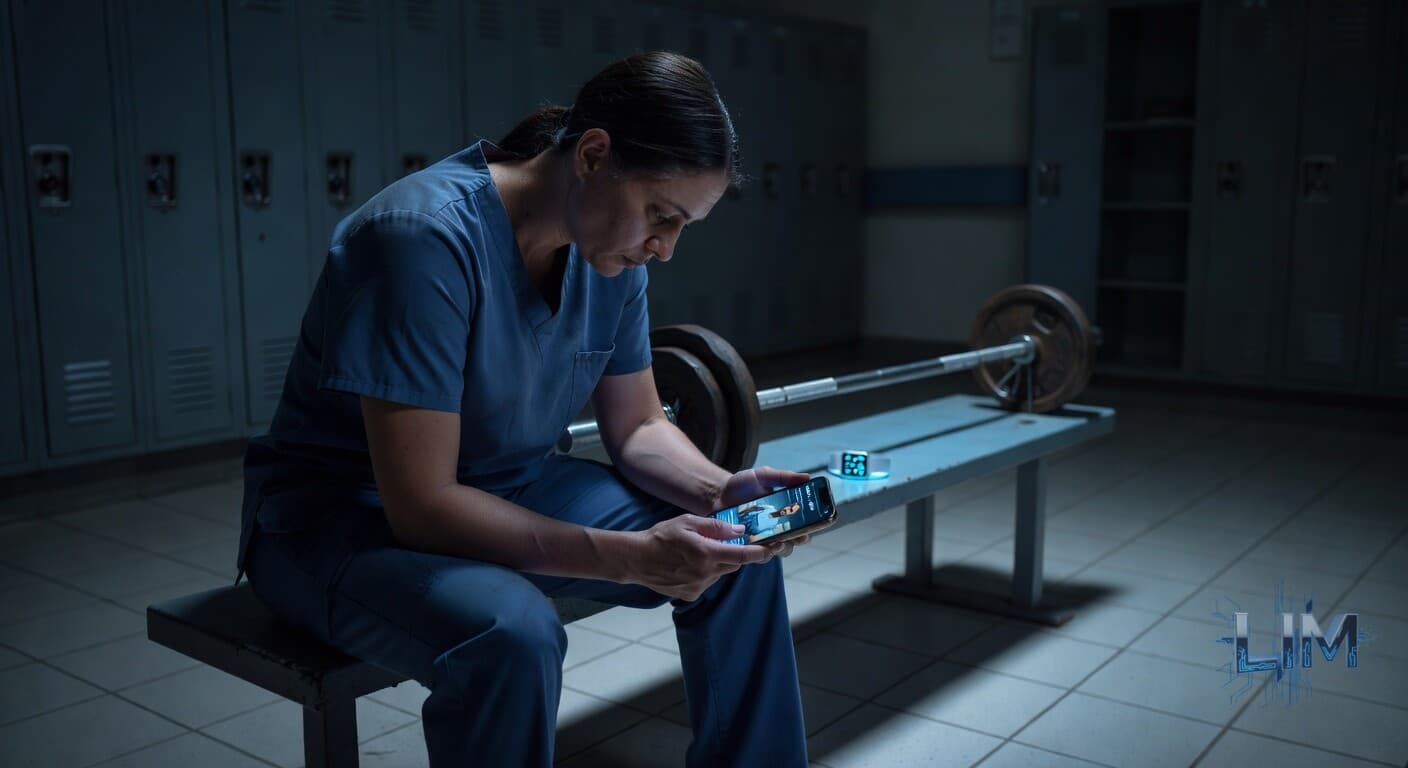
Renee, 39, ED nurse at Mercy General, twin boys age four, 02:14 Wednesday morning in the staff parking lot. Her Civic's heater is wheezing. The coffee in the cup holder went cold an hour ago.
Her 12 became a 17 at 21:40 when a three-car wreck rolled in. Trauma bay didn't release until 01:55. Her thumb is hovering over a Future app message she half-wrote at midnight.
The question is simple. Skip Wednesday's deadlift, or punt it to Friday and miss the boys' swim class. Her coach is asleep in Denver and won't see the message until 9 a.m. his time. By then Renee will be unconscious and Wednesday will already be a memory.
This is the problem $199 a month does not solve.
Related Read
Shift Work Weight Gain: Why Night Shifts Pack Visceral FatWhy night-shift work rewires metabolism toward visceral fat—and the meal-timing, cortisol, and AI-coaching protocol that reversed 112 lbs on hospital security graveyards.
TL;DR (too long, didn't read): - Future earns its $199 if you work one time zone, predictable hours, no overtime surprises. - The model fails the second a shift slides because coaches juggle 30 to 60 clients on business hours. - A 2024 BJSM meta-analysis (41 trials) shows adherence drops below 50% by month six in most programs, while only real-time-adaptive ones hold above 70%. - Morris et al, PNAS (Proceedings of the National Academy of Sciences) 2015, n=14: eight nights of simulated shift work wreck glucose tolerance and flip cortisol phase, and CSCS strength coaches aren't trained on any of it. - The architecture that survives shift life does not sleep, does not forget, and rewrites your week the second the schedule snaps.
What Future Actually Gets Right
Credit where it's owed. Future is not a chatbot in a trench coat pretending to be a coach.
You get a real strength coach, usually CSCS-credentialed (Certified Strength and Conditioning Specialist), and most respond inside a day. They build your program in-app. Your Apple Watch streams sets and heart rate back so the coach can tell if you actually trained or ghosted the session.
Onboarding asks what equipment you have. Commercial gym, garage rack, hotel room, nothing at all. Your program is built around that answer, which already beats half the template apps on the App Store.
Film a squat, upload it, and the coach writes back with cues. For someone learning a movement pattern, that is worth real money.
For a clean 9-to-5 in one time zone, Future earns its $199.
This is not a hit piece. It's a review of what happens when your life does not run on a normal clock.
Where the Model Breaks at 02:14
Your coach has 30 to 60 other clients and works business hours from somewhere in America. Renee's 02:14 message lands while he's eight hours deep in sleep.
It sits in the queue until his morning, which is her afternoon, which is her sleep window. By the time they actually talk, Wednesday's lift is already a ghost.
Shift workers do not have stable weeks.
The Cascade Nobody Plans For
A 12 that turns into a 17 kills Wednesday's session. A swing rotation moves your sleep window six hours. Mandatory overtime nukes Saturday's long cardio.
The check-in arrives after the week is already gone. The credential does not cover the rest. Cortisol phase inversion on nights. Melatonin smashed by ED fluorescents at 23:00. Glucose tolerance crashing in circadian misalignment.
CSCS coaches aren't trained on any of it. That isn't a slight. It's not their field.
What the Adherence Research Actually Says
A 2024 BJSM (British Journal of Sports Medicine) meta-analysis pooled 41 supervised exercise interventions. The headline is brutal.
Adherence dropped below 50% at six months in the majority of programs.
The programs that held above 70% over the same window shared exactly one feature. They adapted in real time to participants' constraints. Schedule shifts, equipment changes, injuries, life events.
Adaptability is the variable. Not program quality. Not coach credential. Adaptation cadence.
Future adapts on a human cadence. Your shift does not.
This is the pattern Chiron, our AI head coach, flags in the daily program review. The second Renee logs her Tuesday 23:11 miss, the morning plan already accounts for it. Nobody waits on a human's next open hour.
Three Trainers Before the Cut
Jake hired three human trainers before he built this system. Two were excellent. Strong programmers, attentive, credentialed. The third was a clown.
None of them could keep up.
Not because they were lazy. The math doesn't math. A coach carrying 40 clients cannot rewrite Wednesday at midnight Tuesday when your shift just exploded. They get to it Thursday afternoon. By then the session is skipped and the streak is gone.
The ceiling on human coaching is not knowledge. It's availability and memory bandwidth.
A coach who sees you 20 minutes a week cannot carry every prior shift, every sleep debt, every glucose response, every missed session into the next revision. They get the highlight reel. Your plan needs the full tape.
Jake himself dropped 112 pounds (308 to 196) working hospital security graveyard shifts at 40. He didn't do it by hiring a better trainer. He did it by building a coach that did not sleep.
What Has to Change Structurally
Set Future aside for a beat. Here's the structural comparison.
Continuous Availability
A well-built AI coach answers your 04:00 panic text the same way it answers your 14:30 strategy question. No queue. No time-zone tax.
Memory Across Every Turn
Every workout, meal, sleep log, and shift change stays in the model's working context. Turn 412 knows exactly what happened on turn 3.
Protocol-Level Specialization
Shift-work physiology. Cortisol-phase-aware volume. Methylated B-complex timing on inversion weeks. Baked into the protocol layer, not buried in a PDF nobody reads.
Real-Time Reshuffle
The second a missed session gets logged, your week reorganizes itself. HERMES, our research agent, scrapes roughly 12,000 fitness and physiology papers a week so the protocols update the moment new evidence drops.
The Morris 2015 PNAS data on glucose dysregulation already shapes how Chiron times pre-shift carbs for nurses like Renee. When her Apple Watch logs sub-90-cadence walking five days running and a sleep score under 70, the daily AI program update worker rewrites her training block before she even opens the app. The voice-note check-in catches the cortisol-tell in her tone before the scale moves.
That isn't a feature list. That's the only architecture that survives a real shift schedule.
The Honest Verdict
Future is a good product for the wrong life.
Work a clean 9-to-5 in one time zone? Pay the $199 and don't look back. A credentialed human writing solid programs and nudging you on Tuesdays is genuinely worth it.
Work nights, swings, 12s that become 17s, fire shifts, long-haul rotations, hospital floors that don't quit? The product shape has to change. A human carrying 40 clients on business hours cannot match the cadence your body actually keeps.
Renee doesn't need a better coach. She needs a coach who is awake at 02:14.
Legacy In Motion was built around the exact constraints Future cannot solve. Meet the coach who does not sleep at https://legacyinmotion.fit
---
Get Chiron in your pocket — $29.99/month
This is what Chiron, our AI head coach, does on every meal and workout you log: catches the small wrong detail before it costs you years. HERMES — our research engine — surfaces new science the morning it publishes, so your coaching moves with the literature instead of trailing it by quarters. You log; we adapt your plan that day. No PDF reprints, no static plan that ages out the day your shift changes or you have a kid.
$29.99/month · $249.99/year · 7-day free trial · cancel anytime · no enrollment fee · no contract
Start coaching → · See the full app →
Jake Long built it after losing 112 lbs working hospital night shifts — when no human coach could keep up with his schedule. He wanted the system he wished he'd had at 308. Now you can use it too.
The Questions Readers Ask Most
Is Future app worth $199 a month for shift workers?
Future's coaches are real and CSCS-credentialed, but check-ins land 1 to 3 times per week on business hours in one US time zone. If your shift slides from a 12 to a 17 at 02:14, the message sits until the coach's morning and the session is already gone.
What does the adherence research say at six months?
A 2024 BJSM meta-analysis of 41 supervised exercise interventions found adherence dropped below 50% at six months in most programs. Only protocols that adapted in real time to participants' constraints (schedule shifts, equipment changes, injuries) held above 70%.
Do night shifts actually wreck strength training results?
Morris et al, PNAS 2015 (n=14), showed measurable glucose tolerance dysregulation and cortisol phase inversion after just 8 days of simulated night work. Most CSCS strength coaches aren't trained on circadian misalignment or glucose handling on rotation, so the programming ignores it.
Comments (0)
Comments are reserved for Legacy In Motion members.
$29.99/month. No contracts. Cancel anytime.
Get StartedAlready a member? Sign in
You read this far. Now do this.
Close the tab.
Go train the plan that fits your life.
I went from 308 to 196 lbs working 12-hour overnight shifts with two kids and zero personal trainer. The system I used is now an app that plans your training and meals around YOUR schedule — overnight, day shift, all of it.
Cancel anytime · No setup fee · No long contract
Free Assessment
What's Really Stopping Your Progress?
Take our 60-second quiz and get a personalized breakdown of what's stopping your progress — plus how AI coaching solves it.
Take the QuizFree PDF · No Credit Card
Your free Shift Worker AI Fitness Blueprint
A 4-week plan that respects what shift work does to sleep: when to go down after a night, the four-minute REHIT window, post-shift macros, and when to back off. In your inbox in 30 seconds.
Built by someone who actually worked them. No fluff. Unsubscribe any time.
Keep Reading
2026-07-09
Shift Work Weight Gain: Why Night Shifts Pack Visceral Fat
Why night-shift work rewires metabolism toward visceral fat—and the meal-timing, cortisol, and AI-coaching protocol that reversed 112 lbs on hospital security graveyards.
2026-06-03
Why First Responders Can't Out-Train Chronic Under-Recovery
Firefighters, cops, and paramedics train through sleep debt, then plateau and blame willpower. The 2026 research says the limiter is recovery, not effort. Here is what HRV-guided training (Javaloyes, J Strength Cond Res, n=20) and the firefighter shift-work data actually show, why a wearable on your wrist does nothing until you act on the recovery signal, and how to program around a rotation instead of pretending you have a normal week.
2026-05-29
The 3,000 Data Points Your Watch Captures — And the Four You Actually Look At
An ER nurse's watch logs thousands of metrics. She only checks four. Here's how an AI agent turns the flood into a plan that actually fits night shifts, kids, and real life.
Join our free fitness community — get coaching tips, share wins, and stay accountable.
JOIN THE DISCORD →