


L-Theanine + Caffeine: The 2:1 Stack for Hour Ten
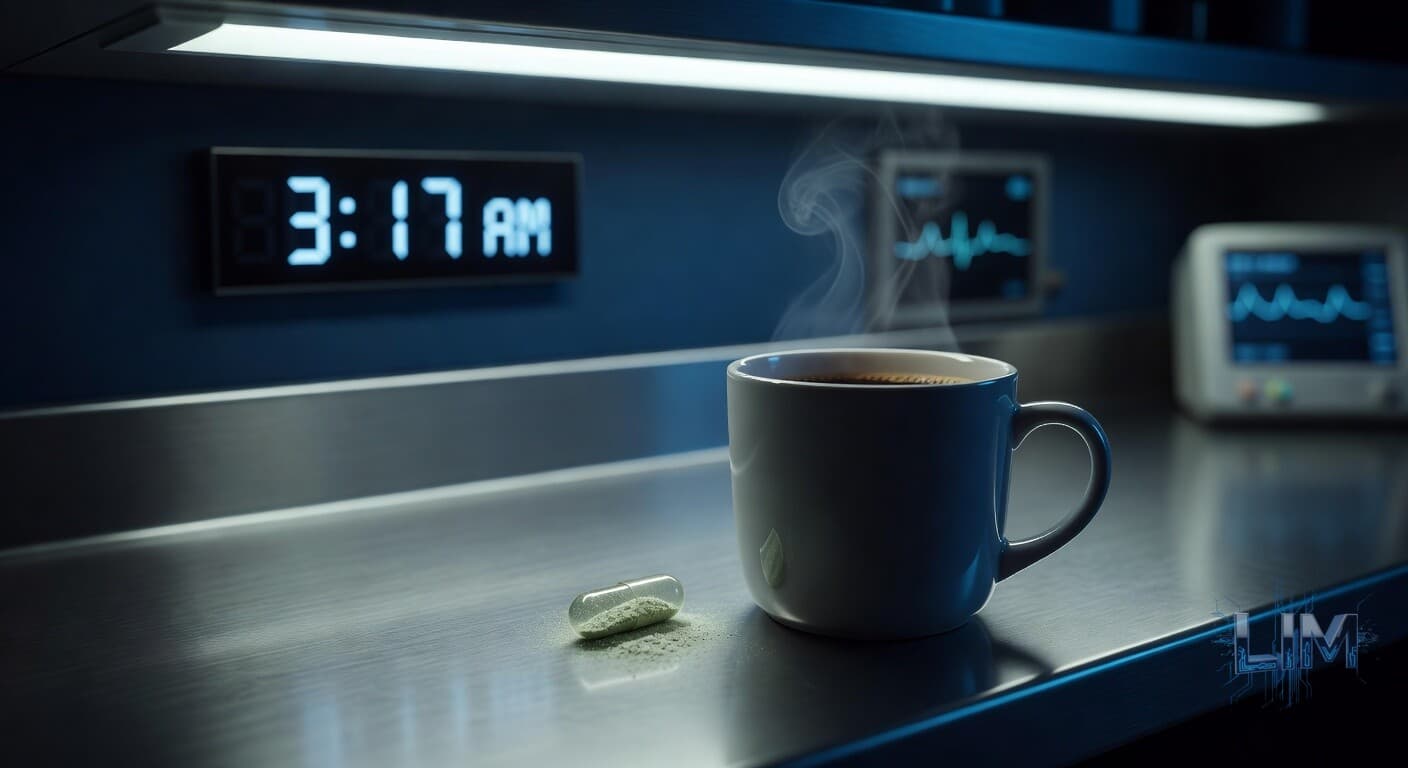
It is 02:47 on a Tuesday in the ER lobby. Marcus, 41, hospital security supervisor, two kids asleep at home, is on hour eight of a twelve.
He has already poured 320mg of caffeine into himself since 19:00. His hands have a fine tremor. A combative patient just rolled in and Marcus is the one who has to put hands on him. His reaction time has quietly dropped 40ms since hour four and he does not know it.
TL;DR - Haskell 2008 (n=27) showed 50mg caffeine + 100mg L-theanine cut reaction time ~10ms and lifted working-memory accuracy 6–8 points vs caffeine alone. - Caffeine half-life is 4–6 hours. L-theanine is 50–70 minutes. One dose covers four hours, not twelve. - Split-dose protocol: 50/100 at shift start, hour four, and hour eight. Theanine-only top-up at hour ten if vigilance is still load-bearing. - Total: 150mg caffeine, 400–500mg L-theanine across the shift. - Skip if you have an arrhythmia, are pregnant, on SSRIs at a changed dose, or on stimulants.
Marcus is not tired. He is over-stimulated and under-buffered.
Adenosine is the brain's fatigue ledger. ATP hydrolysis releases it across the day, and it stacks on A1 and A2A receptors in the basal forebrain and striatum.
Related Read
Hour 10 Is a Choline Problem Before It's a Willpower ProblemCiticoline rebuilds neural membranes over 28 days. Alpha-GPC raises acetylcholine in 45 minutes. The 12-hour overnight needs both, timed to the trough.
A1 binding suppresses cholinergic output. A2A binding throttles dopamine. By hour nine of a twelve, vigilance becomes effortful and error rates climb on every sustained-attention task ever measured.
Caffeine is a non-selective adenosine antagonist. It does not add energy. It removes the brake.
The downstream cost is locus coeruleus noradrenergic firing. That is the tremor in Marcus's hands. That is the jaw tension. Past 200mg the noradrenergic drive overshoots the cognitive sweet spot and starts shredding fine motor control and short-term memory consolidation.
There is no caffeine dose where you get the alertness without the side effects. Yerkes-Dodson in pharmacological form.
L-theanine is the brake on the brake
L-theanine is a non-protein amino acid from Camellia sinensis, structurally close to glutamate. It crosses the blood-brain barrier within 30 minutes and peaks around 50 (Nobre, Rao, Owen, Asia Pacific Journal of Clinical Nutrition 17 S1, 2008).
It binds AMPA, NMDA, and kainate glutamate receptors at low affinity. It lifts extracellular GABA and glycine in the striatum. It modulates dopamine and serotonin tone.
The fingerprint in humans is increased alpha-band EEG power in the 8–13 Hz range, measurable at a 100mg oral dose within 40 minutes. Alpha is relaxed vigilance. Not sedation. Not arousal. Awake, focused inward, not anxious.
Caffeine pulls the adenosine brake off dopamine and acetylcholine. L-theanine clips the glutamatergic and noradrenergic overshoot caffeine alone produces. The vigilance circuit keeps running. The brainstem alarm gets quieter.
This is the kind of pairing Chiron, our AI head coach, flags the moment your morning voice-note check-in starts sounding wired-and-fried instead of calm-and-sharp.
The numbers are not vibes. They are three labs converging on the same ratio.
Haskell, Kennedy, Milne, Wesnes, and Scholey, Biological Psychology 77(2), 2008, ran a double-blind placebo-controlled crossover on 27 healthy adults. Four arms: placebo, 50mg caffeine, 100mg L-theanine, 50/100 combination.
At 60 minutes post-dose: simple reaction time ran ~10ms faster on the combination than on caffeine alone. Numeric working-memory accuracy on one-back and two-back tasks jumped 6–8 percentage points over caffeine alone.
Bond-Lader VAS tiredness dropped on both caffeine arms. Tension and jitteriness only rose on the caffeine-alone arm. L-theanine solo improved accuracy but did not move subjective alertness.
Owen, Parnell, De Bruin, Rycroft, Nutritional Neuroscience 11(4), 2008, replicated on attention-switching. The combination produced faster switch-trial reaction times and a measurable distraction filter on incongruent Stroop trials. Caffeine alone got the speed but not the filter.
Giesbrecht et al., Nutritional Neuroscience 13(6), 2010, ran a 50-minute sustained attention task. The combination group reported less fatigue across the full window than either molecule alone.
At 1:1 the alpha signal is attenuated. At 4:1 theanine starts competing with vigilance and the stack feels flat. At 2:1, across three labs that isolated the variables cleanly, the curves align.
HERMES, our research engine, watches the literature, which is how this protocol stayed in your stack instead of getting buried by the next supplement-aisle blog cycle.
One dose does not cover twelve hours. This is where everyone fails.
Caffeine's plasma half-life is 4–6 hours in adults with normal CYP1A2 activity. L-theanine's is roughly 50–70 minutes.
Take 100mg caffeine and 200mg theanine at 19:00 on an 11p-7a shift. The caffeine is still meaningfully active at 04:00. The theanine is gone by 20:30.
Past the four-hour mark, you are on caffeine monotherapy. Which is the noradrenergic stack you specifically wanted to avoid.
The jitter at hour seven is not the combination failing. It is the theanine clearing while the caffeine sits there alone. This is invisible if you only track total daily milligrams, which is exactly how most shift workers track.
That is also why most of them front-load 300–400mg in the first four hours and crash at hour nine when the adenosine rebound lands.
The protocol that respects the half-lives
For a twelve starting at 19:00:
- 19:00 (start): 50mg caffeine + 100mg L-theanine.
- 23:00 (hour four): 50mg caffeine + 100mg L-theanine. Re-doses theanine while caffeine is still on board.
- 03:00 (hour eight): 50mg caffeine + 100mg L-theanine. This is your caffeine cutoff. Nothing stimulant past hour eight of a twelve.
- 05:00–07:00: If vigilance is still loaded, 100–200mg L-theanine solo. Will not impair post-shift sleep. Clips the residual edge from the 03:00 dose.
Total caffeine across the shift: 150mg. Total theanine: 400–500mg. Well inside published safety data, roughly five to seven cups of green tea over twelve hours.
The late theanine-only dose is the part everyone skips. It is the part that decides whether your last three hours feel controlled or feel like a slow grind.
Forms, sourcing, and the people who should not run this
Use L-theanine, the L-isomer. Not the racemic DL mix some bulk powders ship — DL is cheaper and half-inactive. Suntheanine is the patented L-isomer form with the most data behind it.
Caffeine source does not matter pharmacologically at this dose, but a 50mg anhydrous capsule beats titrating a pour-over at 02:45.
Skip this stack if you have an arrhythmia, are pregnant, are on SSRIs at a recently-changed dose, or are on stimulant medication. The dopamine and noradrenergic effects compound and the math turns on you.
The substrate layer is non-negotiable
A vigilance stack is not a substitute for the substrates underneath it. Run on a methylfolate deficiency, depleted magnesium, or sub-optimal B12 and no nootropic lands cleanly.
Baseline for shift-work cognition: methylfolate 400–800mcg daily (not folic acid), methylcobalamin 1000mcg sublingual (not cyanocobalamin), magnesium glycinate 300–400mg at the post-shift wind-down, D3 5000 IU with K2 MK-7 100mcg taken with fat, and 2g combined EPA+DHA in triglyceride form.
When the LIM daily AI program update worker sees you logged a poor post-shift sleep score on Apple Watch, it rewrites the next day's caffeine ceiling before you finish your coffee. That feedback loop is the part the 2008 papers could not run, because they were 60-minute lab sessions and your life is not.
How we actually run this
Every shift-worker intake at LIM starts with a 14-day baseline. Caffeine log. Oura or Whoop sleep data. A morning cognitive assessment at hour eleven of a shift. Fasting insulin and CYP1A2 genotype when available.
Slow metabolizers get a 100mg total caffeine ceiling. Fast metabolizers run the full 150mg. Theanine scales with caffeine, not body weight. We retest at week six, and if switch-trial reaction time and subjective calm have not both moved, the protocol was wrong and we rebuild it.
Jake ran a version of this on hospital security graveyards while he dropped 112 pounds. The 2:1 is not a wellness slogan — it is the ratio Haskell tested in 2008 and Owen replicated the same year. The split-dose schedule is the part the studies did not cover, because their window was 60 minutes and yours is twelve hours.
Marcus finishes the shift at 07:00 with hands that do not shake. He sleeps. He picks his kids up from school in the afternoon. That is what hour ten is supposed to feel like.
Build the stack inside the app at legacyinmotion.fit.
---
The data behind this
- Haskell CF et al., Biological Psychology 77(2), 2008; n=27 crossover; 50/100 ratio.
- Owen GN et al., Nutritional Neuroscience 11(4), 2008; attention-switching replication.
- Giesbrecht T et al., Nutritional Neuroscience 13(6), 2010; 50-minute sustained attention.
- Nobre AC, Rao A, Owen GN, Asia Pacific Journal of Clinical Nutrition 17(S1), 2008; pharmacokinetics.
- Caffeine half-life and CYP1A2 metabolism literature.
- L-theanine alpha-band EEG signature, 100mg oral dose, 8–13 Hz range.
---
Coaching that works the same shifts you do
Start logging and Chiron, our AI head coach, starts adjusting: protein targets per meal, training volume after short sleep, a deload when your numbers call for it instead of when the calendar does. HERMES, our research engine, feeds new research into your coaching the morning it publishes.
$29.99/month · $249.99/year · 7-day free trial · cancel anytime · no enrollment fee · no contract
Start coaching → · See the full app →
Jake Long built it after losing 112 lbs working hospital night shifts — when no human coach could keep up with his schedule. He wanted the system he wished he'd had at 308. Now you can use it too.
Questions Worth Asking
What is the best ratio of L-theanine to caffeine for focus?
Haskell 2008 tested 100mg L-theanine with 50mg caffeine, a 2:1 ratio, in 27 healthy adults. At 60 minutes post-dose the combination cut simple reaction time roughly 10ms and lifted numeric working-memory accuracy 6 to 8 percentage points over caffeine alone.
How do I dose L-theanine and caffeine across a 12-hour shift?
Caffeine half-life is 4 to 6 hours but L-theanine clears in 50 to 70 minutes, so one dose only covers about four hours. Run 50mg caffeine plus 100mg L-theanine at shift start, hour four, and hour eight, with a theanine-only top-up at hour ten if vigilance is still load-bearing. Total across the shift: 150mg caffeine and 400 to 500mg L-theanine.
Why does caffeine alone make my hands shake at hour eight?
Caffeine drives locus coeruleus noradrenergic firing, and past 200mg the noradrenergic overshoot starts shredding fine motor control and short-term memory consolidation. That is the tremor and jaw tension. L-theanine clips the glutamatergic and noradrenergic overshoot while leaving the vigilance circuit running, which is why the Haskell arm with theanine showed no rise in tension or jitteriness.
Comments (0)
Comments are reserved for Legacy In Motion members.
$29.99/month. No contracts. Cancel anytime.
Get StartedAlready a member? Sign in
You read this far. Now do this.
You've read the theory.
Now put it to work in your real week.
I went from 308 to 196 lbs working 12-hour overnight shifts with two kids and zero personal trainer. The system I used is now an app that plans your training and meals around YOUR schedule — overnight, day shift, all of it.
Cancel anytime · No setup fee · No long contract
Free Assessment
What's Holding Your Fitness Back?
Take our 60-second quiz and get a personalized breakdown of what's stopping your progress — plus how AI coaching solves it.
Take the QuizFree PDF · No Credit Card
Your free Shift Worker AI Fitness Blueprint
A 4-week plan that respects what shift work does to sleep: when to go down after a night, the four-minute REHIT window, post-shift macros, and when to back off. In your inbox in 30 seconds.
Built by someone who actually worked them. No fluff. Unsubscribe any time.
Keep Reading
2026-04-22
Hour 10 Is a Choline Problem Before It's a Willpower Problem
Citicoline rebuilds neural membranes over 28 days. Alpha-GPC raises acetylcholine in 45 minutes. The 12-hour overnight needs both, timed to the trough.
2026-04-22
KSM-66 vs Sensoril: The Same Herb, Two Different Clocks
2026-04-06
Garmin HRV for Night-Shift Workers: The Recovery Edge
Your Garmin already knows when to push and when to pull back. Most night-shift workers ignore it. Here is how to stop.
Join our free fitness community — get coaching tips, share wins, and stay accountable.
JOIN THE DISCORD →