


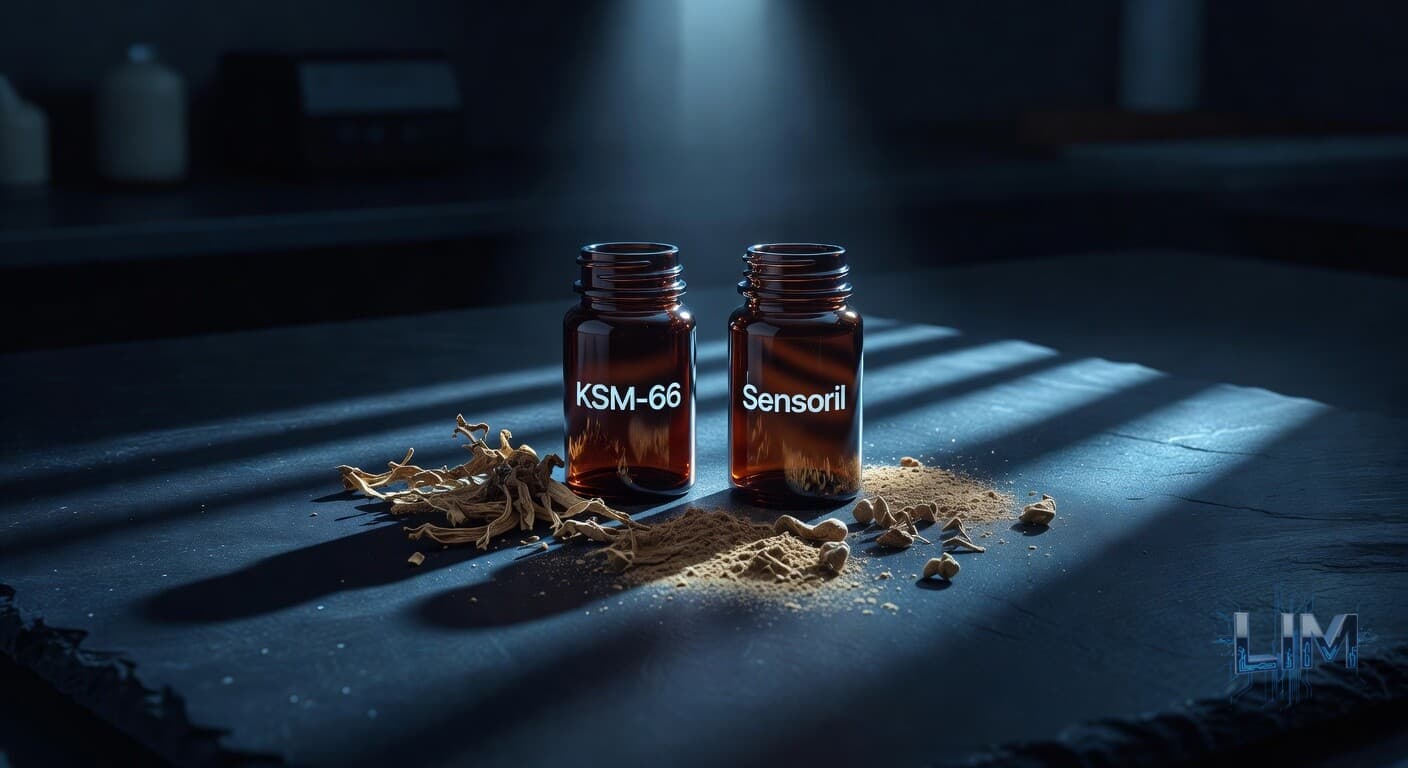
KSM-66 vs Sensoril: The Same Herb, Two Different Clocks
Trevor is 51. Regional VP. 110,000 air miles a year. Hotel gyms in nine time zones, none of them his.
Tuesday morning he is in Frankfurt. Wednesday morning he is in São Paulo. Thursday morning he is in Atlanta and his body genuinely does not know what time it is.
He bought a $14 ashwagandha bottle from an airport kiosk in Singapore at 2 AM local because his cortisol had not turned off in three days and his hands were shaking on the rental-car wheel.
Six weeks later his sleep was worse and his resting heart rate was up. The herb was not broken. The bottle was lying.
Related Read
Shift Work Weight Gain: Why Night Shifts Pack Visceral FatWhy night-shift work rewires metabolism toward visceral fat—and the meal-timing, cortisol, and AI-coaching protocol that reversed 112 lbs on hospital security graveyards.
TL;DR - KSM-66 at 600 mg/day cut serum cortisol 27.9% in 60 days (Chandrasekhar 2012, n=64). - Sensoril at 500 mg/day dropped cortisol 27.4% AND CRP 36% (Auddy 2008, n=130). - Sensoril 120 mg pre-bed lifted sleep efficiency 72% on PSQI (Deshpande 2020). - Withaferin A separates the two: KSM-66 keeps it under 0.1%, Sensoril runs higher by design. - Travelers and rotating-shift workers usually need both, dosed to the local clock you slept on, not the clock on the hotel wall.
"Standardized" is the most useless word on a supplement label
Standardization promises one thing: a minimum percentage of a named marker compound, verified by HPLC. That is it.
Two bottles labeled "5% withanolides" can contain wildly different ratios of withanolide A, withaferin A, withanoside IV, and sitoindosides VII through X. The ratios drive the outcome. The label hides the ratios.
Ashwagandha (Withania somnifera) has over 40 identified withanolides. Two proprietary extracts dominate the clinical literature, and they are not interchangeable. This is the kind of detail HERMES, our research engine, catches the moment a new lot ships. It watches the literature so your protocol updates when the evidence does.
KSM-66 is the morning lever
KSM-66 is a root-only extract from Ixoreal Biomed, produced by a proprietary water-based process. Standardization: minimum 5% withanolides by HPLC, with withaferin A deliberately held below 0.1%.
That low withaferin A number matters. The compound is cytotoxic in vitro at higher concentrations and drives most of the GI complaints and thyroid noise people report on chronic ashwagandha.
The anchor study: Chandrasekhar et al., Indian Journal of Psychological Medicine, 2012. 64 adults with chronic stress, 600 mg/day split as 300 mg twice daily, 60 days. Serum cortisol fell 27.9% in the treatment arm versus 7.9% in placebo. Perceived Stress Scale scores dropped 44%.
Salve et al., Cureus, 2019 replicated it. The 600 mg arm showed a 23% cortisol reduction with measurable sleep improvement on actigraphy.
Mechanism: withanolide A binds GABA-A at the alpha-4 and delta subunit configuration. That modulates tonic inhibition without phasic sedation. You do not feel drugged. You feel less reactive.
KSM-66 at 600 mg, split morning and midday, is the default for the cortisol pattern that shows up as a flat awakening curve and reactive daytime anxiety. This is exactly the pattern Chiron, our AI head coach, flags in your daily program review the moment your morning HRV reads start trending the wrong way.
Sensoril is the night lever
Sensoril is a Natreon extract pulled from both root and leaf biomass. Standardization: minimum 10% withanolides by HPLC, with notably higher withaferin A and a glycowithanolide fraction containing sitoindosides VII and VIII at measurable levels.
The anchor study: Auddy et al., Journal of the American Nutraceutical Association, 2008. 130 adults randomized across 125 mg, 250 mg, 500 mg, or placebo, 60 days. Cortisol reductions ran dose-responsive: 14.5%, 24.2%, 27.4% versus 5.7% placebo.
The secondary panel is where Sensoril separated from the pack. At 500 mg: CRP fell 36%, DHEA-S rose 32%, fasting glucose dropped 4.2%.
Deshpande et al., Cureus, 2020 closed the case on sleep. 120 mg taken 60 minutes before bed: PSQI sleep efficiency improved 72%, total sleep time up 66 minutes versus placebo.
Higher withaferin A pushes Sensoril toward NF-kB suppression and a more sedating subjective profile. Sensoril is what you take when cortisol is spiking at the wrong end of the clock.
Trevor needs both, because the schedule will not pick one
Travelers and rotating-shift workers present with two cortisol pathologies, often at the same time.
First: a flattened or inverted awakening response on the new time zone. The morning CAR should rise 50 to 75% within 30 minutes of waking. It fails to fire when your suprachiasmatic nucleus is taking conflicting orders from light, food, and the city you slept in two days ago.
Second: a cortisol spike during the designated sleep window. A man trying to sleep in Frankfurt at midnight local on a body that is still running São Paulo afternoon shows cortisol values 40 to 60% above age-matched local sleepers at the same chronological clock time.
Trevor runs both. KSM-66, 300 mg on local waking, regardless of city. Sensoril, 125 to 250 mg, 60 to 90 minutes before whatever passes for bedtime that night.
His 90-day repeat panel: awakening response climbed back into normal range, RMSSD up 34%, sleep latency down to 18 minutes on transatlantic turnarounds. The waist measurement also moved, though that is the hotel-gym Wolverine pair he runs three mornings a week, not the herb.
Jake himself ran versions of this stack during the 308 to 196 stretch on hospital security graveyards. The herb is a lever on the HPA axis. It is not a fix for the schedule, only for the damage the schedule does.
What to verify on the COA before you buy
Before any bottle gets shelf space in the travel kit, verify four things.
- Extract name. "Ashwagandha root extract 2.5% withanolides" is not KSM-66 or Sensoril. Both trademarks must appear by name on the label.
- Withanolides by HPLC, not gravimetry. Gravimetric numbers inflate the percentage by counting non-active co-extractives.
- Withaferin A content. KSM-66 should read under 0.1%. Sensoril runs higher by design, that is the sleep indication doing its job.
- Third-party identity testing. USP, NSF, or a recognized contract lab. Ashwagandha is one of the most adulterated botanicals on the open market.
The brands that pass all four are the ones we list. The rest do not make the page. That is the daily AI program update worker rewriting your stack the moment a new lot fails screening, not a static affiliate list someone forgot to update in 2023.
The herb is the lever, not the system
Trevor did not fix his cortisol with an airport-kiosk bottle and a guess. He fixed it by matching the right extract to the right window of his actual schedule, then verifying the label said what it claimed.
That is the work. We do that work for you every day at legacyinmotion.fit.
---
The data behind this
- Chandrasekhar K et al., Indian Journal of Psychological Medicine, 2012; n=64; KSM-66 600 mg/day; 27.9% cortisol reduction.
- Salve J et al., Cureus, 2019; KSM-66 replication; ~23% cortisol reduction with actigraphic sleep improvement.
- Auddy B et al., Journal of the American Nutraceutical Association, 2008; n=130; Sensoril dose-response; 27.4% cortisol + 36% CRP + 32% DHEA-S at 500 mg.
- Deshpande A et al., Cureus, 2020; Sensoril 120 mg pre-bed; PSQI sleep efficiency +72%, total sleep time +66 minutes.
- Withaferin A cytotoxicity and chronic-dosing GI/thyroid signal — in vitro and observational literature.
---
Get Chiron in your pocket — $29.99/month
Most programs die in the gap between the plan and your real week. Chiron, our AI head coach, reads what you log (meals, workouts, skipped sessions) and rewrites tomorrow instead of waiting for you to fall off. HERMES, our research engine, keeps the coaching current with new science the week it publishes.
$29.99/month · $249.99/year · 7-day free trial · cancel anytime · no enrollment fee · no contract
Start coaching → · See the full app →
Jake Long built it after losing 112 lbs working hospital night shifts — when no human coach could keep up with his schedule. He wanted the system he wished he'd had at 308. Now you can use it too.
The Questions Readers Ask Most
What is the difference between KSM-66 and Sensoril ashwagandha?
KSM-66 is a root-only extract holding withaferin A below 0.1%, standardized to 5% withanolides; Sensoril uses root and leaf biomass at 10% withanolides with notably higher withaferin A and sitoindosides VII/VIII. Chandrasekhar 2012 showed KSM-66 at 600 mg/day cut cortisol 27.9% in 60 days, while Auddy 2008 showed Sensoril at 500 mg/day cut cortisol 27.4% and CRP 36%.
Should I take ashwagandha in the morning or at night?
KSM-66 is the morning lever, dosed 600 mg split between morning and midday for flat awakening curves and reactive daytime anxiety. Sensoril is the night lever; Deshpande 2020 found 120 mg taken 60 minutes before bed improved PSQI sleep efficiency 72% and added 66 minutes of total sleep time versus placebo.
Why did my cheap ashwagandha make my sleep worse?
A 5% withanolides label only guarantees a marker percentage, not the ratio of withanolide A, withaferin A, withanoside IV, or sitoindosides VII through X, and those ratios drive the outcome. Withaferin A is cytotoxic in vitro at higher concentrations and drives most GI complaints and thyroid noise on chronic ashwagandha, which is why KSM-66 deliberately keeps it under 0.1%.
Comments (0)
Comments are reserved for Legacy In Motion members.
$29.99/month. No contracts. Cancel anytime.
Get StartedAlready a member? Sign in
You read this far. Now do this.
Close the tab.
Go train the plan that fits your life.
I went from 308 to 196 lbs working 12-hour overnight shifts with two kids and zero personal trainer. The system I used is now an app that plans your training and meals around YOUR schedule — overnight, day shift, all of it.
Cancel anytime · No setup fee · No long contract
Free Assessment
What's Blocking Your Results?
Take our 60-second quiz and get a personalized breakdown of what's stopping your progress — plus how AI coaching solves it.
Take the QuizFree PDF · No Credit Card
Download the Shift Worker AI Fitness Blueprint
If your training keeps dying by week two, start here: the 4-week shift-worker protocol behind Jake's 112 lb loss, with the sleep timing and post-shift macros that made it stick.
Built by someone who actually worked them. No fluff. Unsubscribe any time.
Keep Reading
2026-07-09
Shift Work Weight Gain: Why Night Shifts Pack Visceral Fat
Why night-shift work rewires metabolism toward visceral fat—and the meal-timing, cortisol, and AI-coaching protocol that reversed 112 lbs on hospital security graveyards.
2026-04-20
L-Theanine + Caffeine: The 2:1 Stack for Hour Ten
2026-04-11
Night Shift Easter Reset No Crash Diets
The 4-step weekend reset for night shift workers — circadian-aware, no crash diets, built on what took me from 308 to 196 lbs.
Join our free fitness community — get coaching tips, share wins, and stay accountable.
JOIN THE DISCORD →