


KLOW vs GLOW vs Wolverine: The 2026 Peptide Stack Truth
Wolverine, GLOW, and KLOW peptide stacks compared with 2026 stability data and Dr. Trevor Bachmeyer's protocols.
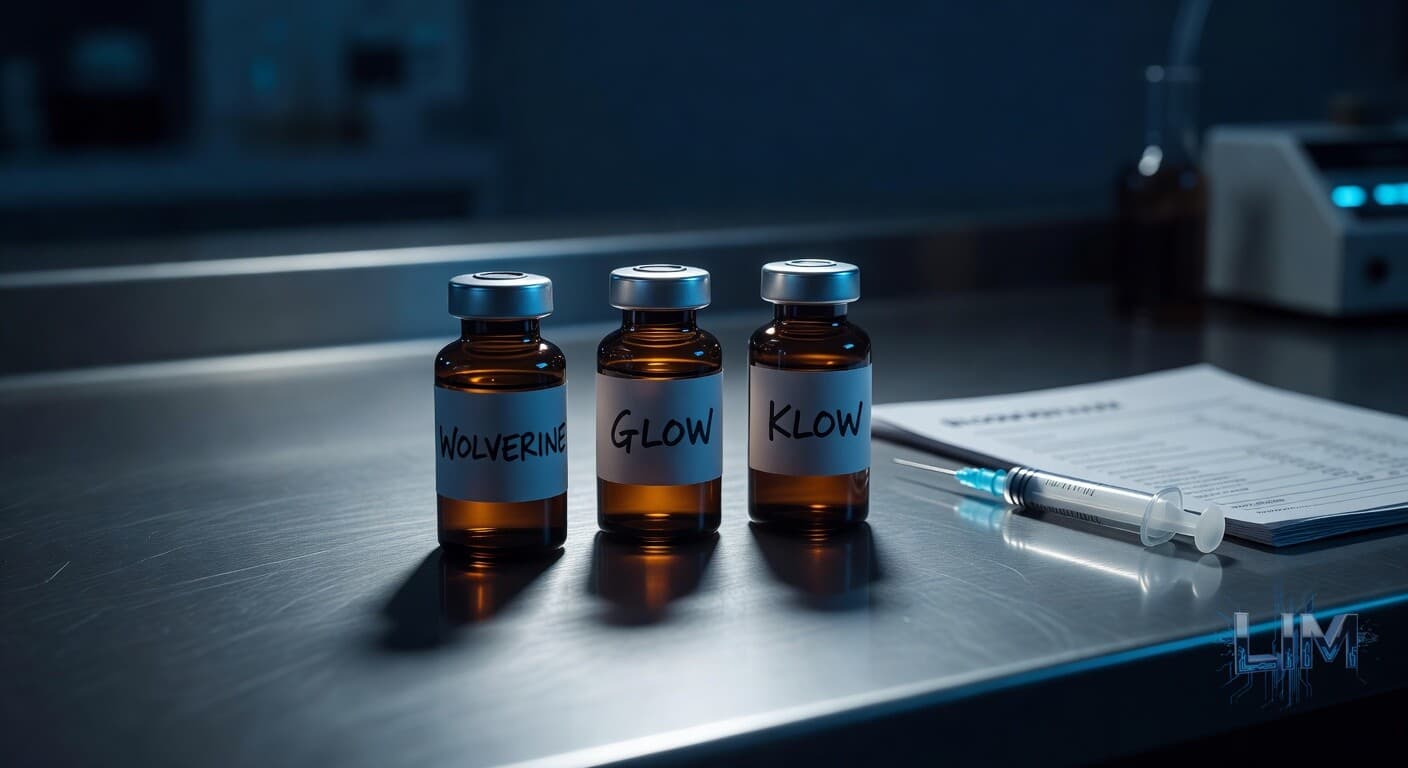
> Disclaimer: Educational content only. Legacy In Motion does not sell, prescribe, or administer research chemicals. BPC-157, TB-500, GHK-Cu, and KPV are investigational and not FDA-approved for human use. Work exclusively with a licensed physician experienced in peptide therapy. Bloodwork before, during, and after is non-negotiable.
Mark is in his mid-fifties. CIDP managed. Both knees replaced four years ago and finally not chirping. The newest line item on the body inventory is the right rotator cuff — torn last summer hauling a pallet of mulch his neighbor wanted moved before the rain.
His twice-a-week trainer of nine years offered the smart, slow path: scapular stability, eccentric loading, twelve weeks before the bench bar even gets touched. His surgeon offered cortisone and "see how it feels in eight weeks."
His brother-in-law handed him a vial labeled KLOW and said it would fix everything. Mark stared at four peptides crammed into one solution and did not know which question to ask first.
Related Read
Five Extra Minutes and Half a Vegetable ServingKoemel 2026: 5 more minutes of sleep, about 2 minutes of harder movement, and half a vegetable serving tracked with one extra year. Not a new fall reset.
This is that question, answered.
TL;DR: - BPC-157 + TB-500 (the "Wolverine" stack) has compatible pH ranges and is the most stable foundation; Dr. Trevor Bachmeyer calls BPC-157 his number-one peptide and takes it daily. - GHK-Cu's optimal pH sits at 5.0 to 6.5, and its copper ion catalyzes oxidation of BPC-157 and TB-500 in any shared vial. - KLOW packs four peptides into one stick: maximum convenience, minimum biochemical fidelity. - Optimized split: BPC-157 250 to 500 mcg daily, TB-500 2.5 to 5 mg twice weekly loading, GHK-Cu 1 to 2 mg daily in a separate syringe. - Add KPV (250 to 500 mcg daily) only when systemic inflammation is the real bottleneck.
The vial in Mark's hand was the convenient lie
KLOW means kitchen sink. KPV plus BPC-157 plus TB-500 plus GHK-Cu, all in one stick.
The marketing pitch is one injection, four benefits. The biochemistry is four molecules with conflicting pH preferences sharing a copper ion that oxidizes its neighbors during storage.
Dr. Trevor Bachmeyer is unambiguous: do not store GHK-Cu in the same vial as BPC-157 and TB-500. Pre-mixed blends trade measurable potency for the appearance of simplicity.
Convenience and biochemistry are not the same scoreboard.
Why the Wolverine stack still wins on stability
BPC-157 is a 15-amino-acid fragment of a gastric protein. It upregulates eNOS (good nitric oxide), suppresses iNOS (the inflammatory kind), and accelerates angiogenesis — tendon, ligament, nerve, and gut repair.
TB-500 is a thymosin beta-4 fragment. It governs actin polymerization and cell migration, with standout preclinical data on cardiac repair and scar-tissue remodeling.
These two share compatible pH ranges. They sit in the same syringe without fighting. That is the entire reason Bachmeyer builds every protocol on top of the Wolverine pair.
Two peptides that play nice are stronger than four that fight in a vial.
GHK-Cu earns its slot, just not in the same syringe
GHK-Cu (Glycyl-L-Histidyl-L-Lysine copper complex) is a naturally occurring tripeptide that crashes with age. It modulates tissue-remodeling genes, boosts collagen, elastin, and glycosaminoglycans, activates stem cells, and supports nerve and blood-vessel growth.
The catch is pH. GHK-Cu lives in a narrow window of 5.0 to 6.5, and the copper ion catalyzes oxidation of neighboring peptides during long-term storage. Park it next to BPC-157 for thirty days and you are injecting partially degraded compounds.
The fix is boring and effective: separate vial, separate syringe, different injection time. Skin, hair, and collagen results compound over 8 to 12 weeks of consistent dosing.
The "glow peptide" earns its slot. In a separate syringe.
KPV is the closer, not the headliner
KPV (Lysine-Proline-Valine) is a tripeptide fragment of alpha-MSH. A potent anti-inflammatory, particularly for gut and skin tissue.
It belongs in the protocol when systemic inflammation is the actual bottleneck — chronic gut issues, persistent skin flares, post-surgical inflammation that will not quit. Stacking it alongside BPC-157 and TB-500 in separate draws makes sense. Cramming it into a four-peptide pre-mixed vial does not.
Add KPV when inflammation is the boss fight, not because the label sounds cool.
The protocol that survives contact with real life
Here is what Mark's surgeon should have handed him alongside the cortisone option.
Protocol A (precision): - BPC-157: 250 to 500 mcg daily, split AM/PM, near the injury when possible. - TB-500: 2.5 to 5 mg twice weekly for a 4 to 6 week loading phase, then 2 to 5 mg weekly maintenance. - GHK-Cu: 1 to 2 mg daily in a fully separate vial and syringe, dosed at a different time of day. - KPV (optional): 250 to 500 mcg daily if systemic inflammation is the primary complaint.
Expect inflammation to drop in 7 to 14 days. Real tissue repair shows up at 4 to 8 weeks. Skin and hair shifts land between 8 and 12 weeks.
None of this works without the boring foundation: 1 gram of protein per pound of bodyweight, 7 to 9 hours of sleep, zone-2 cardio, and progressive rehab loading. The trainer's twelve-week scap-stability block is not optional. It is the floor the peptides are landing on.
Protocol B (acceptable compromise): A freshly reconstituted KLOW or GLOW blend used inside 10 to 14 days. Travel, low compliance, or short-term goals only. Still draw GHK-Cu separately when you can.
Where Legacy In Motion plugs in
Peptides are one input. Whether they actually work depends on whether the rest of the system catches the signal.
This is where HERMES, our research engine, earns its keep. HERMES watches the literature so the moment new stability data on GHK-Cu mixing publishes, your protocol guidance updates inside the app within days.
This is the kind of pattern Chiron, our AI head coach, flags in the daily program review. If your HRV does not rebound the way the literature predicts at week three of BPC-157, Chiron sees it before you do and pulls back training volume automatically.
The daily AI program update worker rewrites your week the moment your HealthKit sleep score craters. Two bad nights and the resistance day downshifts to mobility and zone-2. No "push through it" nonsense that turns a tendon flare into a six-month layoff.
For someone like Mark — twice-weekly trainer, longstanding relationship, partner-coached for nearly a decade — Chiron sits next to the trainer, not in place of him. The trainer programs the eccentric loading. Chiron watches the recovery data between sessions and flags the days where load needs to come off the bar. Same team. Different tools.
FAQ
Is Wolverine better than KLOW? For stability and flexibility, yes. KLOW adds KPV's anti-inflammatory punch and one-stick convenience but trades pH and copper stability for it.
Can I mix GHK-Cu with BPC-157 and TB-500? For acute, freshly reconstituted, used-within-two-weeks scenarios: tolerable. For long-term storage: no, per Bachmeyer and stability data both. Separate injections are the responsible default.
Best stack for an injury like Mark's? Wolverine (BPC-157 + TB-500) as the foundation. Add GHK-Cu separately for connective tissue and skin quality. KPV only if inflammation is unrelenting.
Are these safe? They are research chemicals with strong preclinical data and limited large-scale human trials. Physician supervision, third-party-tested sourcing, and regular bloodwork are mandatory. Never treat them casually.
The closer
Mark did not need a fancier vial. He needed a system that knew what to do with the ones he already had.
Pre-mixed stacks are the peptide version of copying a TikTok workout. His shoulder, his sleep, his nine-year coaching relationship, his CIDP that took years to manage — none of that is a kitchen-sink problem. Build the protocol like the engineering problem it actually is, then run it through a system that watches the signal in real time. That is what we do at Legacy In Motion.
---
The data behind this
- Dr. Trevor Bachmeyer, peptide protocol commentary on pH stability and GHK-Cu storage incompatibility with BPC-157 / TB-500.
- BPC-157 mechanism: eNOS upregulation, iNOS suppression, angiogenesis literature (preclinical).
- TB-500 (thymosin beta-4) actin-polymerization and tissue-remodeling preclinical data.
- GHK-Cu pH-stability window 5.0–6.5; collagen and skin-remodeling clinical work.
- KPV alpha-MSH fragment anti-inflammatory mechanism (gut and skin tissue literature).
---
Coaching that works the same shifts you do
Chiron, our AI head coach, coaches the week you actually have: overnights, doubles, rotation flips, kid pickups. Log the change and tomorrow's plan already knows. No static program that assumes you sleep at 10pm and train at 6.
$29.99/month · $249.99/year · 7-day free trial · cancel anytime · no enrollment fee · no contract
Start coaching → · See the full app →
Jake Long built it after losing 112 lbs working hospital night shifts — when no human coach could keep up with his schedule. He wanted the system he wished he'd had at 308. Now you can use it too.
Questions Worth Asking
Can you mix BPC-157, TB-500, and GHK-Cu in the same vial?
No. GHK-Cu's optimal pH sits at 5.0 to 6.5, and its copper ion catalyzes oxidation of BPC-157 and TB-500 during shared storage. Dr. Trevor Bachmeyer is unambiguous: do not store GHK-Cu in the same vial as BPC-157 and TB-500. Use a separate vial, separate syringe, and different injection time.
What's the optimal BPC-157 and TB-500 dosing for a torn rotator cuff?
The optimized split is BPC-157 at 250 to 500 mcg daily, TB-500 at 2.5 to 5 mg twice weekly during loading, and GHK-Cu 1 to 2 mg daily in a separate syringe. BPC-157 and TB-500 share compatible pH ranges so they can sit in the same syringe, which is why Bachmeyer builds every protocol on the Wolverine pair.
Is KLOW actually worse than injecting peptides separately?
Yes on biochemical fidelity. KLOW crams KPV, BPC-157, TB-500, and GHK-Cu into one stick, but the copper ion in GHK-Cu oxidizes its neighbors during storage, so after thirty days you are injecting partially degraded compounds. Pre-mixed blends trade measurable potency for the appearance of simplicity.
Comments (0)
Comments are reserved for Legacy In Motion members.
$29.99/month. No contracts. Cancel anytime.
Get StartedAlready a member? Sign in
You read this far. Now do this.
You've read the theory.
Now put it to work in your real week.
I went from 308 to 196 lbs working 12-hour overnight shifts with two kids and zero personal trainer. The system I used is now an app that plans your training and meals around YOUR schedule — overnight, day shift, all of it.
Cancel anytime · No setup fee · No long contract
Free Assessment
What's Really Stopping Your Progress?
Take our 60-second quiz and get a personalized breakdown of what's stopping your progress — plus how AI coaching solves it.
Take the QuizFree PDF · No Credit Card
Download the Shift Worker AI Fitness Blueprint
The protocol Jake wishes he'd had at 308 lbs: sleep timing for rotating shifts, post-shift macros, and the AI deload trigger, from the run that took him to 196. Free, no card needed.
Built by someone who actually worked them. No fluff. Unsubscribe any time.
Keep Reading
2026-09-22
Five Extra Minutes and Half a Vegetable Serving
Koemel 2026: 5 more minutes of sleep, about 2 minutes of harder movement, and half a vegetable serving tracked with one extra year. Not a new fall reset.
2026-09-18
Collagen Did Not Speed Workout Recovery
Ravindran 2026: 113 trials, 7,983 people. Skin and osteoarthritis moved. Next-day soreness did not.
2026-09-03
Sleeping In Past 8 Hours Did Not Slow Organ Aging
Wen 2026 Nature: 23 organ clocks in UK Biobank. Lowest aging at 6.4 to 7.8 hours. A Labor Day sleep-in sits on the long arm.
Join our free fitness community — get coaching tips, share wins, and stay accountable.
JOIN THE DISCORD →