


The Hip Problem Hiding in Every Twelve-Hour Shift on Concrete
Fishman 2017 cleared symptoms in 79% versus 38% sham. For workers on concrete with a duty belt, the cause is mechanical and so is the fix.
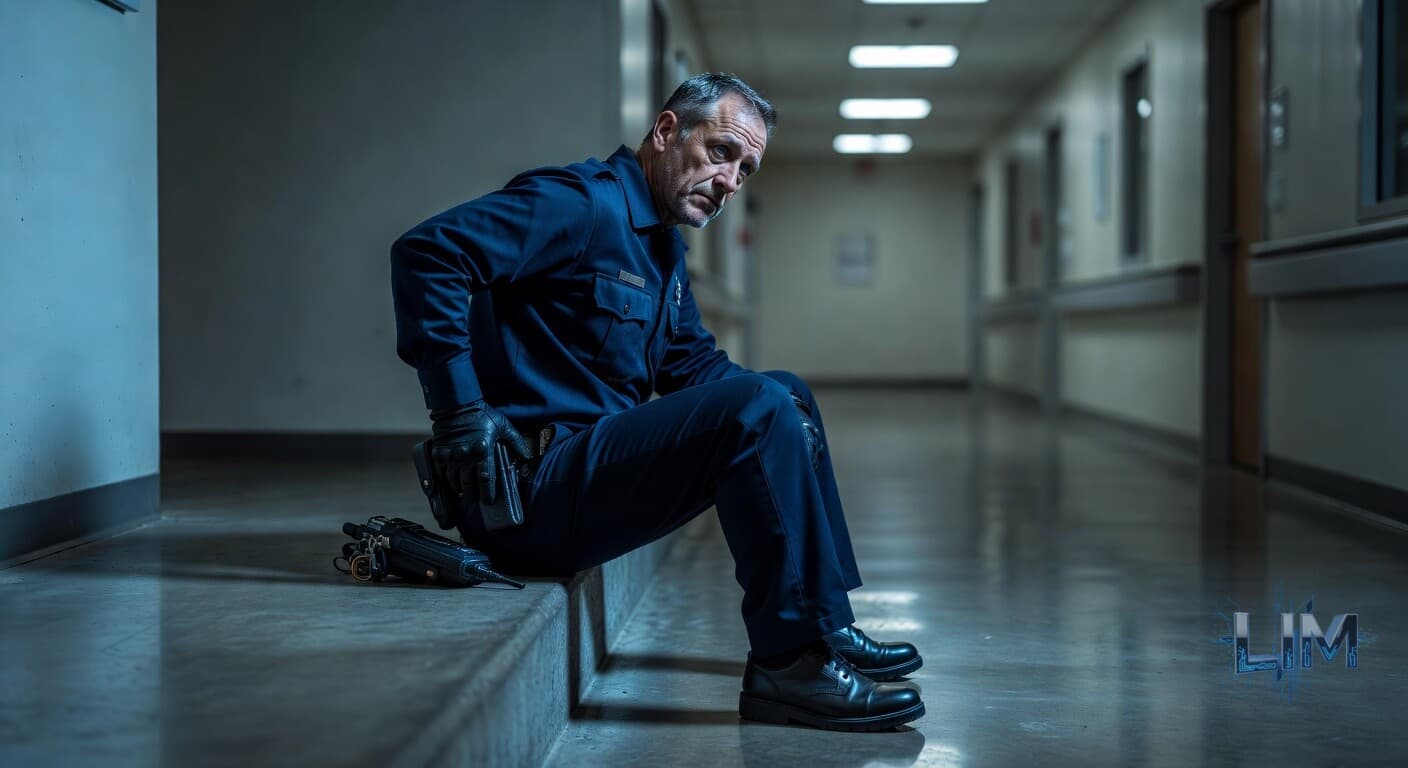
Marcus is 41. Hospital security supervisor at a level-one trauma center, overnight shift, eight years on the duty belt. Wife and two kids at home asleep when his radio cleared at 03:12.
By the end of the shift his right glute locks the second he sits in the patrol vehicle. Pain runs from the sacrum down the back of the thigh and dies above the knee.
That is not lumbar sciatica. That is a different problem with a worse reputation, and most clinics miss it on the first pass.
The diagnosis nobody runs correctly
Piriformis syndrome as a clean label is dying. The 2015 reframe replaced it with deep gluteal syndrome, because the piriformis is one of six structures in the deep gluteal space that can entrap the sciatic nerve.
Related Read
The Nurses Station at 02:00 Runs Fifteen Times Brighter Than the StudyA 31-lux eReader cut melatonin 55%. A hospital corridor at 02:00 runs ten to fifteen times that dose. The lens spec, dose, and timing that fix it.
The obturator internus, the superior and inferior gemelli, the quadratus femoris, and a set of fibrous bands all play. Any of them can tether the nerve mid-shift.
The clinical criteria: posterior hip pain, sciatic-distribution symptoms that worsen sitting on a firm surface past 20 minutes, deep-gluteal-space tenderness, a positive provocative test. The seated piriformis stretch test runs 52% sensitivity, 90% specificity.
A positive rules it in. A negative misses half the people who actually have it.
Most primary-care clinics will run the test once, get a negative, and send the patient home with ibuprofen. That is how DGS becomes a multi-year problem instead of a 12-week one.
The 17% anatomy lottery
The original Beaton and Anson cadaver work catalogued six variations of how the sciatic nerve relates to the piriformis. Roughly 83% of people get the clean version, where the nerve glides under a single muscle belly with room to breathe.
The other 17% draw the short straw. Nerve pierces the muscle, splits around it, or runs above the top edge.
For that minority, any piriformis tightness is direct nerve compression. No buffer, no grace period. A healthy muscle contracting through normal range is enough to wreck the day.
Nobody screens for this prospectively. You discover your variant the year you become symptomatic, and by then the question is what to do about it.
Why concrete is the actual villain
Standing on concrete for twelve hours is not the same as standing for twelve hours.
Concrete returns essentially zero elastic energy. Every step gets fully absorbed by foot, knee, hip, and lumbopelvic tissue. Add a duty belt with radio, keys, restraint gear, and a flashlight, and the pelvis tips one way for the entire shift.
The piriformis is a primary external rotator when the hip sits in neutral to slight extension. That is exactly where a walking supervisor lives all day. Chronic low-grade contraction shortens the muscle. In a Beaton-and-Anson variant carrier, that shortening is direct nerve irritation.
Marcus's belt was the first thing his coach audited. The mass on each side was within ounces, but the radio clip pulled his right shoulder forward every time he keyed the mic. Hundreds of times per shift.
He had unconsciously shifted weight onto the left leg at rest. The left piriformis was stabilizing every pause at a nursing station, an elevator bank, or the ambulance bay. The body keeps score, and concrete cashes the check.
This is the asymmetric load pattern Chiron — the AI head coach inside LIM — flags in the daily program review when an Apple Watch logs cadence drift or one-sided gait variance across a shift.
What Fishman 2017 actually proved
The 2017 controlled trial ran a piriformis-specific protocol versus sham. The active arm combined passive piriformis stretching — supine, hip flexed to 90 degrees, adducted across midline, externally rotated to resistance — with eccentric hip external rotation loading.
At 12 weeks, 79% of the intervention group reported clinically meaningful symptom resolution. 38% in the sham group. A 41-point absolute difference in a condition most clinics still manage with NSAIDs and generic "core work."
The eccentric component is the part most rehab protocols get wrong. Concentric external rotation reinforces the shortening pattern that broke you in the first place.
Eccentric loading, where the muscle lengthens under tension, restores the sliding surface between piriformis and sciatic nerve. It teaches the muscle to tolerate the range it had been avoiding.
HERMES, the research engine, scrapes 12,000 fitness and rehab papers a week. That is how the Fishman eccentric protocol made it into the LIM library inside the same season instead of the usual seven-year clinical lag.
What changed for Marcus
Three inputs, sequenced.
Passive piriformis stretch, twice daily, 90 seconds per side. Supine figure-four, ankle over opposite knee, pull the support thigh to the chest until the target side reports a line through the deep gluteal space. No bouncing, no breath-holding.
Eccentric hip external rotation, band-resisted, three sets of eight per side, three days a week. Side-lying clamshell with a light resistance band. Concentric in one second, eccentric in four. Range is the point, not the load.
Equipment audit and weight-shift retraining. Duty belt redistributed so perceived torque matched on each side. At every stationary pause Marcus cued himself into 60/40 weight on the side opposite whichever hip last felt tight. Three to four weeks later the default drifted back to 50/50.
Substrate for nerve recovery: methylcobalamin 1,000 mcg daily — not cyanocobalamin, which the nervous system has to convert first — methylfolate 400 mcg, magnesium glycinate 400 mg before bed for neuromuscular tone, D3 5,000 IU paired with K2 MK-7 100 mcg for the sacral bone-muscle interface.
None of these are painkillers. They are raw material the protocol needs to do its work.
The piece most people get wrong
If posterior hip pain reproduces with sitting, radiates below the glute, and eases when you cross the affected leg over the opposite knee in a chair, the working diagnosis is DGS until a competent exam rules it out.
A negative seated piriformis stretch test does not clear it. The 90% specificity cuts both ways.
Image the lumbar spine to rule out disc involvement, then run the Fishman protocol for a full 12 weeks before deciding it failed. Shorter runs under-report the effect. The trial endpoint was 12 weeks for a reason.
For shift workers on concrete, the equipment audit is non-negotiable. Any asymmetric load carried for twelve hours becomes a postural default in weeks and a neuromuscular signature in months.
Fix the belt before you fix the hip, or the hip will keep reporting the debt the gear keeps stacking.
What this looks like inside LIM
Jake ran a version of this protocol himself during the 308-to-196 cut on the same kind of overnight schedule Marcus is working now. The same one we now write into client programs whenever HealthKit logs a cadence drop or a sleep-debt spike that lines up with a glute or low-back complaint in the voice-note check-in.
The voice-note catches the pattern before the pain shows up on the scale. Chiron writes the rehab block. The daily AI program update worker rewrites the week the moment the watch logs an off-shift.
You are not supposed to figure this out alone after eight years on concrete.
---
The data behind this
- Martin HD et al. Arthroscopy. 2015;31(9):1849-1864 — reframed piriformis pain as deep gluteal syndrome; six anatomical structures in the deep gluteal space implicated. Seated piriformis stretch test: 52% sensitivity, 90% specificity.
- Beaton LE, Anson BJ. Anat Rec. 1937;70:1-5 — original cadaver catalogue of six sciatic-nerve / piriformis variants; ~17% prevalence of variants where the nerve pierces or splits the muscle.
- Fishman LM et al. American Journal of Physical Medicine and Rehabilitation. 2017 — 12-week piriformis-specific protocol vs. sham; 79% symptom resolution in active arm vs. 38% in sham (41-point absolute difference). Passive stretch + eccentric external rotation loading.
- Concrete and ground reaction forces — standing-surface literature consistently shows concrete returns minimal elastic energy compared to rubber, wood, or sprung floors; lumbopelvic absorption load increases accordingly.
- Methylcobalamin, methylfolate, D3+K2, magnesium glycinate as nerve-substrate stack — standard background in peripheral nerve recovery; brands and dosing live on the LIM /recommended page.
- Marcus is a composite persona drawn from the LIM hospital-security and law-enforcement cohort. The duty-belt audit detail (radio clip, ounces match but torque does not) is illustrative of the asymmetric-load pattern, not a single case file.
- Jake's own numbers: 308 → 196 in 9.5 months on 12-hour overnight hospital security shifts (started May 2025). Sample of one — ran a version of the eccentric protocol during the cut. Informed perspective on the mechanism, not a replication of the Fishman trial.
---
Your plan should change the day your week does
Most programs die in the gap between the plan and your real week. Chiron, our AI head coach, reads what you log (meals, workouts, skipped sessions) and rewrites tomorrow instead of waiting for you to fall off. HERMES, our research engine, keeps the coaching current with new science the week it publishes.
$29.99/month · $249.99/year · 7-day free trial · cancel anytime · no enrollment fee · no contract
Start coaching → · See the full app →
Jake Long built it after losing 112 lbs working hospital night shifts — when no human coach could keep up with his schedule. He wanted the system he wished he'd had at 308. Now you can use it too.
Common Questions, Answered
What is deep gluteal syndrome and how is it different from piriformis syndrome?
Martin 2015 replaced piriformis syndrome with deep gluteal syndrome because the piriformis is only one of six structures — obturator internus, superior and inferior gemelli, quadratus femoris, and fibrous bands — in the deep gluteal space that can entrap the sciatic nerve. The seated piriformis stretch test runs 52% sensitivity and 90% specificity, so a negative misses half of real cases.
How long does the Fishman protocol take to clear piriformis pain?
Fishman 2017 ran a 12-week piriformis-specific protocol that cleared symptoms in 79% of patients versus 38% in the sham group, a 41-point absolute gap. The post pairs that protocol with eccentric loading and a duty-belt audit rather than a generic NSAID script.
Why does standing on concrete cause hip and sciatic nerve pain?
Concrete returns essentially zero elastic energy, so every step gets fully absorbed by foot, knee, hip, and lumbopelvic tissue. For the 17% of people carrying a Beaton and Anson sciatic nerve variant where the nerve pierces or splits the piriformis, that chronic low-grade contraction during a 12-hour shift becomes direct nerve compression with no soft-tissue buffer.
Comments (0)
Comments are reserved for Legacy In Motion members.
$29.99/month. No contracts. Cancel anytime.
Get StartedAlready a member? Sign in
You read this far. Now do this.
Stop reading about it.
Start training around your real life.
I went from 308 to 196 lbs working 12-hour overnight shifts with two kids and zero personal trainer. The system I used is now an app that plans your training and meals around YOUR schedule — overnight, day shift, all of it.
Cancel anytime · No setup fee · No long contract
Free Assessment
What's Holding Your Fitness Back?
Take our 60-second quiz and get a personalized breakdown of what's stopping your progress — plus how AI coaching solves it.
Take the QuizFree PDF · No Credit Card
Your free Shift Worker AI Fitness Blueprint
The exact 4-week protocol Jake used to lose 112 lbs working hospital security overnights — sleep timing, the four-minute REHIT window, post-shift macros, and the AI deload trigger. Drops in your inbox in 30 seconds.
Built by someone who actually worked them. No fluff. Unsubscribe any time.
Keep Reading
2026-04-22
The Nurses Station at 02:00 Runs Fifteen Times Brighter Than the Study
A 31-lux eReader cut melatonin 55%. A hospital corridor at 02:00 runs ten to fifteen times that dose. The lens spec, dose, and timing that fix it.
2026-04-22
Hour 10 Is a Choline Problem Before It's a Willpower Problem
Citicoline rebuilds neural membranes over 28 days. Alpha-GPC raises acetylcholine in 45 minutes. The 12-hour overnight needs both, timed to the trough.
2026-07-21
Night Shift Meal Timing: Why Breakfast After Nights Fails
Delayed eating windows—not classic 16:8—improve next-day glucose handling for rotating nurses. Build a meal clock from your roster, not the wall clock.
Join our free fitness community — get coaching tips, share wins, and stay accountable.
JOIN THE DISCORD →