


The 4-Hour Rule for Evening Workouts
Leota 2025 Nature Communications: hard training within 4 hours of sleep delays bedtime and cuts duration. The Saturday protocol after NFL and kid chaos.
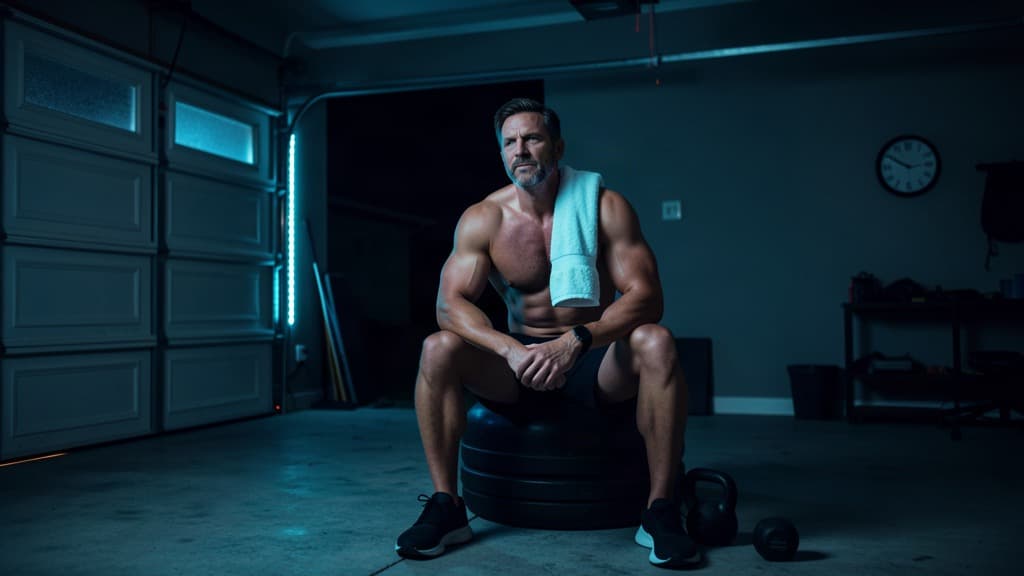
Wes is 43. Saturday, 8:47 p.m. Two kids finally down. Browns–Bears preseason still murmuring from the other room. His phone is a parade of National Relaxation Day memes.
He does not relax.
The garage fan ticks. The notes app still says SAT — HIIT. Yesterday he promised himself one honest block. Tonight he is stacking it after kickoff, after dishes, after the second bedtime stall. He wants the checkmark more than he wants sleep.
You might be Wes. Different garage. Same late math.
Related Read
Sleeping In Past 8 Hours Did Not Slow Organ AgingWen 2026 Nature: 23 organ clocks in UK Biobank. Lowest aging at 6.4 to 7.8 hours. A Labor Day sleep-in sits on the long arm.
Quick take - Leota, Presby, Facer-Childs et al., 2025, Nature Communications watched 14,689 physically active adults for a year — 4,084,354 person-nights — on a wrist wearable. Mean age 37.9. About 74% men. - They scored each session by exercise strain (heart-rate time in zones, not “I felt tired”) and when it ended relative to that person’s usual sleep. - Finish four or more hours before sleep and the night looks like a rest day. Any strain. - Finish a maximal session two hours before usual bedtime versus a light one: sleep starts 36 minutes later, lasts 22 minutes less, overnight resting heart rate (RHR) climbs 3.9 beats per minute, and heart rate variability (HRV — the beat-to-beat wobble that tracks recovery) drops 14%. - Finish that same maximal session two hours after your usual bedtime and the tax gets ugly: 80 minutes later to fall out, 43 minutes less sleep, +9.4 bpm overnight.
The garage where he almost “makes up” the week
Wes screenshots a Relaxation Day post while the kettlebell is still in his hand. Recovery is productive. He snorts.
He is not taking a spa day. He missed Tuesday. He missed Thursday. Saturday was supposed to be the rescue. Kickoff ate the afternoon. So the rescue is now a 9 p.m. interval block in a hot garage.
That is the exact pattern the paper was built to catch.
He wipes his face on a towel that used to be a t-shirt and mutters at the rack.
The clock is not your bedtime.
That is the line he writes on the grocery list stuck to the fridge. His usual lights-out is 10:30. Four hours back is 6:30. The session he is about to start already lost.
What they actually measured — not gym folklore
Older reviews said evening exercise was fine. They were not lying. They were looking at the wrong sessions.
Stutz 2019 (Sports Medicine) and Frimpong 2021 (Sleep Medicine Reviews) pooled small lab nights. Most of those workouts would score light or moderate on Leota’s strain scale. About 82%, the authors note. A 25-minute moderate spin at 7 p.m. is not a 70-minute redline after a football doubleheader.
Leota’s group used WHOOP heart-rate data, validated against lab heart monitors and sleep labs, then asked a dirtier question: how hard, and how late, in real life?
Strain came from minutes in heart-rate zones. Light was a walk or easy spin. Maximal was long and high — the kind of Saturday punishment Wes is about to run. Timing was not “evening.” Timing was when the last interval ended versus when that person usually falls asleep, adjusted for weekday versus weekend and the calendar month.
Wes hates that. It means 8:45 p.m. is late for him even if some night-shift dad is just warming up.
Jake learned the same ugly lesson at 308, hospital security, nights. The session that “counted” at 5 a.m. after a 12-hour graveyard was not the same tax as a 9 p.m. hero workout before a 10:30 lights-out. He got to 196 by training the life he had — and by stopping the ones that stole the next day’s engine.
Strain plus lateness is the tax. Not the hour on the microwave.
Wes underlines lateness so hard the pen pokes the list.
The numbers that should stop the last interval
He sits on the bumper and does the napkin math the paper already did.
If he smashes a maximal block and finishes two hours before his usual 10:30:
- Bedtime slides about half an hour
- He loses a little over 20 minutes of sleep
- His overnight heart stays ~4 beats quicker
- Recovery signal (HRV) drops about 14%
If he is stubborn and finishes after 10:30 — the “one more block because I already started” version:
- Bedtime can slide 80 minutes
- Sleep shrinks by ~43 minutes
- Overnight heart jumps ~9 bpm
- HRV falls about a third versus a light session
Light or moderate work that ends more than two hours before bed? Sleep onset and quality looked like nights he did nothing. That is the loophole he actually owns.
He puts the kettlebell down. Not because he is lazy. Because the last two intervals were about to buy him a worse Sunday than a missed Saturday.
Relaxation is a buffer, not a personality.
National Relaxation Day can keep the bath bombs. He needs four hours, or he needs an easy session.
What he does instead of quitting the week
This is not a permission slip to skip training. Yesterday’s once-weekly HIIT block still stands if the week died. The dose can live on Saturday. It cannot live at 9 p.m. if he sleeps at 10:30.
Wes writes the salvage on the same list:
- If it is after 6:30, the hard session is dead. Walk. Easy bike. Short lift that never redlines.
- If he still wants the 75-minute interval dose, it moves to late morning — before the next preseason window, not after.
- Keep two lifts in the week. Ninety minutes of strength is a different column. Heart-rate strain undercounts brief heavy sets, so if a late lift leaves him buzzing, treat it like high strain anyway.
- If he wants the overnight rebuild, that is food, not more intervals. Forty grams of protein before sleep is a last feeding. It is not a reason to add a fourth block.
He also writes the caveat so he does not turn one paper into a religion. This is observational. WHOOP users are already active. Two coauthors work at the company. The device did not catch “I tried to fall asleep.” Strain can undersell a heavy barbell night. None of that erases the dose-response they saw across four million nights.
His neighbor texts: You lifting or watching the late game?
Wes: Walking the block. Sleep is the set.
Where a static plan dies — and where ours does not
Monday the app will still say evening HIIT. Soccer will run to 8. The Bears will play another Saturday. The plan will not notice.
That is the midweek death Wes already knows. The calendar is a wish. The night is a constraint.
Chiron — our AI head coach — is built for the night you actually have. Log that bedtime is 10:30 and the only open slot is 8:50. Tomorrow can protect a light session or slide the hard block to a morning you still own. It does not send a shame badge for choosing the buffer.
HERMES is why you are reading a strain-by-timing map on the Saturday the league is filling the background noise and the internet is selling “relax.” Research should hit coaching while the argument is live.
Forge is the quiet ops layer when travel, overtime, or a late kickoff flips the board. Log the constraint. The system adapts. No PDF reprint. No theatrical Monday reset.
What that looks like for Wes:
- A hard-session cutoff pinned to his sleep, not 10 p.m. Eastern
- An evening swap to light strain when the cutoff already passed
- A Saturday morning hold for the interval dose so the week still ships
- A recovery veto after a brutal school week — shorten the ramps, do not cancel the week, do not steal the night
You want the free community version of this conversation — parents comparing real Saturdays, not fantasy split charts — it is on Discord: https://discord.gg/8QBuFFA5Pf.
If you want a plan built around your bedtime instead of a 6 a.m. sticker chart, start at https://legacyinmotion.fit.
Steal this before the late window
- Write down usual lights-out. Subtract four hours. That is the hard-training wall.
- If you are past the wall, drop strain. Walk. Easy spin. Leave the redline for morning.
- Do not “make up” a missed week with a 9 p.m. hero block after football.
- Keep the Saturday dose if you need it. Move the clock, not the medicine.
- Treat a buzzing late lift like high strain even if the watch shrugs.
- Protect the night you just bought. That is the whole point of the day with the silly name.
Wes peels the dead SAT — HIIT line off his notes app. He writes SAT AM — HARD. SAT PM — EASY. The garage light goes off. The late game can finish without him.
Hard work after eight only works if you sleep at one.
Your move. Not next season. Tonight’s cutoff.
---
Get Chiron in your pocket — $29.99/month
Chiron, our AI head coach, coaches the week you actually have: overnights, doubles, rotation flips, kid pickups. Log the change and tomorrow's plan already knows. No static program that assumes you sleep at 10pm and train at 6.
$29.99/month · $249.99/year · 7-day free trial · cancel anytime · no enrollment fee · no contract
Start coaching → · See the full app →
Jake Long built it after losing 112 lbs working hospital night shifts — when no human coach could keep up with his schedule. He wanted the system he wished he'd had at 308. Now you can use it too.
Common Questions, Answered
Does evening exercise ruin sleep?
Hard, long sessions close to bedtime can. Leota et al. 2025 (Nature Communications, n=14,689, 4.08 million person-nights) found later finish times plus higher heart-rate strain delayed sleep onset, shortened sleep, and raised overnight heart rate. Light or moderate work ending more than about two hours before bed looked like rest days.
How long before bed should I finish a hard workout?
Aim to finish four or more hours before your actual sleep, not the clock on the wall. In that dataset, any strain ending at least four hours before sleep left sleep looking like a non-training night.
What if the only time I can train is after the kids are down?
Keep the session. Drop the strain. A walk, easy bike, or short lift that never redlines is the trade. Maximal intervals two hours before lights-out cost about 36 minutes of later sleep and 22 minutes of duration versus a light session.
Is this the same as the once-a-week HIIT fat-loss trial?
No. That paper asked whether one Saturday block matches three weekday HIIT days for fat mass. This one asks when a hard session ends relative to sleep. You can keep the Saturday dose. Just do not park it at 9 p.m. if you sleep at 10:30.
Will a late lift wreck me the same way late HIIT does?
Maybe less. Their strain score is built from heart-rate zones, so brief heavy sets can look easier than they feel. If the session leaves you buzzing, treat it like high strain and protect the buffer.
Comments (0)
Comments are reserved for Legacy In Motion members.
$29.99/month. No contracts. Cancel anytime.
Get StartedAlready a member? Sign in
You read this far. Now do this.
Close the tab.
Go train the plan that fits your life.
I went from 308 to 196 lbs working 12-hour overnight shifts with two kids and zero personal trainer. The system I used is now an app that plans your training and meals around YOUR schedule — overnight, day shift, all of it.
Cancel anytime · No setup fee · No long contract
Free Assessment
What's Holding Your Fitness Back?
Take our 60-second quiz and get a personalized breakdown of what's stopping your progress — plus how AI coaching solves it.
Take the QuizFree PDF · No Credit Card
Grab the Shift Worker AI Fitness Blueprint
If your training keeps dying by week two, start here: the 4-week shift-worker protocol behind Jake's 112 lb loss, with the sleep timing and post-shift macros that made it stick.
Built by someone who actually worked them. No fluff. Unsubscribe any time.
Keep Reading
2026-09-03
Sleeping In Past 8 Hours Did Not Slow Organ Aging
Wen 2026 Nature: 23 organ clocks in UK Biobank. Lowest aging at 6.4 to 7.8 hours. A Labor Day sleep-in sits on the long arm.
2026-08-20
400mg Caffeine 12 Hours Out Still Wrecks Sleep
Gardiner 2025: 400mg of caffeine 12 hours before bed still delays sleep. You often cannot feel it. 100mg did not.
2026-09-18
Collagen Did Not Speed Workout Recovery
Ravindran 2026: 113 trials, 7,983 people. Skin and osteoarthritis moved. Next-day soreness did not.
Join our free fitness community — get coaching tips, share wins, and stay accountable.
JOIN THE DISCORD →