2026-04-20
7 min readBy Jake LongThe Psoas Trap: Why 12-Hour Shift Workers Get Low-Back Pain an MRI Will Never Show
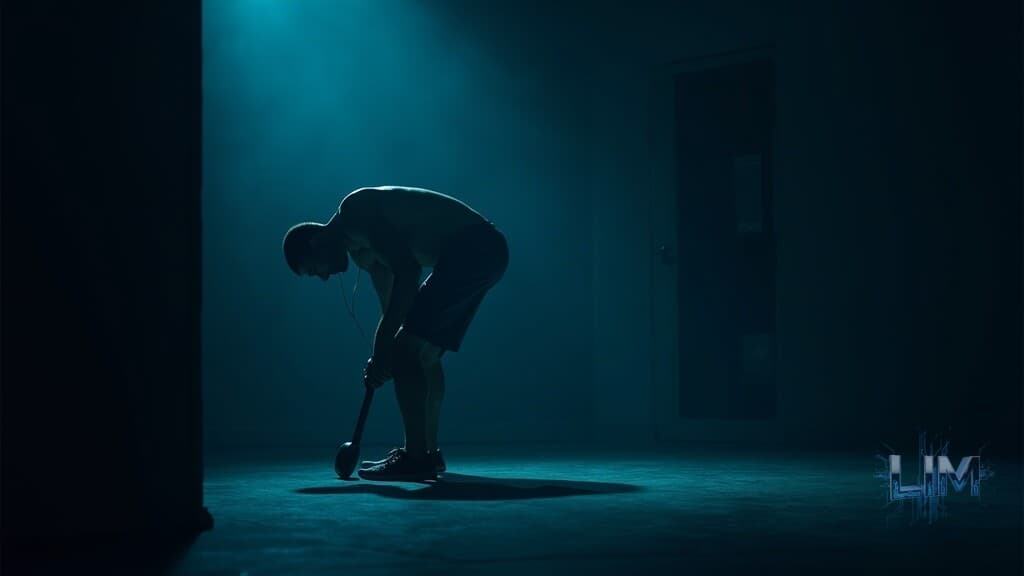
Jake was deep into his cut when he stopped being able to put his socks on standing up.
Not from pain. From geometry. He would hinge forward, and somewhere around the point his trailing hip hit full extension, his low back would pull him out of the movement like a rope that had run out of slack. He is 40, a day-shift hospital security supervisor, and by the time he finished at 196 pounds, 112 off a starting weight of 308 in about nine and a half months, the sock thing still had not fixed itself. The scale moved. The hip did not. That was the first real clue.
His imaging came back boring. No disc pathology. No stenosis. No facet arthropathy worth a note. A lot of shift workers get handed that same clean report and told to stretch their hamstrings and take an anti-inflammatory.
The answer was almost never in his spine. It was in a muscle the radiologist did not comment on because it was not frankly atrophied. The psoas.
What the psoas is actually doing during a 12-hour shift
The psoas major originates on the transverse processes and vertebral bodies of T12 through L4, then inserts on the lesser trochanter of the femur. It is one of a very small number of muscles that crosses the hip and attaches directly to the lumbar spine. When its resting length changes, the spine feels it whether you want it to or not.
Now picture a 12-hour rotation. You stand for 90 to 120 minutes at a charting station, a patient room, a bedside, a line. The psoas holds a moderately lengthened, low-tension position. Then you sit hard into a break-room chair for 15 to 20 minutes with the hip flexed past 90 degrees, which shoves the psoas into its shortest possible length. Then you stand up fast, radio going off, and ask the same muscle to produce force out of that shortened state. Ten to fourteen cycles a shift. Four or five shifts a week. Over a 36 to 48 hour week, that is roughly 500 stand-to-sit-to-stand transitions, every one of them loading the psoas at the two ends of its range and almost never in the middle.
Muscle is not passive under that pattern. Dangaria and Bogduk, writing in Spine in 1998, measured psoas major cross-sectional area in subjects under chronic postural loading and found meaningful side-to-side CSA differences on the symptomatic side that persisted independent of any visible structural lesion. The muscle remodels around the position it is held in most often. In a shift worker who lives in deep hip flexion during recovery and produces force out of hip flexion during duty, that remodeling bias is toward a shorter resting length.
That shortening is what radiology does not see. An MRI reads structure. It does not read the tonic length of the tissue at rest, and it does not read how that length changes what the lumbar spine is being asked to do the moment you stand up.
Why clean imaging still hurts
Sahrmann and colleagues, in the Journal of Orthopaedic and Sports Physical Therapy in 2011, framed exactly this as a movement system impairment of the lumbar spine. The argument is simple and has held up. Pain is often driven by the direction the spine is repeatedly forced into during daily tasks, not by a single structural lesion on the film. A shortened psoas biases the lumbar spine into extension and anterior pelvic tilt in standing, and into flexion in sitting. Every transition between the two happens across an already irritated tissue. Sahrmann's group reported that patients classified into this subgroup responded to targeted hip flexor length work plus motor control retraining, while generic lumbar stabilization without the hip component lagged behind. You cannot unload a lumbar spine by training a lumbar spine. You unload it by restoring the length and control of the tissues pulling on it.
Harris-Hayes and colleagues, writing in 2014 on hip-spine load transfer, mapped the corollary. When hip range of motion is restricted, the lumbar spine picks up the motion the hip will not give. A psoas that will not let the trailing hip extend past neutral during a gait cycle forces the lumbar spine into extension on every single step. Over a shift, that is thousands of micro-extensions driven by a hip that has stopped doing its job.
Three mechanical consequences stack up:
- Anterior shear on the lower lumbar segments increases because a shortened psoas pulls the lumbar vertebrae forward and down on the sacrum.
- The lumbar extensors run in a shortened, chronically active state to hold the pelvis against that anterior pull.
- Deep stabilizers like transverse abdominis and multifidus downregulate because the global extensors are already doing their job.
A spine that is structurally clean, mechanically overloaded, and neurologically poorly controlled. The scanner misses all three.
The four-position daily protocol
This is what we run with clients 30 to 50 who are mid-transformation, already training hard, and fighting a low back that imaging will not indict. Under 15 minutes. Daily, not three times a week. Do it after your shift, not before. Tissue responds better when it is warm and when you are not about to go load it for 12 hours. The psoas was trained by frequency. It unlearns by frequency.
Position 1. Couch stretch, 90 seconds per side. Kneel with your back to a couch or wall. Top of your rear foot against the vertical surface, shin flat. Front foot forward into a tall half-kneel. Tuck the pelvis under by squeezing the rear glute hard. The glute squeeze is not optional. Without it, you hang on the anterior hip capsule instead of loading the psoas into lengthened tension. You are chasing posterior pelvic tilt with the rear hip in extension. If your low back is extending to get the position, back off. This restores the hip extension range Harris-Hayes flagged as the rate-limiting piece.
Position 2. 90/90 transitions, 8 slow reps per side. Seated on the floor, front shin and back shin both at 90 degrees. Sit tall. Hinge forward over the front shin with a flat spine, then lift both legs a couple of inches off the floor and transition to the other side under control. This restores internal and external rotation at the hip, the ranges prolonged sitting eats first, and it decouples hip rotation from lumbar rotation, which is half of the Sahrmann correction.
Position 3. Half-kneel chop, 2 sets of 8 per side. Down-kneeling leg is the working side. Light cable, band, or dumbbell. Rear glute squeezed, ribs stacked over pelvis, pull the resistance from high on one side diagonally down across your body to the opposite hip. No lumbar extension, no lateral shift. This teaches the anterior core to resist the exact extension moment a short psoas keeps creating. It is the missing link between mobility work and real-life standing posture.
Position 4. Deadbug, 2 sets of 8 per side. On your back, arms straight over your shoulders, hips and knees bent to 90 degrees. Press your low back flat into the floor by engaging the deep abdominal wall. Slowly extend the opposite arm and leg without losing that floor contact. The point is not the reps. The point is teaching the lumbar spine to stay neutral while the hip moves independently, which is precisely the coordination that collapses across a 12-hour shift, and it reactivates the transverse abdominis in a position where the psoas cannot cheat for it.
Why this beats generic core training
Crunches, planks, and back extensions do not address the length-tension problem created by the stand-sit-stand cycle. They often make it worse by further shortening the anterior chain. The protocol above moves through length restoration at the hip, rotational decoupling at the pelvis, anti-extension control in half-kneel, and deep core reactivation on the floor. Each position targets one of the failure modes Dangaria, Sahrmann, and Harris-Hayes describe.
Give it 21 days of daily execution before you judge it. Tissue adaptation to repeated length work shows up on a three-week timeline, not a three-day one.
The honest read
If you work 12s, alternate long standing bouts with short seated recovery in that brutal on-off pattern, and your low back has been talking to you despite clean imaging, the psoas is the first place to look. Not the last. The scan is not lying. It is reading the wrong tissue in the wrong state.
Jake can tie his boots now. The sock thing fixed itself around week three of running that four-position protocol, well before the last pounds came off. The weight mattered. The hip mattered more than the weight.
Comments (0)
Comments are reserved for Legacy In Motion members.
Free 30-day trial — first 100 customers only.
This won’t last.
Start Your Free TrialAlready a member? Sign in
Ready to Build a Plan That Fits Your Schedule?
I went from 308 to 196 lbs working 80-hour weeks. Our AI coaching adapts to your schedule, recovery data, and real-time progress — so every workout actually counts.
Start Your Free 30-Day TrialNo enrollment fee. No commitment.
Free Assessment
What's Holding Your Fitness Back?
Take our 60-second quiz and get a personalized breakdown of what's stopping your progress — plus how AI coaching solves it.
Take the QuizKeep Reading
Join our free fitness community — get coaching tips, share wins, and stay accountable.
JOIN THE DISCORD →