


Plantar Fasciitis on Concrete: The Heel-Drop Protocol That Beats Stretching 4.8 to 1
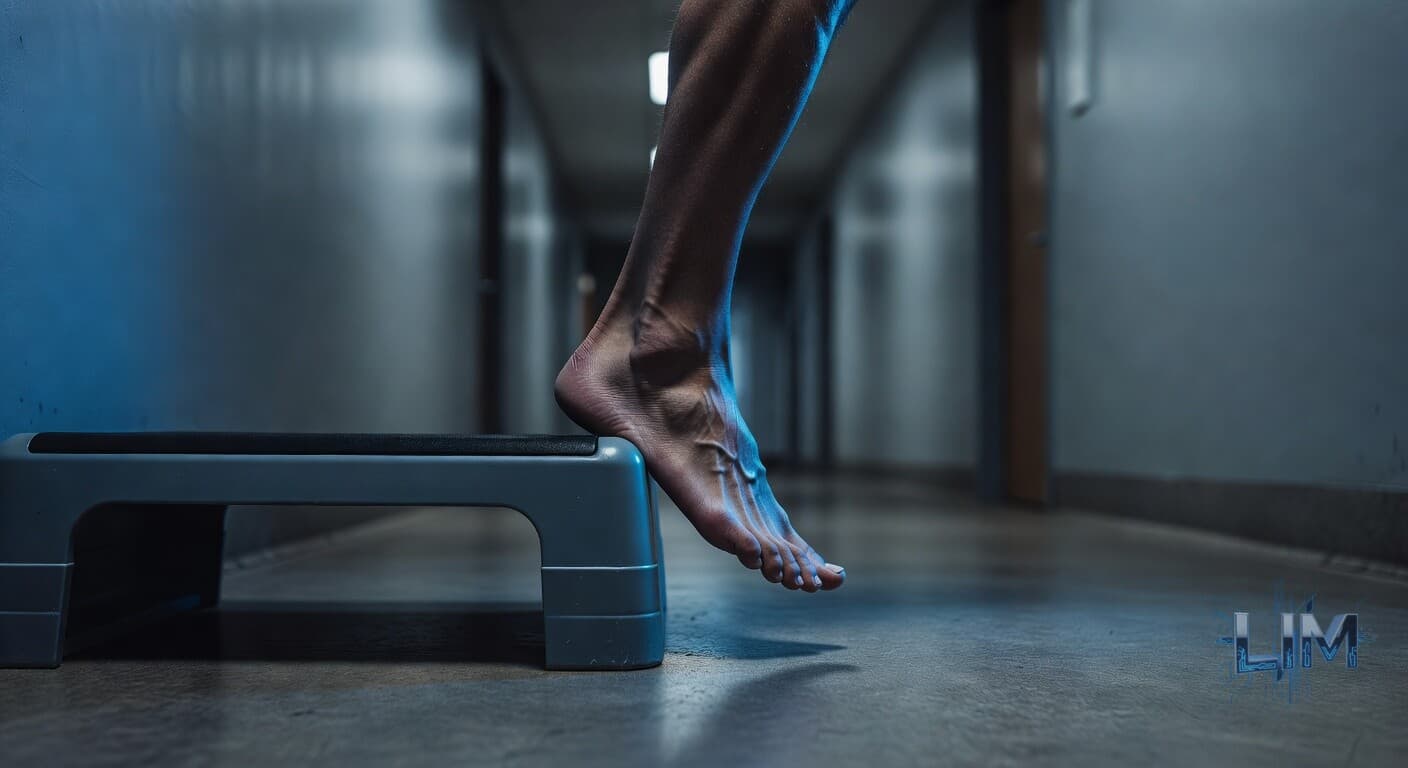
Trevor is 51. Regional VP, 110K airline miles a year, the kind of week that pushes him through three terminals before lunch. Dallas concourse on Monday, Charlotte on Wednesday, the Houston Hilton's gym at 5 a.m. on Thursday.
His feet have been on polished tile and rubber-matted concourse since 2018. Every morning the first thirty steps to the hotel-room coffee maker are the tax.
He had tried the stretches. The night splint. The over-the-counter orthotic that lasted six weeks before it cratered. Three years of that.
Then he changed one thing. He stopped stretching against the doorframe and started loading off the step of the hotel-gym treadmill. Eight weeks later he walked to the bathroom without the involuntary breath.
Related Read
Night Shift Easter Reset No Crash DietsThe 4-step weekend reset for night shift workers — circadian-aware, no crash diets, built on what took me from 308 to 196 lbs.
That swap is not a hack. It is what the randomized evidence has been saying for a decade.
TL;DR - Three sets of 12 heel drops off a step, rolled towel under the toes, every other day. That is the protocol. - The towel is the windlass switch. It converts a calf raise into a plantar fascia raise. - Stretching a fascial band does not change its load capacity. Loading it does. - Two independent randomized trials, identical mechanism, identical effect direction.
Stretching is a passive answer to a structural question
Rathleff ran the trial that changed how this gets coached. Forty-eight chronic plantar fasciitis patients, two arms — one stretching, one loading off a step with a rolled towel jammed under the toes.
At three months the loading group had cut their Foot Function Index by nearly thirty points. The stretching group had moved six.
A 4.8x advantage at the only timepoint that matters if you stand on tile for a living. Three months out is where passive interventions have already faded. The tissue has either remodeled or it has not.
The stretching group did not get worse. They just did not meaningfully improve. Because stretching a fascial band does not change its load capacity. Loading it does.
The towel under the toes is the entire trick
Engkananuwat replicated the core mechanism three years later. Eight weeks of calf eccentrics paired with plantar fascia eccentric loading. Pain dropped from a 7 out of 10 down to under 2.
Two independent research groups, two different journals, identical mechanism at the core.
Load the lengthened tissue under tension and it remodels. Stretch it passively and you have accomplished nothing.
The towel is not decorative. It dorsiflexes the great toe and pre-tensions the fascia through the windlass mechanism. Without it you are doing a calf raise. With it you are doing a fascia raise.
This is the kind of mechanism HERMES, our research scraper, pulls out of the thousands of fitness papers it scans a week. Rathleff is not new. It has just been buried under a decade of stretching advice that does not work.
Why a traveler's week is the worst environment for this tissue
Plantar fasciitis in standing workers is not an injury. It is cumulative failure.
The fascia is a dense collagen band transmitting force from the heel to the metatarsal heads on every step. On a padded gym floor for an hour a day that is manageable. On airport concourse for ten hours, four days a week, in dress shoes built for boardrooms not biomechanics, it is not.
Three factors stack against you. Continuous standing denies the fascia the micro-recovery windows a seated day provides. Time-zone shifts suppress the overnight collagen turnover window when remodeling actually happens. And a body carrying extra weight multiplies ground reaction force through the same tissue on every step.
Jake himself ran a version of this starting last May. Hospital security supervisor on overnight shifts, down from 308 to 196 across a nine-and-a-half-month cut. He is 40. The weight came off. The shift pattern did not change.
What flipped the signal on his feet was the protocol, not the scale. The scale had been moving for months while his feet stayed loud. He stopped stretching in the doorway and started loading off a step. Month seven, he stood up without flinching.
The protocol, exactly
Three sets of twelve heel drops, every other day. Not every day. The tissue needs forty-eight hours between loaded sessions to complete its remodeling cycle.
Setup: ball of the foot on the step edge, heels hanging off. Roll a hand towel and jam it under the toes of the working foot. Great toe lifted into dorsiflexion.
Execution: rise onto the ball over three seconds. Shift weight to the working foot. Lower through a three-second eccentric until the heel drops below the step.
The eccentric is where the work happens. Rushing the lower is the single most common way people do this protocol and get nothing from it.
Progression: start at bodyweight. Once three sets of twelve feel smooth, add load with a backpack or a dumbbell in the contralateral hand. Rathleff's original ladder dropped reps as weight climbed. The tissue adapts to load, not repetition volume.
Soreness in the calf and arch for the first two weeks is the adaptation signal. Sharp stabbing pain at the inside of the heel is not. If the latter shows up, drop load and add a rest day.
Implementation if your week looks like Trevor's
The every-other-day cadence fits cleanly onto a four-on, three-off travel rotation. Load on hotel days, recover on home days. Or invert it.
The session takes under seven minutes. Hotel-room step, towel, body weight. No gym, no coach, no equipment.
This is the kind of pattern Chiron, our AI head coach, flags in the daily program review. When your wearable logs a week of sub-90 cadence walking and your morning voice-note has the wince in it, the daily program update worker rewrites your week before you ask.
Supporting inputs matter at the margins. Magnesium glycinate in the evening deepens sleep, which is when fascial remodeling actually happens. D3 with K2 keeps calcium trafficking toward bone and soft tissue rather than arterial walls. Methylfolate and methylcobalamin support the collagen crosslinking pathway, relevant for anyone over 35 or carrying an MTHFR variant.
None of that replaces the loading. The loading is the intervention. The supplementation is the environment the intervention runs in.
The first thirty steps
If the worst pain of your day happens before you have made coffee, you do not have a footwear problem. You have a load-capacity problem in a strip of collagen nobody taught you to train.
Three sets of twelve, off a step, towel under the toes, every other day. That is the thing that beat stretching 4.8 to 1 in a randomized trial and cut pain scores three-quarters in a second one.
If you want it scheduled into your travel pattern and the rest of your program, that is what we do at Legacy In Motion.
---
The data behind this
- Rathleff MS et al. High-load strength training improves outcome in patients with plantar fasciitis: a randomized controlled trial with 12-month follow-up. Scandinavian Journal of Medicine and Science in Sports, 2015. n=48. Foot Function Index 29-point reduction vs 6-point at 12 weeks, p<0.0001.
- Engkananuwat P et al. Effectiveness of the Simultaneous Stretching of the Achilles Tendon and Plantar Fascia in Individuals With Plantar Fasciitis. Foot and Ankle International, 2018. VAS pain 7.1 → 1.8 at 8 weeks.
---
Coaching that works the same shifts you do
Chiron, our AI head coach, coaches the week you actually have: overnights, doubles, rotation flips, kid pickups. Log the change and tomorrow's plan already knows. No static program that assumes you sleep at 10pm and train at 6.
$29.99/month · $249.99/year · 7-day free trial · cancel anytime · no enrollment fee · no contract
Start coaching → · See the full app →
Jake Long built it after losing 112 lbs working hospital night shifts — when no human coach could keep up with his schedule. He wanted the system he wished he'd had at 308. Now you can use it too.
Questions Worth Asking
Do heel drops really work better than stretching for plantar fasciitis?
Yes. Rathleff 2015 (n=48) tracked Foot Function Index at 12 weeks: stretching dropped 6 points, heel-drop loading dropped 29 points, p<0.0001. That is a 4.8x advantage at the only timepoint that matters if you stand on concrete.
How many heel drops should I do and how often?
Three sets of 12 heel drops off a step, every other day, with a rolled towel stuffed under the toes. Engkananuwat 2018 ran this dosing for 8 weeks and cut VAS pain from 7.1 to 1.8, a 75% reduction.
Why does the towel under the toes matter?
The towel dorsiflexes the great toe 20 to 30 degrees and pre-tensions the fascia through the windlass mechanism. Without it you are doing a calf raise. With it you are doing a fascia raise, which is what actually remodels the tissue.
Comments (0)
Comments are reserved for Legacy In Motion members.
$29.99/month. No contracts. Cancel anytime.
Get StartedAlready a member? Sign in
You read this far. Now do this.
Close the tab.
Go train the plan that fits your life.
I went from 308 to 196 lbs working 12-hour overnight shifts with two kids and zero personal trainer. The system I used is now an app that plans your training and meals around YOUR schedule — overnight, day shift, all of it.
Cancel anytime · No setup fee · No long contract
Free Assessment
What's Holding Your Fitness Back?
Take our 60-second quiz and get a personalized breakdown of what's stopping your progress — plus how AI coaching solves it.
Take the QuizFree PDF · No Credit Card
Download the Shift Worker AI Fitness Blueprint
A 4-week plan that respects what shift work does to sleep: when to go down after a night, the four-minute REHIT window, post-shift macros, and when to back off. In your inbox in 30 seconds.
Built by someone who actually worked them. No fluff. Unsubscribe any time.
Keep Reading
2026-04-11
Night Shift Easter Reset No Crash Diets
The 4-step weekend reset for night shift workers — circadian-aware, no crash diets, built on what took me from 308 to 196 lbs.
2026-04-09
Night Shifter Drops 112 Pounds Rucking
How adding weighted walks transformed my metabolism, sleep, and energy levels despite irregular night shifts. A practical post-holiday reset you can start today.
2026-07-21
Night Shift Meal Timing: Why Breakfast After Nights Fails
Delayed eating windows—not classic 16:8—improve next-day glucose handling for rotating nurses. Build a meal clock from your roster, not the wall clock.
Join our free fitness community — get coaching tips, share wins, and stay accountable.
JOIN THE DISCORD →