


The Drive Home Is When The Shift Catches You — The Ten-Minute Parking-Lot Reset For Night Shift
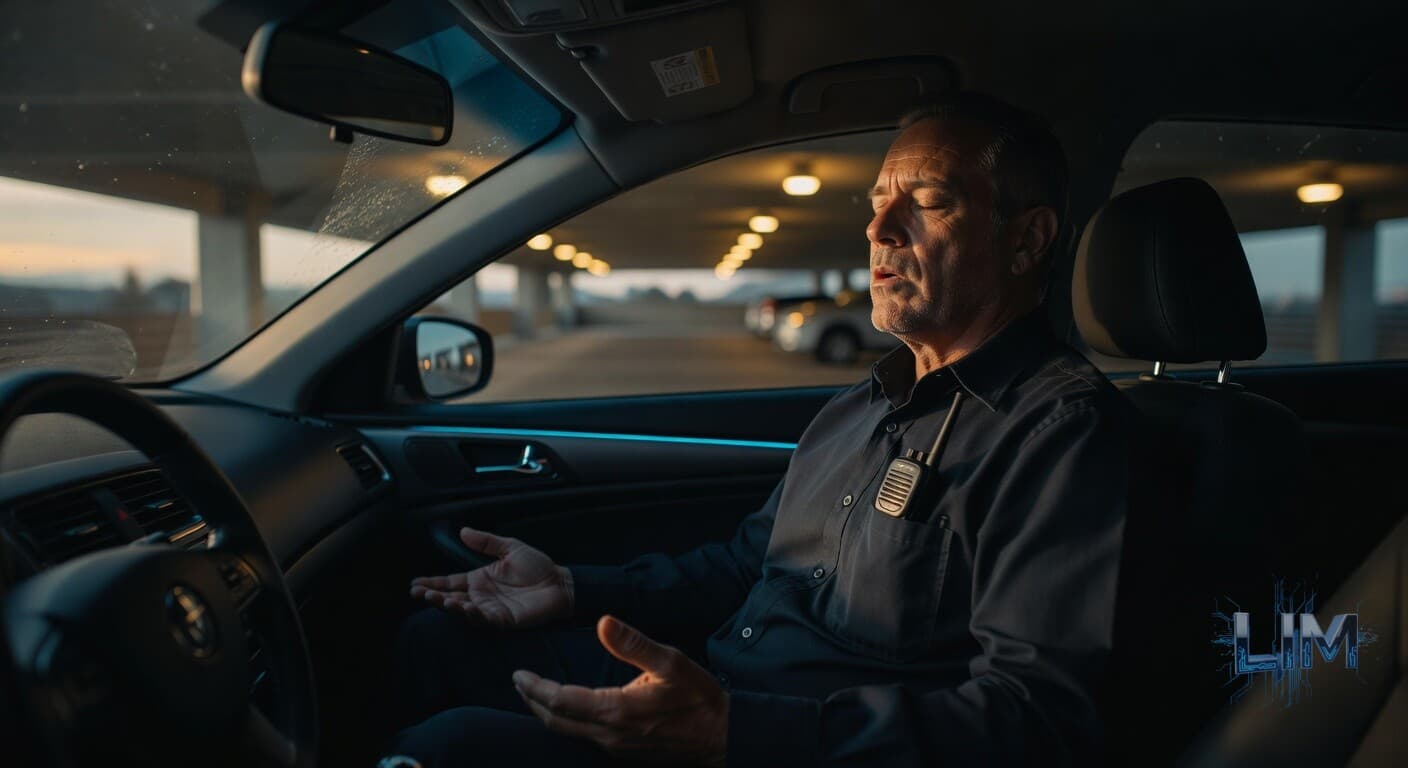
Marcus is 41, hospital security supervisor at a level-one trauma center, overnight shift. It is 07:04 Tuesday morning. He just clocked out after a Monday-night-into-Tuesday-morning that included two restraints, a combative-patient call in the parking deck, and a four-hour stretch where the radio did not stop.
He is sitting in his Ford F-150 in the staff lot. Keys still in his hand. He has not started the engine. The wife is at home, kids are on the bus, and he should already be merging onto the interstate.
Jaw set. Pulse he can feel in his ears. Clavicular breathing at 17 to 20 a minute, nothing moving below the second rib.
That nervous system is about to merge onto a highway in rush-hour traffic. The drive-home cigarette and the gas-station energy drink are not interventions. They are accelerants.
Related Read
The Great Nervous System Reset: 2026's Hottest Wellness Trend Your AI Coach Can Actually Deliver DailyBurned-out desk workers, busy parents, and over-40 professionals are booking nervous system reset retreats. Here's how Legacy In Motion's AI coach turns the trend into daily protocols you can run between meetings, school runs, and flights — without needing a $5k wellness vacation.
The variable nobody is naming for night shift
You can spot them before they speak. The bodies clocking out at 07:00 carry a signature. Jaw set. Pulse in the high 80s when it should sit in the 60s. Clavicular breathing that never drops below the upper ribs.
I dropped from 308 to 196 working hospital security graveyard. I now supervise day shift, which means I am the one relieving the overnight crew coming off. The tell is consistent. Twelve hours of vigilance loads the sympathetic nervous system the same way a hard interval session loads the muscles — except no cool-down ever happens.
That is the variable. Not cortisol. Not melatonin. Not the magnesium-glycinate stack everybody is recommending. Those all matter. The variable Marcus controls in the next ten minutes is which branch of the autonomic nervous system is driving his body home.
End the shift in sympathetic dominance, drive home without resetting, and three things happen in sequence. Catecholamines keep cortisol elevated into the sleep window. Slow-wave sleep and growth-hormone release blunt. Insulin sensitivity at the post-shift meal collapses, so the food partitions worse than it would in a rested state.
He falls asleep in a state his body reads as threat. The next shift starts from a lower baseline. Across months, that is the difference between a body that responds to training and a body that cannot.
Six breaths a minute does what an SSRI does
The published meta-analysis on slow-paced breathing pooled 58 controlled trials. The protocols clustered near six breaths per minute with a longer exhale than inhale. The effect on vagal HRV indices — Hedges' g between 0.45 and 0.71.
Medium to large. Across 58 datasets. Across varied populations.
That sits in the same effect-size ballpark as established psychotropics on their primary endpoints. From breathing.
The wellness internet keeps yelling take a deep breath. The variable that moves the autonomic system is breath rate and ratio. Not breath size.
The 4:6 ratio is the lever, not the depth
Drop respiration to roughly six per minute and three things happen at the same time. The breath cycle synchronizes with the baroreflex oscillation near 0.1 Hz. Respiratory sinus arrhythmia gets amplified, training the vagal brake. Resisted exhale lengthens the parasympathetic-dominant phase of each cycle.
That is why 4:6 outperforms even pacing. A 4-second inhale paired with a 6-second exhale gives the brake more time on than off.
Each person has a personal resonance frequency between 4.5 and 6.5 breaths per minute where heart rate, blood pressure, and respiration phase-lock. Train at that frequency and you do not just calm down for ten minutes. You raise baseline baroreflex gain across weeks.
Roughly 20 minutes a day, four to ten weeks, durable shifts in resting HRV.
A deep breath can sabotage a post-shift state
A deep breath at a fast rate does the opposite of what Marcus wants at 07:04. It increases minute ventilation, blows off CO2, raises blood pH. Some people get cerebral vasoconstriction and call it lightheadedness.
Take a deep breath when stressed works for a single startle response. It fails for chronic sympathetic loading built across twelve hours.
The other trap is breath-holding at the top. Anxious people pause after the inhale, sustaining intrathoracic pressure and working against vagal activation. Slow-paced breathing has no pause at top or bottom. Save box breathing and 4-7-8 for pre-workout, where the sympathetic bias actually belongs.
The ten-minute parking-lot protocol
Run this before you start the car. The car itself is a cue the nervous system reads as shift is over. You want the reset before the cue, not after.
Phone in airplane mode, face down. Seat reclined to about 110 degrees. Feet flat. Lips closed, nasal breathing only.
Minutes zero to one — calibration. Hand on the lower belly, hand on the upper chest. Exhale fully through pursed lips until the abdomen is hollow. Let the next inhale come unforced into the belly. Lower hand rises first and travels further. You are re-seating the diaphragm. Nothing more.
Minutes one to nine — 4:6 at six breaths a minute. Inhale through the nose for a count of 4. Exhale through the nose, slightly resisted as if fogging a mirror with your mouth closed, for 6. No pause at top. No pause at bottom.
If 4:6 feels forced, start at 3:5 for the first two minutes and migrate. Do not push for deeper. Push for slower and longer on the exhale.
Minute nine to ten — reorient. Drop the count. Two normal breaths. Check the pulse at the wrist for 30 seconds and double it. If you came in around 90 and you are leaving around 70, the protocol did what it should.
Then drive.
The nights you feel fine are the nights it works hardest
Skip this on the nights you feel fine and you miss the largest delta. Sympathetic tone in those windows is high enough that you cannot feel it. That is exactly when the reset matters most.
Do not replace it with a podcast or a phone scroll. Both preserve cognitive load and block the resonance effect. Do not add breath holds. Holds recruit sympathetic tone, which is the opposite of what you are trying to do at 07:00.
If you measure, a chest strap paired to an HRV app will show the change. One-minute RMSSD on waking, before coffee, before phone. After two weeks the trend should rise and resting heart rate should drop three to seven beats per minute.
When the Apple Watch logs an RMSSD swing or a sleep score below the trailing average, the daily program update worker rewrites Marcus's week before he opens the app. The breathwork block goes into the morning ahead of training, not after, so he does not have to argue with himself about it.
Where this fits
Breathwork alone will not fix circadian disruption, light-hygiene errors, or the magnesium and B-vitamin deficits that night-shift bloodwork consistently shows. Magnesium glycinate post-shift. Methylfolate and methylcobalamin in the morning. D3 with K2 to compensate for missed sun. All of it matters.
But of the levers available to a security supervisor walking out of a building at 07:00, the cheapest one with the largest published effect size is ten minutes of slow-paced breathing before the key turns.
Twelve hours of vigilance is a physiological load. It deserves a physiological offramp.
The 58 studies in the meta-analysis say breathe slower is not too small to matter against twelve hours of sympathetic loading.
What changed for me at 252
Somewhere around 252 pounds my wife told me I had stopped white-knuckling the steering wheel on the way home from shift. I had not noticed.
The 12-hour graveyard had a tell. I could not see it from inside it. I thought the weight was coming off because I was finally counting calories. It was coming off because I was finally sleeping in parasympathetic instead of crashing in sympathetic.
Ten minutes of breathing in the parking lot before the key turned. That was the whole shift.
The system that schedules the protocol, tracks the HRV trend, and writes the rest of the stack around the shift you actually work is at legacyinmotion.fit.
---
The data behind this
- Laborde S et al. 2022 (Neuroscience and Biobehavioral Reviews, pooled 58 controlled trials) — slow-paced breathing protocols clustered near 6 breaths per minute with longer exhale than inhale; Hedges' g for vagal HRV indices (RMSSD and high-frequency power) between 0.45 and 0.71. Medium-to-large effect across 58 datasets.
- Russo MA, Santarelli DM, O'Rourke D 2017 (Breathe) — physiological mechanism of slow-paced breathing; synchronization of breath cycle with baroreflex oscillation near 0.1 Hz amplifies respiratory sinus arrhythmia and trains vagal tone.
- Lehrer PM 2020 review (Applied Psychophysiology and Biofeedback) — personal resonance frequency between 4.5 and 6.5 breaths per minute; 20 minutes a day for 4-10 weeks durably raises baseline baroreflex gain.
- Cerebral vasoconstriction from rapid deep breathing — established hypocapnia / hyperventilation physiology; increased minute ventilation blows off CO2, raises blood pH, triggers cerebrovascular response.
- Vagal-tone suppression mechanism of breath-holding at top of inhale — sustained intrathoracic pressure works against parasympathetic activation; documented in the breath-pause autonomic literature.
- Catecholamine-cortisol-sleep cascade — post-shift sympathetic dominance impairs slow-wave sleep architecture and growth-hormone release; covered in our night-shift VO2 piece and the broader shift-work HRV literature.
- Magnesium glycinate / methylfolate / methylcobalamin / D3+K2 supporting stack — covered in our magnesium for night-shift brains and methylation trap pieces.
- Jake's own numbers: 308 → 196 in 9.5 months on 12-hour overnight hospital security shifts (started May 2025). Sample of one — informed perspective, not population data.
---
Your plan should change the day your week does
Most programs die in the gap between the plan and your real week. Chiron, our AI head coach, reads what you log (meals, workouts, skipped sessions) and rewrites tomorrow instead of waiting for you to fall off. HERMES, our research engine, keeps the coaching current with new science the week it publishes.
$29.99/month · $249.99/year · 7-day free trial · cancel anytime · no enrollment fee · no contract
Start coaching → · See the full app →
Jake Long built it after losing 112 lbs working hospital night shifts — when no human coach could keep up with his schedule. He wanted the system he wished he'd had at 308. Now you can use it too.
Comments (0)
Comments are reserved for Legacy In Motion members.
$29.99/month. No contracts. Cancel anytime.
Get StartedAlready a member? Sign in
You read this far. Now do this.
You've read the theory.
Now put it to work in your real week.
I went from 308 to 196 lbs working 12-hour overnight shifts with two kids and zero personal trainer. The system I used is now an app that plans your training and meals around YOUR schedule — overnight, day shift, all of it.
Cancel anytime · No setup fee · No long contract
Free Assessment
What's Really Stopping Your Progress?
Take our 60-second quiz and get a personalized breakdown of what's stopping your progress — plus how AI coaching solves it.
Take the QuizFree PDF · No Credit Card
Grab the Shift Worker AI Fitness Blueprint
The protocol Jake wishes he'd had at 308 lbs: sleep timing for rotating shifts, post-shift macros, and the AI deload trigger, from the run that took him to 196. Free, no card needed.
Built by someone who actually worked them. No fluff. Unsubscribe any time.
Keep Reading
2026-06-28
The Great Nervous System Reset: 2026's Hottest Wellness Trend Your AI Coach Can Actually Deliver Daily
Burned-out desk workers, busy parents, and over-40 professionals are booking nervous system reset retreats. Here's how Legacy In Motion's AI coach turns the trend into daily protocols you can run between meetings, school runs, and flights — without needing a $5k wellness vacation.
2026-06-03
Why First Responders Can't Out-Train Chronic Under-Recovery
Firefighters, cops, and paramedics train through sleep debt, then plateau and blame willpower. The 2026 research says the limiter is recovery, not effort. Here is what HRV-guided training (Javaloyes, J Strength Cond Res, n=20) and the firefighter shift-work data actually show, why a wearable on your wrist does nothing until you act on the recovery signal, and how to program around a rotation instead of pretending you have a normal week.
2026-04-24
The Best Fitness App for Shift Workers in 2026
Honest comparison of MyFitnessPal, Fitbod, Future, Trainerize for shift workers. What a night-shift fitness app actually needs.
Join our free fitness community — get coaching tips, share wins, and stay accountable.
JOIN THE DISCORD →