


Bottom-Third Partials Beat Full ROM (Wolf & Schoenfeld 2026)
Wolf and Schoenfeld's April 2026 meta-analysis pooled 13 trials and 348 lifters and found stretched-position partials beat full ROM at SMD 0.27. Here's the mechanism and the protocol that fits hour ten of a 12-hour shift.
TL;DR
- Wolf & Schoenfeld 2026 (J Strength Cond Res) pooled 13 RCTs, n=348 trained lifters: stretched-position partials beat full ROM at SMD 0.27. Every trial favored or tied partials. None favored full ROM.
- The mechanism is titin — the third filament — bearing the load at long muscle lengths and triggering mTORC1 through phosphatidic acid.
- Maeo 2023: long-length partials produced 2-2.5x greater long-head biceps growth than short-length at matched volume.
- For the 40-year-old shift worker, recovery is the constraint. Half a rep in the right half is the highest hypertrophy yield per unit of recovery cost you can buy.
04:13 in the Basement Gym
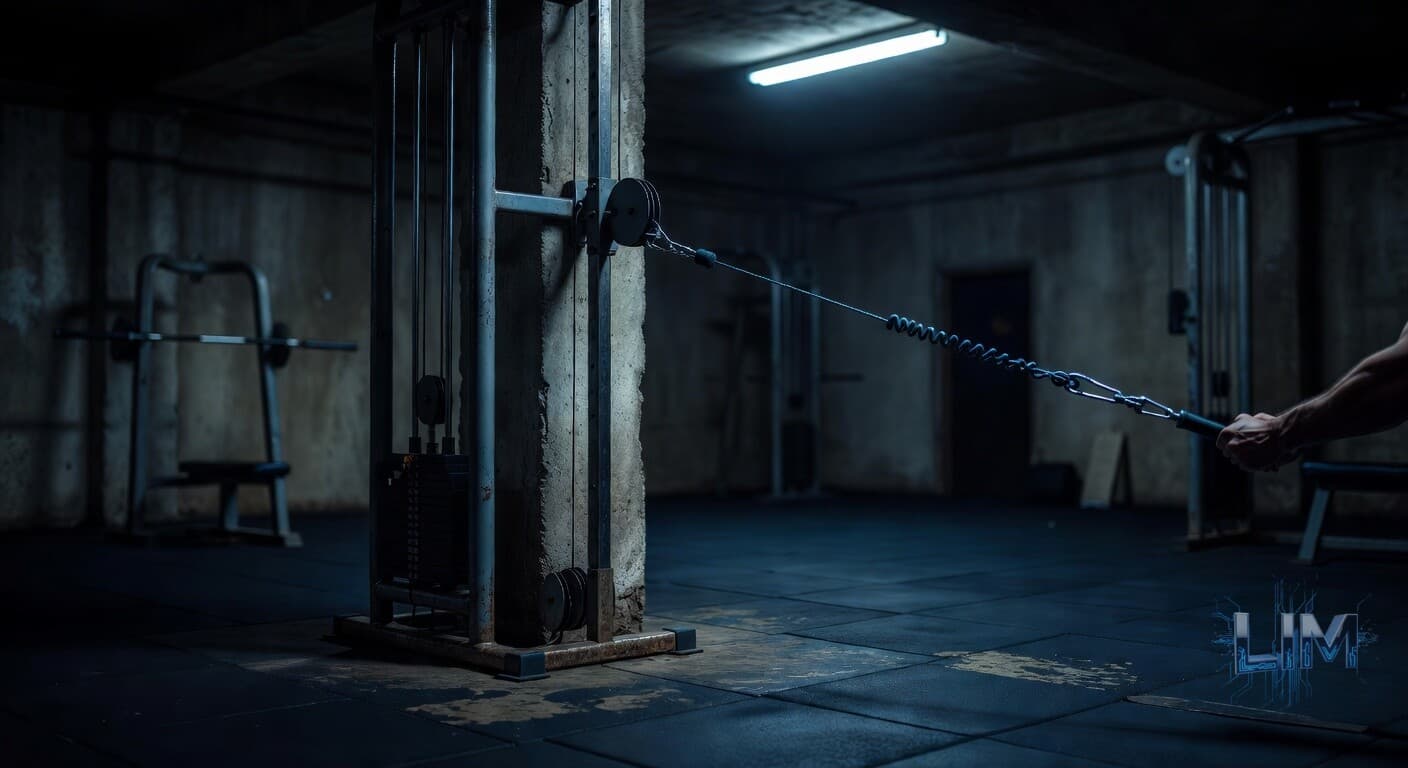
Saturday. Hour ten of twelve. The cable stack bolted to a 1974 load-bearing column is the only piece of equipment in the building not assigned to someone in scrubs.
Two sets of single-arm cable flyes. Deep stretch. Bottom third only. Ten reps a side.
My left pec felt like a guitar string at the bottom of every rep. Not painful — loaded in a way a full-ROM rep never produced.
Related Read
Half a Rep, in the Right Half, Is the Whole JobStretched-position partials match or beat full ROM for hypertrophy in trained lifters. For the 50-year-old training around a rotator cuff, that's the highest yield per unit of recovery cost a body can buy.
I racked the handle, walked back to the security office, and pulled out the printed Wolf & Schoenfeld meta-analysis. Fourteen pages. Highlights in three colors. Three years earlier I weighed 308 lbs and couldn't finish a flight of stairs at the back of the ED. At 196 and forty, on six hours of fragmented daytime sleep, I'd stumbled into the protocol my recovery budget could finally afford.
The Mechanism: Titin Bears the Load
The mechanism lives in three nested compartments.
Cross-bridges fall off. Titin picks up.
Actin and myosin develop their highest force at intermediate sarcomere lengths. Past that point, force drops as filament overlap thins.
The muscle as a whole doesn't lose tension in the lengthened position. It transfers the load to titin — the third filament, a giant spring protein running from the Z-line to the M-line. Its PEVK and immunoglobulin-like domains unfold under stretch.
When you sit at the bottom of a Romanian deadlift, your hamstring sarcomeres are at long length, the cross-bridges are dialed back, and titin is bearing the load.
Stretched titin is a growth signal
Titin under stretch isn't passive. It binds a kinase domain at the M-line, exposes phosphorylation sites, and recruits mechano-transduction proteins (FAK, integrin complex at the costamere). Long-length training also activates mTORC1 through phosphatidic acid generated when titin pulls on the Z-line.
That's the molecular handshake. Stretched titin in a loaded sarcomere is a growth signal the shortened position simply does not produce.
Sarcomerogenesis stacks on top
Two more mechanisms layer:
- High-threshold motor units fire earlier in the rep at long lengths because mechanically disadvantaged fibers can't meet torque demand on lower-threshold units alone.
- Long-length training drives sarcomerogenesis — adding sarcomeres in series, extending the muscle's optimal length.
What Wolf & Schoenfeld 2026 Actually Pooled
The paper screened 482 candidates and kept 13. Inclusion required at least 8 weeks of training, a within-subject or matched-volume between-subject design, and ultrasound or MRI muscle thickness as the primary outcome.
The kept trials:
- Pedrosa 2022 (n=20, leg extension)
- Maeo 2022 (n=21, preacher curl)
- Newmire 2023 (n=26, hack squat)
- Larsen 2024 (n=42, lying leg curl)
- Nine others spanning seated calf raise, cable fly, lat pulldown, Bulgarian split squat
Total pooled sample: 348 trained lifters, average age 24, average training history 3.6 years.
Pooled standardized mean difference: 0.27 favoring lengthened partials. Small to moderate by Cohen's convention.
The more interesting finding is the directional consistency. Every single trial favored or tied partials. Not one trial favored full ROM.
The lower-body subgroup hit SMD 0.45 (95% CI 0.21-0.69, p=0.0003).
This sits on a stack of single-trial work:
- Maeo 2023 (Eur J Sport Sci, n=26, 12 weeks): long-length partials produced 2.0-2.5x greater long-head biceps growth vs. short-length at matched volume.
- Kassiano 2023 (Sports Medicine): up to 3x greater medial gastrocnemius hypertrophy from full-dorsiflexion partial work vs. mid-range work.
Across muscles, the signal is consistent. The biological hard part of a rep is the bottom. The top half is mostly tax.
Why It Lands Differently at 40 With a Cortisol Problem
Recovery is the constraint that defines training past 35. Same constraint defines training under shift work at any age.
Vincent 2024 (Sleep Medicine Reviews, n=1,210 rotating-shift workers): mean salivary cortisol elevation of 23% the morning after a night shift, persisting 48-72 hours in workers over 35.
Stack that on the anabolic-resistance curve documented in Moore 2015 (Journals of Gerontology, leucine threshold ~0.4 g/kg per meal), and the 40-year-old night-shift lifter is paying double rent on every set.
A protocol that produces equal or superior hypertrophy at lower total recovery cost isn't a curiosity. It's the difference between progressing for years and burning out in months.
If stretched-position partials capture the dominant hypertrophy signal and the shortened half contributes minimally, then a thoughtful 40-year-old can run two-thirds of his working sets in the bottom-third range, bank the recovery debt, and feed the resulting stimulus at four daily 0.4 g/kg leucine-threshold meals — including the 02:00 feeding most apps refuse to schedule.
Five Exercises That Map Onto the Wolf 2026 Subgroup Data
The trials that produced the biggest effects shared one feature: the lengthened position loaded the muscle with significant passive tension.
- Seated calf raise (gastrocnemius and soleus stretched at the bottom)
- Romanian deadlift (hamstrings at hip flexion)
- Bulgarian split squat (rectus femoris and glute on the lengthened side)
- Cable fly or pec deck (pec major in horizontal abduction)
- Incline dumbbell curl (long head of biceps in shoulder extension)
The protocol isn't "do half reps everywhere." It's identify the stretched position of each exercise and bias your working sets toward that half in the exercises where the stretch is real.
The Basement Protocol at Hour Ten
What I run between rounds:
- RDL to bottom third only: 3×8, dumbbells stop just below knee height, weight you'd normally rep for 10
- Bayesian cable curls (lengthened partial): 3×12, 3-second eccentric, deliberate stop in the stretched position
- Standing calf raise (full dorsiflexion to mid-range): 3×15
- Single-arm cable fly partials, hands wide and stretched: 2×12
Total session: 22 min including warm-up. The top half of every rep is left in the rack on purpose.
What LIM's AI Coaching Does With This
When a member's HRV drops more than 0.7 SD below their 14-day rolling baseline — often 2-3 days before the lifter feels the parasympathetic crash — the system auto-substitutes lengthened-partial variants for full-ROM working sets in the next session. Holds the hypertrophy stimulus while cutting eccentric load.
The substitution is pulled from the Wolf 2026 subgroup data. Seated calf raise, RDL, Bulgarian split squat, and cable fly flag as stretch-priority and substitute first.
The progressive-overload tracker logs lengthened-partial sets as a separate stimulus stream from full-ROM. A 5-pound jump on a stretched-position curl is never silently averaged against a top-half cheat rep from the previous block.
Per-set tempo, RPE, and rep count get read in real time. The system flags when a stretched-position set drops below the 3-second eccentric threshold that separates a genuine partial from a bouncing tendon-load rep.
The shift-aware feeding window protects 0.4 g/kg leucine at four daily meals including the 02:00 feeding. Cortisol-aware volume pulls weekly working sets back 18% on weeks with more than three night shifts. A 7-day maintenance phase auto-schedules every 8-10 weeks when caloric deficit and shift load stack.
None of this is a feature you toggle. It runs in the background. The only thing the lifter sees on Tuesday is a session card that reads: "lengthened-partial bias today, RPE cap 7."
The basement gym at 04:13 was empty when I racked the cable handle. The protocol I'd stumbled into was the same one a meta-analysis of 348 trained lifters had just confirmed.
Half a rep, in the right half, is the highest hypertrophy yield per unit of recovery cost a 40-year-old shift worker can buy. If you want a coaching system that reads your shift schedule, your HRV, your per-meal protein, and your tempo log — and tells you which half of the rep to leave in the rack — that's the work happening at legacyinmotion.fit.
References
- Wolf MI, Schoenfeld BJ. J Strength Cond Res. 2026 (in press).
- Pedrosa GF et al. Eur J Sport Sci. 2022;22:1250-1260.
- Maeo S et al. Med Sci Sports Exerc. 2022;54:1992-2003.
- Maeo S et al. Eur J Sport Sci. 2023;23:1077-1088.
- Newmire DE et al. Eur J Appl Physiol. 2023.
- Larsen S et al. Sports Med. 2024.
- Kassiano W et al. Sports Medicine. 2023;53:1373-1395.
- Vincent K et al. Sleep Medicine Reviews. 2024;73:101878.
- Moore DR et al. J Gerontol A Biol Sci Med Sci. 2015;70:57-62.
---
Log tonight's shift. Wake up to an adjusted plan.
This is what Chiron, our AI head coach, does on every meal and workout you log: catches the small wrong detail before it costs you years. HERMES — our research engine — surfaces new science the morning it publishes, so your coaching moves with the literature instead of trailing it by quarters. You log; we adapt your plan that day. No PDF reprints, no static plan that ages out the day your shift changes or you have a kid.
$29.99/month · $249.99/year · 7-day free trial · cancel anytime · no enrollment fee · no contract
Start coaching → · See the full app →
Jake Long built it after losing 112 lbs working hospital night shifts — when no human coach could keep up with his schedule. He wanted the system he wished he'd had at 308. Now you can use it too.
Comments (0)
Comments are reserved for Legacy In Motion members.
$29.99/month. No contracts. Cancel anytime.
Get StartedAlready a member? Sign in
You read this far. Now do this.
Close the tab.
Go train the plan that fits your life.
I went from 308 to 196 lbs working 12-hour overnight shifts with two kids and zero personal trainer. The system I used is now an app that plans your training and meals around YOUR schedule — overnight, day shift, all of it.
Cancel anytime · No setup fee · No long contract
Free Assessment
What's Blocking Your Results?
Take our 60-second quiz and get a personalized breakdown of what's stopping your progress — plus how AI coaching solves it.
Take the QuizFree PDF · No Credit Card
Your free Shift Worker AI Fitness Blueprint
If your training keeps dying by week two, start here: the 4-week shift-worker protocol behind Jake's 112 lb loss, with the sleep timing and post-shift macros that made it stick.
Built by someone who actually worked them. No fluff. Unsubscribe any time.
Keep Reading
2026-04-26
Half a Rep, in the Right Half, Is the Whole Job
Stretched-position partials match or beat full ROM for hypertrophy in trained lifters. For the 50-year-old training around a rotator cuff, that's the highest yield per unit of recovery cost a body can buy.
2026-05-09
Below Four Sauna Sessions a Week, the Mortality Curve Is Flat
Laukkanen 2026 30-year extension: cardiovascular mortality only bends at 4-7 weekly sauna sessions, 79°C, 19 minutes. One sauna is theater.
2026-07-27
Copenhagen Adduction Over 40: The Groin Strength Desk Workers Skip
The Copenhagen adduction exercise is the adductor brake most over-40 templates never program. Harøy BJSM cluster-RCT context, side-lying progressions for busy parents and desk workers, a 12-minute protocol, and how Chiron inserts it when lateral cuts keep failing.
Join our free fitness community — get coaching tips, share wins, and stay accountable.
JOIN THE DISCORD →