


Your Standing Desk Won't Save Your Heart. 83,000 Wrists Said So.
Standing instead of sitting did nothing for heart disease across 83,013 tracked adults, and over two hours a day raised circulatory risk. Here's what actually moved the needle.
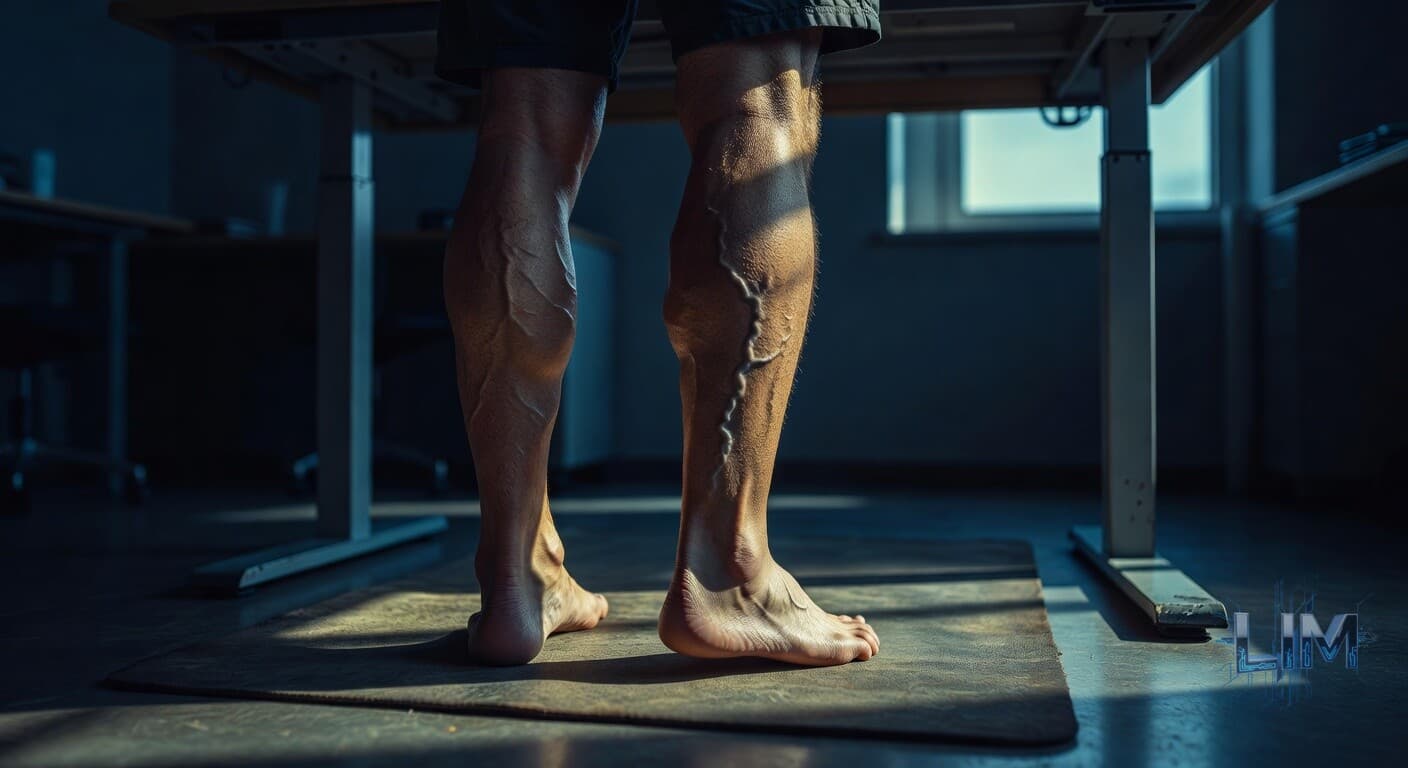
Marcus is 44, a software architect, and he is very proud of his standing desk.
He bought it eighteen months ago after a physical where his doctor used the phrase "borderline" three times. The desk cost $640. He stands roughly six hours a day now, coffee in hand, Slack open, calves quietly aching by 3 PM. He believes, the way most desk workers believe, that he is undoing the damage of the chair.
Here is the uncomfortable part. The largest objective study ever run on this question says the standing did almost nothing for the organ he was trying to protect. And past about two hours a day, it may have started working against him.
TL;DR
Related Read
The Late Snack Did Not Diagnose Your LiverWilechansky 2026, Clinical Gastroenterology and Hepatology: late-night eating tracked with liver disease. One fridge trip is not cirrhosis.
- Across 83,013 UK adults tracked with wrist wearables for 7 to 8 years, standing more instead of sitting did not lower the risk of coronary heart disease, stroke, or heart failure (Ahmadi and Stamatakis, International Journal of Epidemiology, 2024).
- Standing beyond about two hours a day was tied to a higher risk of circulatory problems: varicose veins, deep vein thrombosis, orthostatic hypotension. Roughly an 11% bump in that risk for every extra 30 minutes of standing past the two-hour mark.
- Sitting more than 10 hours a day raised both cardiovascular and circulatory risk. So the answer is not "just sit back down" either.
- What the wrist data rewards is movement, not posture. A separate readout this month found roughly 30 minutes a week of breathless, high-intensity bursts cut premature-death risk 40 to 50% (NTNU / CERG, Progress in Cardiovascular Diseases).
- The standing desk isn't useless. It's just the wrong tool for the job you bought it for. The fix is cheaper than the desk and takes less time than your lunch.
The Study That Quietly Killed The Standing-Desk Promise
For a decade the pitch was clean and sticky: sitting is the new smoking, so stand up and reclaim your years. Half the open-plan offices in America bought the hardware on that one sentence.
Then Matthew Ahmadi and Emmanuel Stamatakis at the University of Sydney did something the slogan never did. They stopped asking people to remember how much they sat and stood, and strapped research-grade accelerometers to 83,013 wrists from the UK Biobank, none of them with heart disease at baseline, and watched for seven to eight years.
Self-reported posture studies are a swamp. Nobody accurately recalls their sitting. Wrist wearables don't lie about it. That's why this dataset matters more than the dozen survey papers that built the standing-desk industry.
The headline finding, published in the International Journal of Epidemiology in 2024: more standing did not translate into less heart disease. Coronary heart disease, stroke, heart failure. Flat. The posture swap people spent $600 chasing didn't show up where they wanted it.
Worse, standing has its own bill. Past roughly two hours a day on your feet, the risk of circulatory trouble climbed: pooling blood, varicose veins, deep vein thrombosis, the lightheaded head-rush of orthostatic hypotension. About 11% more of that risk for every additional half hour of standing beyond the two-hour line. Your circulatory system was built to be pumped by moving muscle, not held rigid in one position. Standing still is still still.
Before You Sit Back Down: That's Worse
Here's where the bro-takes will overcorrect. "See, standing's a scam, recline and relax."
No. The same dataset nailed sitting to the wall too. Past 10 hours a day of sitting, both cardiovascular and circulatory risk went up. The chair didn't get exonerated. It got a co-defendant.
The real signal underneath both findings is the one nobody can sell you in a single SKU: your body does not care whether you are sitting or standing. It cares whether you are moving. Static is the enemy. Posture is a rounding error next to that.
This is the part that should actually change your Tuesday. You can stand at attention for nine hours and still be sedentary in every way that matters to an artery.
What The Wrist Data Actually Rewards
If standing is a wash and sitting too long is a tax, the obvious question is what the same kind of objective tracking does reward. We got a fresh answer this month.
A readout out of the Norwegian University of Science and Technology and its cardiac group (CERG), pulling from over 500,000 participants, landed on a number that sounds like a typo: roughly 30 minutes a week of genuinely hard exercise, the kind that leaves you breathing through your mouth, was associated with a 40 to 50% lower risk of premature death, better blood pressure and blood-sugar control for a day or two after each session, and a long list of lifestyle diseases dropping off.
Thirty minutes. A week. Not thirty a day. The catch, and there's always a catch, is intensity. This is not a stroll to the printer. The protocol is short breathless bursts at around 85% of your max heart rate: think 4-minute hard / 3-minute easy intervals, or 45 seconds on / 15 off, or classic Tabata. Spread it across two to four days so each session gives you that 24-to-48-hour metabolic afterglow.
The Sydney team landed in the same neighborhood from the other direction. Their related work found about 6 minutes of vigorous or 30 minutes of moderate-to-vigorous movement per day meaningfully cut heart-disease risk even in people who sit for a living. Different study, same verdict: brief and breathless beats long and static.
The Desk-Worker Protocol That Actually Banks Years
You don't need to throw out the standing desk. You need to demote it from "health intervention" to "furniture," and put the real work somewhere it counts. Here's the build, and none of it requires a gym.
1. Treat the desk as a posture rotator, not a treatment. Alternate sit and stand on a loose 30-on, 30-off rhythm so you never cross the two-hour standing line or the long-sitting line. The win from a sit-stand desk is real but small: less neck and shoulder strain, not a new heart. Set the expectation correctly and it stops disappointing you.
2. Break up every static hour with 2 to 3 minutes of actual movement. Not standing. Moving. Air squats, a lap of the floor, calf raises, a flight of stairs. This is the muscle pump the circulatory findings are screaming for. Ten of these scattered through a workday is 20 to 30 minutes of the movement the data rewards, and you barely noticed it leave your calendar.
3. Bank the breathless 30 a week. Two or three short, hard sessions. A weighted hill walk, a stationary-bike interval set, a kettlebell circuit, stair sprints in your building. Hit the point where talking gets ugly. That's the dose that bought the 40 to 50%. This is the non-negotiable, and it's still less time than one lunch meeting.
4. If you're over 40, add two lifting days. Strength training is the longevity lever the standing-desk conversation keeps ignoring entirely, and the decline curve starts around 35. Two full-body sessions a week protects the muscle that pumps the blood, stabilizes glucose, and keeps you off the orthostatic-dizziness list as you age.
The arithmetic that should sting a little: Marcus spent $640 and eighteen months on a posture swap the best data says did nothing for his heart. The thing that would have actually moved his "borderline" numbers was free, fit inside the breaks he already takes, and added up to about half an hour a week of effort he was avoiding precisely because it's the part that's hard.
The chair was never the villain. Stillness was. And you can beat stillness from a sitting desk, a standing desk, or no desk at all, as long as you keep interrupting it.
---
At Legacy In Motion we build training around the life you actually have, including the one that happens at a desk for ten hours a day. Our AI coach schedules the movement breaks and the breathless 30 around your real calendar, then adapts when the week falls apart. If you want the protocol built for your schedule instead of a generic one, the 7-day free trial is there. And the gear we actually trust for desk-bound training lives on our recommended page, no $640 desk required.
Sources: Ahmadi M, Stamatakis E, et al. "Device-measured stationary behaviour and cardiovascular and orthostatic circulatory disease incidence." International Journal of Epidemiology, 2024;53(6) (n=83,013, UK Biobank). · Norwegian University of Science and Technology / CERG, Progress in Cardiovascular Diseases (high-intensity short-duration exercise, n>500,000). · Stamatakis E, et al. on vigorous intermittent lifestyle physical activity, University of Sydney.
This article is educational and not medical advice. If you have a diagnosed cardiovascular or circulatory condition, talk to your physician before changing your activity pattern.
---
Log tonight's shift. Wake up to an adjusted plan.
Chiron, our AI head coach, coaches the week you actually have: overnights, doubles, rotation flips, kid pickups. Log the change and tomorrow's plan already knows. No static program that assumes you sleep at 10pm and train at 6.
$29.99/month · $249.99/year · 7-day free trial · cancel anytime · no enrollment fee · no contract
Start coaching → · See the full app →
Jake Long built it after losing 112 lbs working hospital night shifts — when no human coach could keep up with his schedule. He wanted the system he wished he'd had at 308. Now you can use it too.
Comments (0)
Comments are reserved for Legacy In Motion members.
$29.99/month. No contracts. Cancel anytime.
Get StartedAlready a member? Sign in
You read this far. Now do this.
Close the tab.
Go train the plan that fits your life.
I went from 308 to 196 lbs working 12-hour overnight shifts with two kids and zero personal trainer. The system I used is now an app that plans your training and meals around YOUR schedule — overnight, day shift, all of it.
Cancel anytime · No setup fee · No long contract
Free Assessment
What's Really Stopping Your Progress?
Take our 60-second quiz and get a personalized breakdown of what's stopping your progress — plus how AI coaching solves it.
Take the QuizFree PDF · No Credit Card
Download the Shift Worker AI Fitness Blueprint
The protocol Jake wishes he'd had at 308 lbs: sleep timing for rotating shifts, post-shift macros, and the AI deload trigger, from the run that took him to 196. Free, no card needed.
Built by someone who actually worked them. No fluff. Unsubscribe any time.
Keep Reading
2026-10-16
The Late Snack Did Not Diagnose Your Liver
Wilechansky 2026, Clinical Gastroenterology and Hepatology: late-night eating tracked with liver disease. One fridge trip is not cirrhosis.
2026-10-13
Breakfast Did Not Buy the Stress Skill
Five breakfasts a week lined up with a stress skill in 19-year-olds. Lining up is not buying it.
2026-10-09
Only One Workout Is Not Your Saturday Card
Rose and Schaumberg, Maturitas, 30 October 2025: 123 adults, average age 72. ScienceDaily rewrote it October 9. Tomorrow's game is a clock, not a protocol.
Join our free fitness community — get coaching tips, share wins, and stay accountable.
JOIN THE DISCORD →