


Squat Alternatives When Knees Hurt: Over-40 Options That Still Build Legs
Bar back squats are not mandatory. When knees complain — desk hips, parent stairs, over-40 restarts — swap the pattern, keep the progressive overload. Goblet, box, leg press, step-ups, and hinges that still train legs without the aggravation.
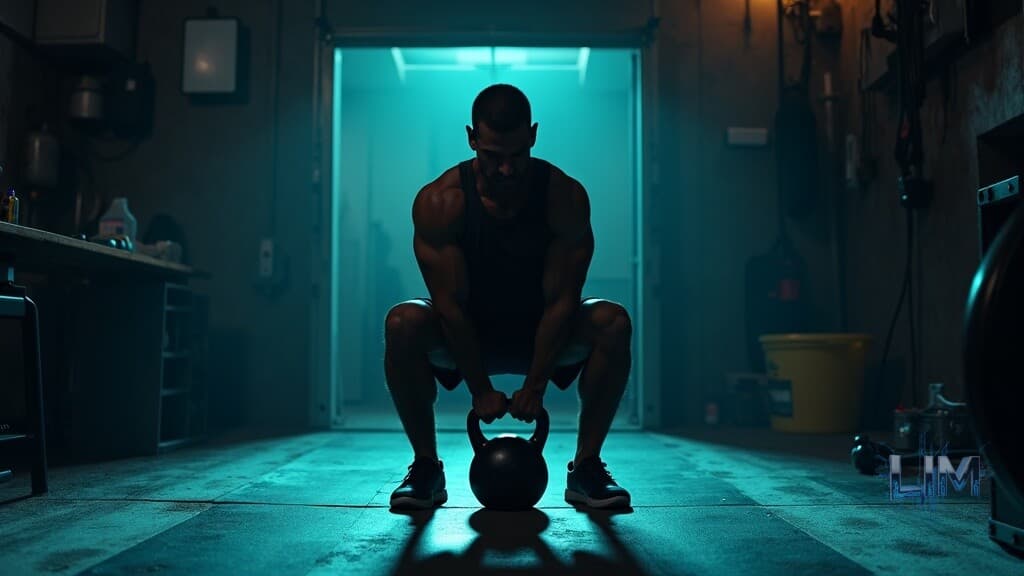
Marcus is 44. He sits nine hours at a desk, carries a six-year-old up the stairs every night, and still opens a program that says Back Squat 5×5.
Tuesday he hits the bottom of rep three and the right knee lights up — not delayed onset muscle soreness (DOMS), not "good pain," the sharp kind that makes him limp to the car. Wednesday he skips legs. Thursday he "rests until it feels better." Three weeks later the only thing that got progressive overload is his excuse list.
If that scene is yours — busy parent, desk worker, over-40 restart — this is the swap list. Not a "never squat again" lecture. A way to keep training legs when the bar is the wrong tool this week.
The bar is optional. Progressive overload is not. You do not earn toughness points by grinding an angry joint. Skipping legs for three weeks is not recovery.
Related Read
Silent Atherosclerosis in 57% of Healthy AdultsBundgaard 2026 found silent atherosclerosis in 57.1% of 16,808 adults with no known disease. This Saturday, feeling fine was the entry rule, not a clearance.
Quick take - Squats are not banned. Depth, stance, trunk angle, and load choice change joint stress. That is biomechanics, not motivation. - When the bar squat aggravates you, keep the stimulus (quads, glutes, progressive tension) and change the tool (goblet, box, leg press, step-up, hinge). - Best default for home / hotel / lunch gym: goblet or box squat to a quiet depth + hinge + step-ups if single-leg is clean. - Distinct from HILIT (impact filter), metabolic resistance training (MRT) (density format), and hybrid programming (week structure). This is pattern substitution. - Chiron should rewrite the session the day the knee flags — not leave you staring at a frozen PDF that says "Back Squat 5×5."
Why this hits daytime life hard
Over-40 adults, desk workers, and parents live in the same failure mode: sitting compresses the hips, stairs and playgrounds demand knee tolerance, and the internet still treats the bar back squat like a moral test.
2026 training culture keeps pushing strength for longevity and time-efficient lower-body work. What it rarely says out loud: the pattern matters more than the implement. If the only leg day you will actually finish is the one that does not scare your knees, we pick that one and load it honestly.
The science without the brochure
Joint stress is adjustable
Escamilla (2001) mapped knee biomechanics of the dynamic squat: compressive and shear forces change with technique, depth, and related multi-joint exercises — not as a single fixed "squats = bad" switch. Earlier work (Escamilla et al., 1998, Medicine & Science in Sports & Exercise) showed how technique variations and the leg press redistribute knee and hip demand compared with free squats. The practical takeaway is boring and useful: change the geometry, change the stress.
Straub & Powers (2024) in the International Journal of Sports Physical Therapy reviewed how trunk inclination, tibia angle, stance width, foot rotation, and depth bias the knee versus the hip. Clinical framing from that review (and the broader rehab literature it synthesizes):
- Patellofemoral irritability often hates deep, high-load knee-dominant squats early — limit depth, bias hip, widen stance, or rotate toes out modestly when it reduces valgus collapse.
- Tibiofemoral osteoarthritis still benefits from lower-extremity strength; the job is progressive loading with tolerable joint stress, not permanent rest.
- Forward trunk vs upright torso and tibia angle shift whether the session taxes the knee extensors harder or softens them — useful when you are choosing goblet vs more hip-hinged patterns.
None of that means "never bend your knees." It means depth is a dial, not a loyalty oath.
Depth is earned. It is not a loyalty oath.
Progressive overload still wins
If you swap the bar squat for a goblet and never add load, reps, or control, you did not solve programming — you just changed the Instagram angle. Same rule as the 6–8 week plateau post: stimulus must progress on whatever pattern you keep.
Pain rules (the adult ones)
- Sharp, catching, or swelling that worsens session to session → stop that variant and get a clinician involved if it persists.
- Dull, familiar joint noise that settles with warm-up and stays stable under progressive load → often trainable with range control.
- "It only hurts at the bottom" → raise the box, shorten the leg-press range, or stop above the angry angle and own that range first.
This is coaching, not diagnosis. Red flags get medical eyes.
The swap menu (what to do instead)
Pick one primary knee-friendly squat pattern per session. Add a hinge. Add a single-leg option if clean. That is a full lower day for real life.
1. Goblet squat (default home tool)
Hold a dumbbell or kettlebell at the chest. Elbows inside knees if mobility allows. Sit to a depth that stays quiet.
Why it works: Anterior load encourages a more upright torso for many people, easier to self-spot depth, and you can train hard with one implement in a living room after the kids are down.
Progression: Heavier bell → more reps → 3-second lowering → pause above the painful zone → deeper only when quiet.
2. Box squat (depth governor)
Sit back to a sturdy box or chair. Lightly touch. Stand. No bounce-crash.
Why it works: The box caps depth so you stop arguing with "ass to grass" when your knees are not ready. Desk workers with stiff hips often tolerate this better than free-depth bar work.
Progression: Lower the box over weeks. Add load only after the touch is controlled.
3. Leg press (machine option that is not cheating)
Feet mid-platform, full foot contact, stop short of the range that pinches or shears.
Why it works: Escamilla-style comparisons put the leg press in the same family of multi-joint lower-body loading with different knee/hip moment arms. Useful when free-bar confidence is low or a hotel gym has nothing else.
Progression: Load, controlled eccentrics, full pain-free range — not ego stacks with half-inch pumps.
4. Step-ups (single-leg strength without a deep bilateral fold)
Low box first. Whole foot on the box. Drive through the working leg. Control the lower.
Why it works: You train hip and knee extensors one side at a time with an easy depth dial (box height). Parents who climb stairs all day need this capacity anyway.
Progression: Higher box only if the knee stays quiet. Then load with dumbbells.
5. Hip hinge family (when the knee wants less fold)
Romanian deadlift, hip thrust, cable pull-through, backpack good morning.
Why it works: You keep glute and posterior chain progressive overload when deep knee flexion is the problem. Legs are not "quads only."
6. What to deprioritize while irritable
- Deep, heavy bar back squats with forward knee travel you cannot control
- Jump squats, depth jumps, and high-impact plyos on an angry joint (see HILIT if you still want intensity)
- Walking lunges for miles when every reverse step grinds
You can return to these. You do not earn toughness points by forcing them this week.
Skipping legs for three weeks is atrophy with a story.
A 25-minute session that fits a real day
Warm-up (4 min): walk, ankle rocks, bodyweight sit-to-stand to pain-free depth, 1 light goblet set.
Main (16–18 min): 1. Goblet or box squat — 3–4 sets of 6–10 controlled reps 2. Romanian deadlift or hip thrust — 3 sets of 8–12 3. Step-ups or split squat to a short range — 2–3 sets each side
Finish (2 min): easy walk, note what range stayed quiet.
That is enough for busy parents between bedtime and collapse, desk workers on a lunch break, and over-40 restarts who need a win they can repeat Thursday.
> Mid-article path if you already know you need the plan to change when the joint does: $29.99/mo, cancel anytime → pricing
Who this is for
Busy parents You train in the living room with a single dumbbell and a dining chair as a box. Goblet + hinge + step-up beats "I'll squat heavy when I get a gym membership and a free Saturday." Log the depth and the load. Progress one of them next week.
Desk workers Eight hours of hip flexion plus a sudden deep bar squat is how people invent "my knees are shot." Open the day with walks and hip extension work, then load a controlled squat pattern. Travel week: leg press or goblet only is still a leg day.
Over-40 restarts Muscle and tendon remodel slower than your ambition. Depth is a long game. Strength on a shorter range with honest progressive overload beats one heroic deep set and a week of swelling.
Where Jake's story fits (without the fairy tale)
I did not get from 308 to 196 on perfect bar squat form after every hospital security overnight. I got there by keeping lower-body training alive when joints, sleep, and schedule were ugly — swaps, shorter ranges, machines when free weights were stupid that day. The goal was never "look like a powerlifter on YouTube." The goal was still training legs when life said no.
If your program cannot rename the exercise the day your knee says no, you do not have a coach. You have a PDF with a logo.
How Chiron uses this research
When you log "knee angry on back squat," Chiron should not moralize. It should swap the pattern: goblet or box to a quiet depth, keep the hinge, keep progressive overload on the substitute, and flag if swelling or sharp pain keeps climbing. HERMES feeds the coaching layer with what the biomechanics literature actually supports — technique changes joint stress; rest forever is not the only option; depth is a dial. Forge rebuilds the session in the minutes you actually have: hotel leg press, living-room goblet, no bar required.
The research is clear. Pattern first. Load second. Ego last.
Join the people who train like adults with real joints and real calendars: https://discord.gg/8QBuFFA5Pf
The swap is not a demotion. It is how you still have legs next month — and still want to use them.
---
Coaching that works the same shifts you do
This is what Chiron, our AI head coach, does on every meal and workout you log: catches the small wrong detail before it costs you years. HERMES — our research engine — surfaces new science the morning it publishes, so your coaching moves with the literature instead of trailing it by quarters. You log; we adapt your plan that day. No PDF reprints, no static plan that ages out the day your shift changes or you have a kid.
$29.99/month · $249.99/year · 7-day free trial · cancel anytime · no enrollment fee · no contract
Start coaching → · See the full app →
Jake Long built it after losing 112 lbs working hospital overnights — when no human coach could keep up with his schedule. He wanted the system he wished he'd had at 308. Now you can use it too.
Frequently Asked Questions
Are squats bad for your knees?
No — poorly matched load, depth, and recovery are bad for irritated knees. The squat pattern itself is useful. When pain shows up, change stance, depth, trunk angle, or swap to a related pattern (goblet, box, leg press, step-up, hinge) instead of quitting legs.
What is the best squat alternative for knee pain over 40?
Start with a goblet or box squat to a pain-free depth, or a leg press with controlled range. If single-leg work is tolerated, high step-ups with a short box often train the same hip/knee extensors with easier load control. There is no single best move — only the one you can load progressively without next-day swelling or sharp pain.
Can busy parents build legs without bar back squats?
Yes. A pair of dumbbells, a backpack, a sturdy chair for box squats, and a living-room hinge + step-up circuit covers the pattern. Progressive overload via load, reps, or slower eccentrics still applies.
Should desk workers avoid deep squats?
If you sit all day with stiff hips and cranky knees, deep loaded squats are often the wrong first tool. Open the hips, train glutes and quads through a range that stays quiet, then expand depth as tissue tolerance returns. Depth is earned, not demanded on day one.
How does AI coaching help with knee-friendly leg training?
Chiron and Forge can swap a bar squat for a goblet, box, or hinge the day you flag knee pain — and keep progressive overload on the substitute instead of defaulting to rest forever or random machine chaos.
Comments (0)
Comments are reserved for Legacy In Motion members.
$29.99/month. No contracts. Cancel anytime.
Get StartedAlready a member? Sign in
You read this far. Now do this.
You've read the theory.
Now put it to work in your real week.
I went from 308 to 196 lbs working 12-hour overnight shifts with two kids and zero personal trainer. The system I used is now an app that plans your training and meals around YOUR schedule — overnight, day shift, all of it.
Cancel anytime · No setup fee · No long contract
Free Assessment
What's Holding Your Fitness Back?
Take our 60-second quiz and get a personalized breakdown of what's stopping your progress — plus how AI coaching solves it.
Take the QuizFree PDF · No Credit Card
Grab the Shift Worker AI Fitness Blueprint
A 4-week plan that respects what shift work does to sleep: when to go down after a night, the four-minute REHIT window, post-shift macros, and when to back off. In your inbox in 30 seconds.
Built by someone who actually worked them. No fluff. Unsubscribe any time.
Keep Reading
2026-10-03
Silent Atherosclerosis in 57% of Healthy Adults
Bundgaard 2026 found silent atherosclerosis in 57.1% of 16,808 adults with no known disease. This Saturday, feeling fine was the entry rule, not a clearance.
2026-09-30
Supersets Cut Session Time 36% With Similar Muscle
Burke 2026 found supersets cut session time 36% with similar muscle changes. The clock moved. The trophy did not.
2026-09-25
Doubling Weekly Sets Did Not Grow More Muscle
Camargo 2026 found no extra quad growth from a 120 percent volume jump versus 20 percent. The protocol main effect is not a bigger change.
Join our free fitness community — get coaching tips, share wins, and stay accountable.
JOIN THE DISCORD →