


The Plateau Was the Postprandial Curve, Not the Scale
Berberine cut HbA1c 2.0 pts in 12 weeks. Dihydroberberine hits 5x plasma. Where it earns a slot in your stack — and where it stops.
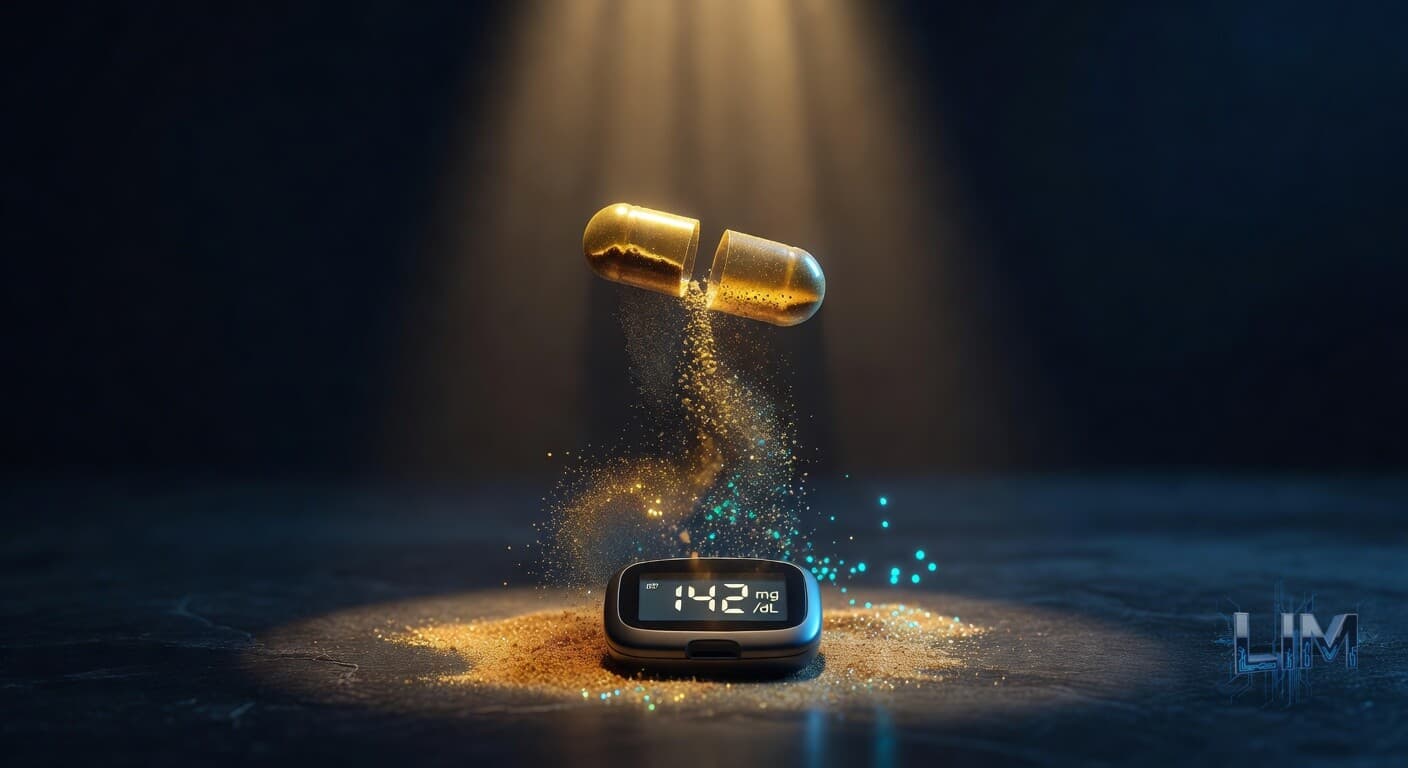
Renee, 47, third-shift ICU tech, sits in her dented Subaru in the hospital parking garage at 06:52 Thursday morning. Coffee gone cold. Phone in her lap. Two breakfast tacos already on the receipt.
She's not looking at the scale. She's looking at her CGM trace. The line just punched through 162 mg/dL at the ninety-minute mark, same as Tuesday, same as last Friday. Her morning weight has read 198.4 for fourteen straight days.
Her food is dialed. Her sleep is the best it's been in a decade. Her plateau isn't on the scale. Her plateau is the curve on her phone.
TL;DR
- Yin et al (Metabolism 2008, n=36) cut HbA1c 2.0 points on 1g/day berberine in new type 2 diabetics — beating metformin at 1.5g/day (1.7 points).
- Berberine activates AMPK (AMP-activated protein kinase) by inhibiting mitochondrial complex I. Same upstream lever as metformin. Different planet from GLP-1.
- Parent berberine has sub-1% oral bioavailability. Moon 2022 showed dihydroberberine hits ~5x the plasma Cmax at matched doses.
- Run pattern: 100–200 mg dihydro, 15–30 min before your two biggest carb meals. Pull HbA1c, HOMA-IR (homeostatic model assessment of insulin resistance), postprandial glucose pre and post an 8-week trial.
- It's a glucose-disposal adjunct. It will not generate your deficit, satiate you centrally, or build the muscle that uses the sugar.
"Nature's GLP-1" is a quote card. AMPK is the actual lever.
Berberine is an alkaloid from the Berberis shrub. Its trick is firing up AMPK (AMP-activated protein kinase) — the enzyme that flips a cell from "store this" to "burn this" when energy runs thin (Turner et al, Diabetes 2008;57(5):1414-1418).
Related Read
Longevity Biomarkers Meet AI Coaching: The 2026 Protocol Busy Parents and Desk Workers Can Actually Run DailyEveryone's chasing longevity in 2026, but the real edge isn't another supplement stack. It's AI that reads your actual biomarkers and calendar, then builds metabolic-prevention protocols busy parents and desk workers can execute between meetings and school runs. Here's the part the retreats and generic apps miss.
AMPK fires. GLUT4 sugar-transporters slide to the muscle surface. Your liver throttles back glucose output. Fat oxidation climbs.
GLP-1 drugs do none of that. They hit pancreatic beta cells, slow gastric emptying, and bend central appetite. Calling berberine "nature's GLP-1" jams two unrelated pathways into one Instagram caption.
If your bottleneck is appetite, berberine won't move it. If your bottleneck is muscle-side glucose disposal, this molecule has a real mechanism and the receipts to prove it.
This is exactly the distinction HERMES — our research worker that scrapes ~12,000 fitness and metabolic papers a week — keeps surfacing into your protocol instead of letting it die in a supplement company's marketing brief.
The head-to-head trial worth citing
Thirty-six adults. Brand new type 2 diabetes. Three arms. Twelve weeks. Yin et al, Metabolism 2008;57(5):712-717.
- Berberine, 500 mg three times a day (1 g total): HbA1c down 2.0 points.
- Metformin, 500 mg three times a day (1.5 g total): HbA1c down 1.7 points.
- Triglycerides dropped harder on the berberine arm.
A two-point HbA1c drop in twelve weeks is not supplement-aisle confetti. That is a plant alkaloid running shoulder-to-shoulder with a first-line diabetes drug.
Here's the catch. Berberine HCl's oral bioavailability is sub-1%. You swallow grams to land milligrams past your gut wall and liver. That's why 1.5 grams a day of the HCl salt earned its nickname from the bathroom-tile crowd.
Why the dihydro form earns its slot
Dihydroberberine clears the bottleneck. Roughly 5x the plasma Cmax (peak blood concentration) of berberine HCl at matched oral doses (Moon et al, 2022).
Your gut bacteria already do this conversion for you with regular berberine — they reduce a slice of it to dihydroberberine before it crosses the intestinal wall. The dihydro form moves through your enterocytes more efficiently, then re-oxidizes back to berberine once it hits circulation. Feed it directly and you skip the line.
Translation: 100–200 mg of dihydro lands roughly the same cellular exposure as 500 mg to 1 g of the HCl salt. Fewer pills. Less GI grief. Tighter dose-response.
This is the pattern Chiron — our AI head coach — flags in the daily program review when your post-meal CGM trace parks above 140 mg/dL for ninety-plus minutes three days running. The adjustment hits your plan before you have to ask.
Where it fit for Renee. And where it stopped.
Renee's coach added 200 mg dihydroberberine, twenty minutes before her two biggest carb meals. Her CGM peaks flattened inside three weeks. The 150s and 160s parked over her post-shift breakfast window stopped showing up.
Her fasting glucose barely budged. That's the expected pattern when the bottleneck is muscle-side disposal, not hepatic output. The drug works where the carbs actually land.
What it did not do is the part the marketing copy hides:
- It did not replace her nutrition plan. Berberine doesn't touch appetite.
- It did not create her calorie deficit. Eight months of eating less did that.
- It did not work without training. AMPK in muscle only matters if there's muscle using the sugar. Sedentary users see smaller effects in every trial that measures it.
Berberine is a glucose-disposal adjunct. Dihydroberberine is a better-absorbed version of the same adjunct. Neither one replaces training, food, or sleep.
When Renee's Apple Watch logged sub-90-cadence walking three nights in a row — the tell that the 12-hour shift was eating her — the daily AI program update worker rewrote her week before her resistance calendar even reloaded. The supplement doesn't fix the order. The system does.
Run it like a protocol, not a hope
If your postprandial glucose or triglycerides are the marker you're trying to move — and training, protein, and sleep are already locked — the dose-and-timing pattern with the cleanest evidence is unambiguous.
100–200 mg dihydroberberine. 15–30 minutes before your two largest carb-containing meals. Twice a day, not five times.
Stack supports that pull on the same axis:
- Methyl-B12 + methylfolate if homocysteine runs high. Long-term AMPK activators can nick B12 absorption.
- Magnesium glycinate, 300–400 mg in the evening. Hits insulin sensitivity from a different angle.
- D3 5,000 IU + K2 MK-7 100 mcg if your 25-hydroxy is under 50 ng/mL — which it usually is in indoor workers and night-shift staff who lost the sun years ago.
Pull labs before and after an eight-week run. HbA1c. Fasting insulin so you can calculate HOMA-IR (insulin × glucose / 405). Fasting triglycerides. Postprandial glucose at 60 and 120 minutes after a standardized meal.
The in-app meal log + barcode scan handles the "I don't have time to track" problem in one tap. The lab tracker tells you in eight weeks whether the compound earned its slot. If the markers move, it's doing work. If they don't, your bottleneck was somewhere else, and a different lever is the honest next call.
The honest closing
Renee broke through three weeks after the dihydro pre-meal dose hit her stack. The supplement wasn't the hero. The food, the training, and eight months of saying no to the breakroom donuts at four in the morning — those were the hero.
Jake ran a version of the same pre-dinner stack across the back half of his own cut, the one that moved him from 308 to 196 over nine and a half months on twelve-hour overnight hospital-security shifts. Sample of one. Not a replication of Yin 2008.
Pinned correctly, that's the entire job of a supplement: keep the postprandial curve from becoming the ceiling. If you want a system that runs your labs, your CGM, your training, and your protocol against current evidence instead of marketing copy, we built it for you.
---
Get Chiron in your pocket — $29.99/month
Chiron, our AI head coach, coaches the week you actually have: overnights, doubles, rotation flips, kid pickups. Log the change and tomorrow's plan already knows. No static program that assumes you sleep at 10pm and train at 6.
$29.99/month · $249.99/year · 7-day free trial · cancel anytime · no enrollment fee · no contract
Start coaching → · See the full app →
Jake Long built it after losing 112 lbs working hospital night shifts — when no human coach could keep up with his schedule. He wanted the system he wished he'd had at 308. Now you can use it too.
The Questions Readers Ask Most
How much dihydroberberine equals 1g of regular berberine?
Moon 2022 showed dihydroberberine hits roughly 5x the plasma Cmax of berberine HCl at matched oral doses. 100 to 200 mg of the dihydro form lands about the same cellular exposure as 500 mg to 1 g of the HCl salt, with far less GI grief.
When should I take dihydroberberine for blood sugar?
Dose it 15 to 30 minutes before your two biggest carb meals. The lever is AMPK in muscle, so timing matters where the glucose actually lands. Members running 200 mg pre-meal commonly watch postprandial CGM peaks flatten inside three weeks.
Is berberine really 'nature's GLP-1'?
No. Berberine activates AMPK (AMP-activated protein kinase) in skeletal muscle and inhibits mitochondrial complex I, which moves GLUT4 to the muscle surface. GLP-1 drugs act on pancreatic beta cells, gastric emptying, and central satiety. Different pathway, different bottleneck.
Comments (0)
Comments are reserved for Legacy In Motion members.
$29.99/month. No contracts. Cancel anytime.
Get StartedAlready a member? Sign in
You read this far. Now do this.
Enough reading about it.
Time to train around the life you actually live.
I went from 308 to 196 lbs working 12-hour overnight shifts with two kids and zero personal trainer. The system I used is now an app that plans your training and meals around YOUR schedule — overnight, day shift, all of it.
Cancel anytime · No setup fee · No long contract
Free Assessment
What's Blocking Your Results?
Take our 60-second quiz and get a personalized breakdown of what's stopping your progress — plus how AI coaching solves it.
Take the QuizFree PDF · No Credit Card
Grab the Shift Worker AI Fitness Blueprint
The protocol Jake wishes he'd had at 308 lbs: sleep timing for rotating shifts, post-shift macros, and the AI deload trigger, from the run that took him to 196. Free, no card needed.
Built by someone who actually worked them. No fluff. Unsubscribe any time.
Keep Reading
2026-06-30
Longevity Biomarkers Meet AI Coaching: The 2026 Protocol Busy Parents and Desk Workers Can Actually Run Daily
Everyone's chasing longevity in 2026, but the real edge isn't another supplement stack. It's AI that reads your actual biomarkers and calendar, then builds metabolic-prevention protocols busy parents and desk workers can execute between meetings and school runs. Here's the part the retreats and generic apps miss.
2026-06-02
Morning Exercise Nudged Their Blood Sugar Up. Afternoon Exercise Brought It Down.
In a Diabetologia crossover trial, morning HIIT actually pushed blood sugar up in men with type 2 diabetes, while the same session in the afternoon brought it down. A 29,836-person UK Biobank study found evening movement carried the lowest mortality risk in adults over 40 with obesity. Here is what exercise timing really means for your blood sugar if you are over 40, chained to a desk, or squeezing training around kids, and why the honest answer is not simply train whenever you can.
2026-05-20
What 7 Days Without Food Actually Does to the Body: The Queen Mary Proteomics Map and Why the 3-Day Threshold Matters for the Over-40 Reader
A May 2026 Queen Mary University of London proteomics study tracked roughly 3,000 circulating proteins across a 7-day water-only fast in 12 healthy adults. The headline that traveled — 'the body transforms at 72 hours' — is real, but it is also the part of the data most people are misusing. Here is what the molecular map actually shows, where the over-40 metabolic-reset crowd is getting it wrong, and the honest version of what to take from this without booking a multi-day fast you do not need.
Join our free fitness community — get coaching tips, share wins, and stay accountable.
JOIN THE DISCORD →