2026-04-14
6 min readBy Jake LongSleep Tracking for Fitness: What Wearables Actually Measure vs. What Matters
Your wearable tracks sleep stages, HRV, and respiratory rate. But which metrics actually impact your training, recovery, and fat loss? Here's what the science says.
Your watch says you got 7 hours and 42 minutes of sleep. It tracked four sleep cycles, flagged your HRV at 48ms, and gave you a "readiness score" of 72. Cool dashboard. But does any of it actually help you train better, recover faster, or lose fat?
After wearing every major wearable on the market and working with the AI coaching system that monitors my own recovery metrics daily, I'll break down what your sleep tracker is actually measuring, what it's guessing at, and which numbers are worth paying attention to.
What Wearables Actually Measure
Let's start with what your wrist-mounted sensor can physically detect. Because there's a significant gap between what the marketing says and what the hardware does.
Heart rate (optical PPG sensor): This is the one thing wearables do reasonably well. The green LED on the back of your watch measures blood volume changes in your wrist capillaries. During sleep, without motion artifacts, accuracy is decent — typically within 2-5 BPM of medical-grade devices.
Related Read
Sleep Architecture for Night Shift Workers: Optimizing Deep and REM Sleep on an Irregular ScheduleNight shift wrecks your sleep stages, not just your hours. Learn how to protect deep sleep and REM cycles when your schedule fights your biology — backed by 2026 research and real shift worker results.
Movement (accelerometer): Your wearable knows when you're still and when you move. It uses this to estimate when you fell asleep, when you woke up, and how restless you were. This is essentially the same technology as a pedometer.
Skin temperature (some devices): Newer wearables like the Oura Ring track skin temperature deviations overnight. This can flag illness, hormonal shifts, or overtraining — but it's a relative metric, not an absolute temperature reading.
Blood oxygen (SpO2 sensor): The red LED measures oxygen saturation. Useful for detecting sleep apnea patterns, but the wrist is a notoriously unreliable location for SpO2 compared to a fingertip or earlobe.
What Wearables Are Guessing At
Here's where it gets interesting — and where most people get misled.
Sleep stages (light, deep, REM): Your wearable cannot directly measure brain waves. That requires an EEG — electrodes on your scalp in a sleep lab. Instead, your watch infers sleep stages from heart rate patterns, heart rate variability, movement, and breathing rate. A 2024 systematic review in Sleep Medicine Reviews found that consumer wearables correctly identified sleep stages only 60-70% of the time compared to polysomnography (the gold standard).
That means your "deep sleep" number could be off by 30-40%. Every single night.
Sleep quality scores: These proprietary algorithms combine multiple signals into a single number. The problem? Every manufacturer calculates them differently, they're not validated against clinical outcomes, and they can create anxiety that actually worsens your sleep. Researchers at the University of Oxford coined the term "orthosomnia" — the obsessive pursuit of perfect sleep data that paradoxically causes insomnia.
Recovery readiness: Whoop, Oura, and Garmin all generate readiness scores. These correlate loosely with HRV and resting heart rate trends, but a 2025 study in the British Journal of Sports Medicine found that athletes who trained based on subjective "how do I feel?" assessments performed equally well as those following algorithm-driven readiness scores.
The Three Metrics That Actually Matter for Training
Cut through the noise. Here's what's worth tracking:
1. Sleep Duration (Total Time in Bed)
The single most impactful sleep metric for fitness performance. A 2023 meta-analysis in Sports Medicine covering 8,000+ athletes found that sleeping less than 7 hours was associated with:
- **29% higher injury risk**
- **11% reduction in time-to-exhaustion performance**
- **Significantly impaired muscle protein synthesis**
You don't need a $300 ring to track this. But having it logged automatically eliminates the "I think I slept enough" self-deception. When I was working 80-hour weeks at the hospital doing night shifts, I thought I was getting 6-7 hours. My tracker showed it was closer to 4.5-5. That data point alone changed my approach to training.
2. Resting Heart Rate Trends
Not the daily number — the 7-day rolling trend. A rising resting heart rate over several days reliably indicates accumulated fatigue, illness onset, or overtraining. A 2024 study from the Norwegian School of Sport Sciences found that a sustained 5+ BPM elevation in resting heart rate predicted overtraining syndrome an average of 4 days before athletes reported symptoms.
This is where wearables genuinely earn their keep. The trend line is more valuable than any single-night snapshot.
3. HRV (Heart Rate Variability) — With Context
HRV measures the variation in time between heartbeats. Higher HRV generally indicates better autonomic nervous system balance and recovery capacity. But here's what most people get wrong:
HRV is individual. My baseline HRV of 48ms might be excellent for me and terrible for you. Comparing your HRV to population averages is meaningless.
Morning HRV is what counts. Random daytime readings are contaminated by caffeine, stress, hydration, and activity. The only reliable measurement window is within the first 5 minutes of waking, lying still.
The trend matters more than the number. A single low HRV reading means nothing. Three consecutive days of suppressed HRV compared to your 30-day baseline? That's a signal to reduce training intensity.
A 2025 longitudinal study in Frontiers in Physiology showed that athletes who adjusted training load based on HRV trends had 23% fewer non-functional overreaching episodes than those following fixed periodization.
What Your Tracker Can't Tell You (That Actually Matters Most)
Sleep timing consistency. Going to bed at 10pm five nights and 2am two nights is worse than consistently sleeping 11pm-6am. Your circadian rhythm doesn't average out. Shift workers know this better than anyone — it's not just how much you sleep, it's the consistency of when you sleep.
Sleep environment quality. Room temperature, light exposure, noise levels, and mattress quality affect recovery more than any metric your watch tracks. A dark, cool room (65-68F) with no blue light exposure 90 minutes before bed will do more for your recovery than obsessing over sleep stage percentages.
Nutrition timing around sleep. What you eat and when you eat it relative to sleep has a massive impact on recovery. A casein protein shake 30-60 minutes before bed supports overnight muscle protein synthesis — something no wearable will tell you to do.
How an AI Coach Uses Sleep Data Differently
This is where traditional tracking falls short and adaptive coaching picks up the slack.
A wearable gives you data. An AI coach acts on it.
When our coaching system sees three consecutive nights of elevated resting heart rate and suppressed HRV, it doesn't just flag it — it automatically reduces your training volume for the next session, shifts the focus from strength to recovery-oriented work, and adjusts your nutrition targets to support immune function.
When it sees that a night shift worker consistently gets their best sleep quality between 8am-2pm, it restructures their entire training window and meal timing around that pattern. No generic "sleep 8 hours" advice. Actual adaptation to your real life.
That's the difference between a dashboard and a coach.
The Bottom Line
Stop chasing perfect sleep scores. Start paying attention to three things:
- **Are you getting 7+ hours consistently?** If not, that's your #1 priority.
- **Is your resting heart rate trending up over a week?** Back off training.
- **Is your morning HRV suppressed for 3+ days?** Reduce intensity, increase recovery.
Everything else — sleep stage breakdowns, readiness scores, respiratory rate graphs — is interesting noise. Don't let it become orthosomnia.
Your wearable is a tool. A good one, when used correctly. But it's not a coach. It can tell you what happened last night. It can't tell you what to do about it today.
That's what adaptive coaching is for. And that's what we built Legacy In Motion to do — take data from every source available and turn it into action that fits your actual life, your actual schedule, and your actual body.
Ready to stop guessing and start training with a system that adapts to your recovery in real time? Start your free 30-day trial — no commitment, no enrollment fee, just 30 days to see what data-driven coaching actually feels like.
Ready to Build a Plan That Fits Your Schedule?
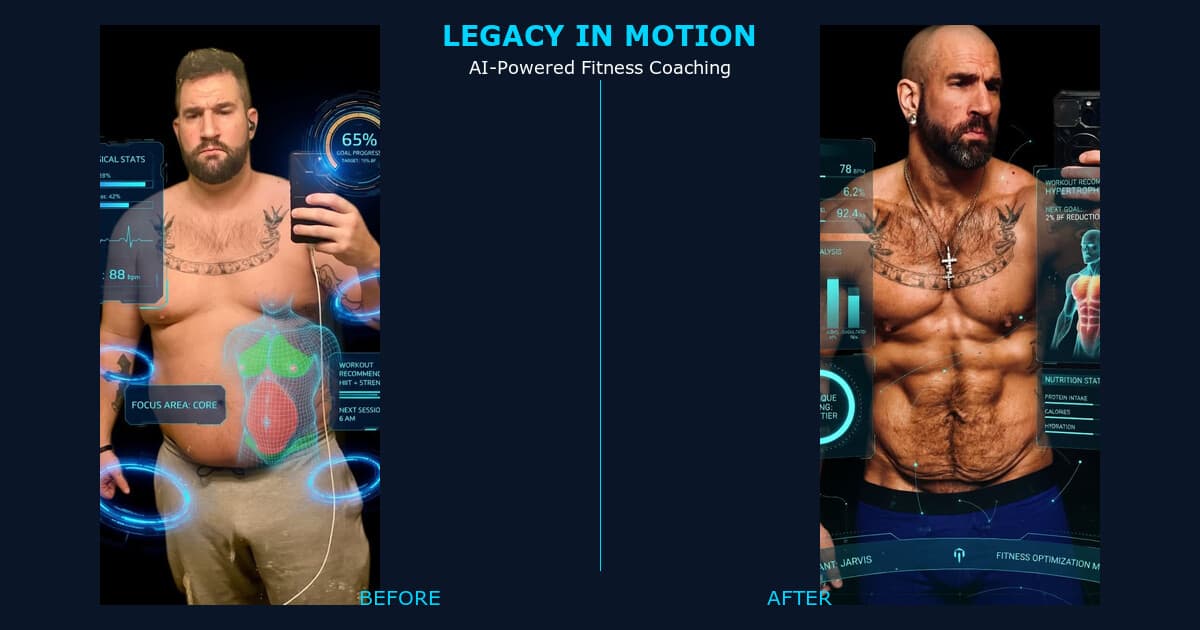
I went from 308 to 196 lbs working night shifts. Our AI coaching adapts to your sleep schedule, recovery data, and real-time progress — so every workout actually counts.
Start Your Free 30-Day TrialNo enrollment fee. No commitment.
Free Assessment
What's Holding Your Fitness Back?
Take our 60-second quiz and get a personalized breakdown of what's stopping your progress — plus how AI coaching solves it.
Take the QuizKeep Reading
2026-04-08
Sleep Architecture for Night Shift Workers: Optimizing Deep and REM Sleep on an Irregular Schedule
Night shift wrecks your sleep stages, not just your hours. Learn how to protect deep sleep and REM cycles when your schedule fights your biology — backed by 2026 research and real shift worker results.
2026-04-11
Post-Easter Reset for Night Shift Workers: How to Drop the Holiday Weight Without Crash Dieting
Easter candy, big family meals, and disrupted sleep can derail even the best plans. Here’s the practical 4-step weekend reset that actually works for night shift schedules — backed by what helped me go from 308 to 196 lbs.
2026-04-09
The Rucking Protocol That Helped a Night Shift Worker Drop 112 Pounds After Easter Indulgences
How adding weighted walks transformed my metabolism, sleep, and energy levels despite irregular night shifts. A practical post-holiday reset you can start today.
Join our free fitness community — get coaching tips, share wins, and stay accountable.
JOIN THE DISCORD →